
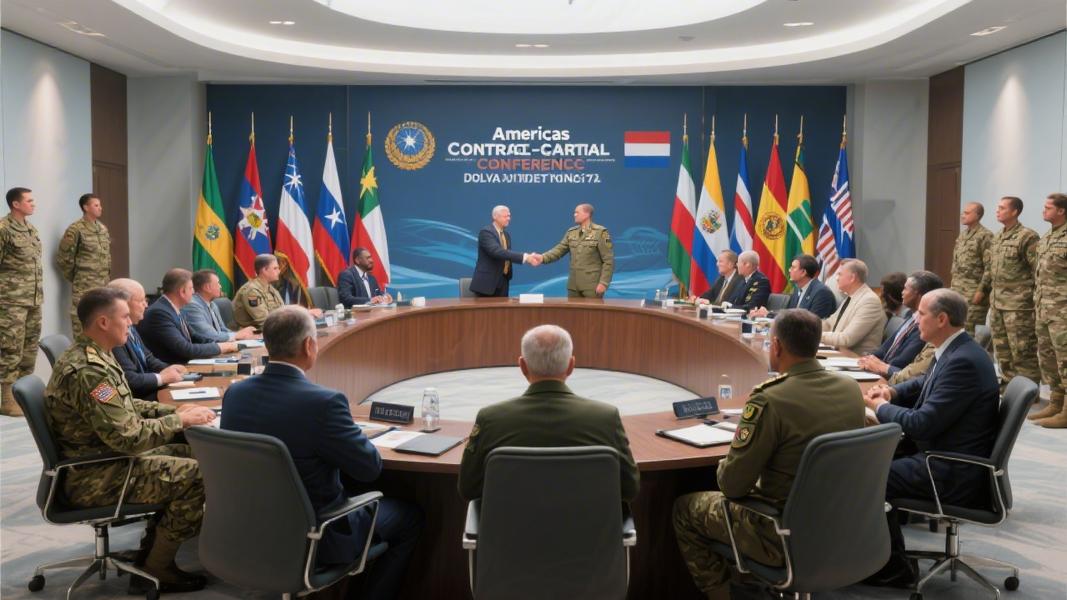
The Pentagon is doubling down on its push to militarize the fight against drug cartels — and it’s bringing nearly two dozen nations along for the ride.
Secretary of Defense Pete Hegseth hosted the Americas Counter Cartel Conference this week at U.S. Southern Command headquarters in Doral, Florida, gathering regional defense and security leaders from across the Western Hemisphere to coordinate what the Defense Department is framing as an urgent, unified offensive against organized crime and narco-trafficking networks. The message from the Pentagon was blunt: the cartel problem isn’t a law enforcement nuisance anymore. It’s a hemispheric security threat — and the U.S. military intends to treat it like one.
A Conference With Teeth
Doral isn’t exactly a neutral backdrop. Home to SOUTHCOM — the combatant command responsible for U.S. military operations across Latin America and the Caribbean — it’s a deliberate signal of where the Pentagon sees this fight being waged. Not in courtrooms. Not in customs offices. In operational military planning rooms, with partner nations seated at the same table.
The conference drew defense and security officials from across the Americas, with the explicit goal of strengthening multilateral cooperation against cartels that have, for years, operated with a kind of brazen impunity that has embarrassed governments from Mexico City to Bogotá to Washington. Officials focused on disrupting trafficking routes, targeting cartel financing, and building the kind of real-time intelligence-sharing architecture that, frankly, has been promised before — and hasn’t always materialized.
Still, the sheer scale of participation signals something different this time. Getting that many sovereign nations into the same room, under a military framework, with a joint security posture on the table — that’s not nothing.
Why Hegseth, Why Now
It’s worth asking: why is the Secretary of Defense personally hosting a counter-cartel summit? Historically, that’s been the territory of the DEA, the State Department, or at most, joint interagency task forces operating quietly in the background. The Pentagon’s front-and-center role here reflects a deliberate policy shift under the current administration — one that has increasingly characterized cartels not merely as criminal organizations but as quasi-terrorist entities threatening national security.
Hegseth has been among the most vocal advocates for that reframing. His presence in Doral wasn’t ceremonial. It was a statement of institutional priority — the kind that comes with budget implications, operational mandates, and, eventually, consequences for how the U.S. military deploys assets across the region.
The Stakes for Partner Nations
For the countries that attended, the calculus is complicated. Many of them are dealing with cartel violence that has hollowed out local institutions, corrupted police forces, and destabilized entire regions. U.S. military cooperation — intelligence, training, equipment, logistics — is genuinely valuable. But it also comes with strings. It comes with optics. And in some capitals, the idea of deepening military ties with Washington on domestic security matters remains politically sensitive in ways that don’t always translate cleanly into English-language press releases.
That’s the catch. The cooperation that looks seamless in a Doral conference room can get very messy very fast when it hits the ground in countries with their own sovereignty concerns, their own political pressures, and their own complicated histories with U.S. intervention in the region.
What Comes Next
The conference was framed around concrete outcomes — not just handshakes and photo ops. Officials pointed to strengthened bilateral and multilateral security frameworks, enhanced coordination mechanisms, and a shared commitment to targeting the financial infrastructure that keeps cartels funded and operational. Whether those commitments translate into durable, measurable results is the question that will define this initiative’s legacy.
Counter-cartel efforts have a long, complicated history of producing impressive conference declarations and underwhelming field results. The Pentagon knows that. The partner nations know that. The cartels, almost certainly, know that too.
But the scale of this week’s gathering — the military venue, the cabinet-level leadership, the regional breadth of participation — suggests the U.S. is at least betting that this time the architecture will hold. Whether the cartels are worried remains, for now, an open question.
The real test won’t come in Doral. It never does.
