
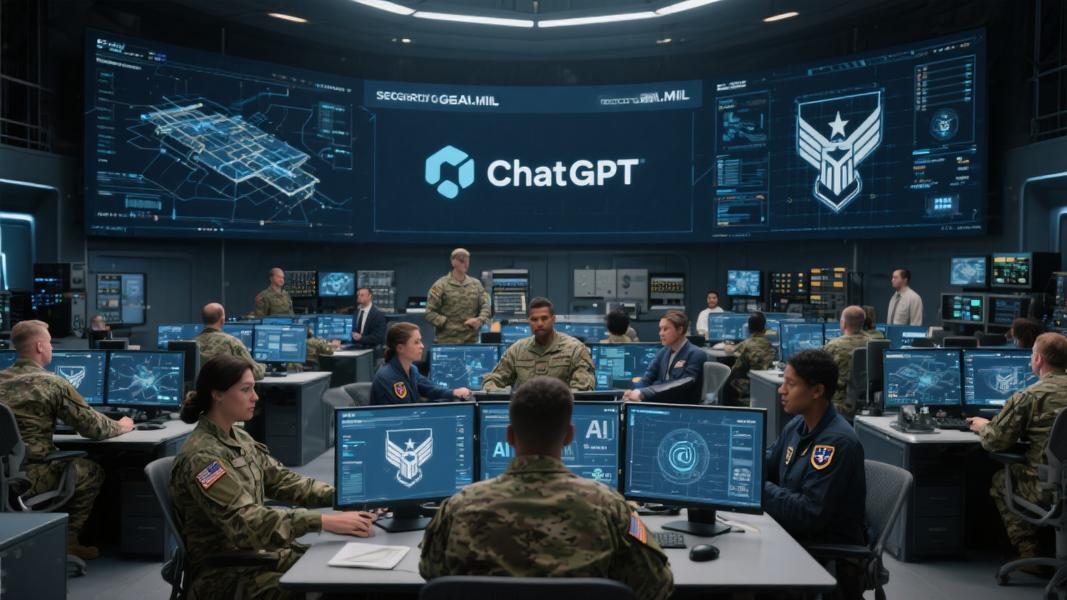
The U.S. War Department is bringing ChatGPT to the battlefield — or at least to the military’s digital infrastructure — through a landmark partnership with OpenAI that will integrate the popular AI assistant into the department’s GenAI.mil platform.
AI Goes Military-Grade
In a move that significantly expands artificial intelligence capabilities across America’s armed forces, the War Department announced a partnership with OpenAI that will make ChatGPT available to all three million military personnel. The integration with GenAI.mil marks one of the largest enterprise-wide AI deployments in government history.
“ChatGPT will be made available to enhance mission execution and readiness, delivering reliable capabilities to the joint force,” the department stated in its official release. The AI assistant joins a suite of frontier models already available on the platform from companies including Google, Anthropic, and xAI.
What’s driving this AI arms race? The rapid adoption suggests military leaders see generative AI as a strategic necessity rather than a technological luxury. Since its December 9, 2025 launch, GenAI.mil has reached over one million unique users in just two months while maintaining what the department proudly notes is “100% uptime” — a reliability metric rarely achieved in large-scale technology deployments.
Military-Wide Adoption
Five of six military branches have already implemented GenAI.mil across their operations, with only the U.S. Coast Guard not yet onboard, according to a weekly roundup published by the Business of Government. The platform’s rapid expansion suggests an unusual level of cross-branch coordination for a technology initiative.
“The platform’s proven reliability, evidenced by its 100% uptime since launch and its robust infrastructure, has established it as the trusted AI platform across the Department,” notes a recent defense technology assessment.
The military’s AI ambitions don’t come cheap. The Department of Defense has committed up to $200 million each to OpenAI, Anthropic, Google, and xAI for frontier AI projects. These contracts reflect the Pentagon’s determination to maintain technological superiority in what many defense analysts consider a critical domain for future conflicts.
Security Concerns
Bringing advanced language models into sensitive military operations raises obvious questions about security. How does the military plan to prevent potential leaks of classified information or guard against adversarial prompting?
The War Department emphasizes that GenAI.mil was built with cybersecurity as a priority. The Hanscom Air Force Base’s Cyber and Networks Division played a key role in the platform’s development, integrating protections specifically designed for military applications.
“The GenAI.mil platform releases AI capabilities to three million personnel across the department,” the military noted in its technical documentation, suggesting controlled access rather than unrestricted use.
The partnership’s official announcement on the War Department website confirmed the integration while emphasizing the “rapid expansion” of the platform’s capabilities. This language suggests military planners see this as just one step in a broader AI strategy rather than a standalone achievement.
With China and Russia making their own investments in military applications of artificial intelligence, America’s push to get ChatGPT and other frontier models into the hands of service members represents more than just technological curiosity. It’s increasingly clear that military leadership views AI literacy as a core competency for the modern warfighter — one worth hundreds of millions in contracts and years of development.
