
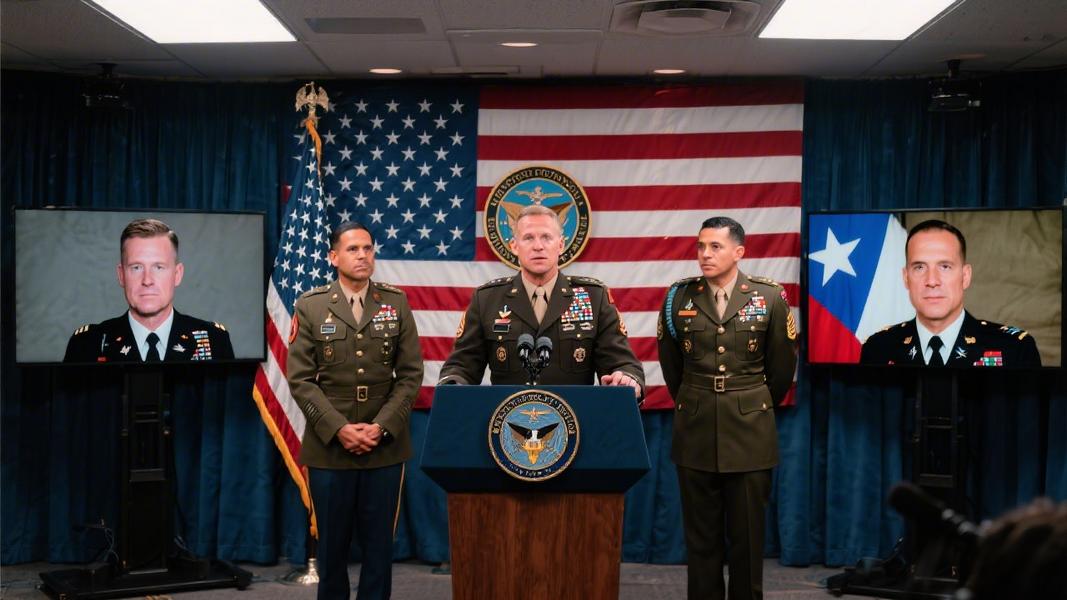
The Pentagon is making moves — both on the promotion front and on the battlefield. In a pair of announcements that underscore the current administration’s military posture, Secretary of War Pete Hegseth has nominated three Army colonels for promotion to brigadier general while simultaneously defending the ongoing Operation Epic Fury against Iran as a mission advancing “decisively.”
The nominations, announced March 9, 2026, reflect routine but consequential shifts in Army leadership. Three officers are moving up the ranks, each currently embedded in roles that span medical command infrastructure and regional support. It’s the kind of institutional machinery that keeps the military running — and the choices made here tend to ripple outward for years.
Three Colonels, One Step Closer to a Star
Leading the list is Army Col. Paul A. Lucci, Jr., nominated to brigadier general. Lucci currently serves as chief of staff for the 807th Medical Command (Deployment Support) in Salt Lake City, Utah — a command that plays a critical logistics role in getting medical assets into theater. Alongside him, Army Col. Arnold Rivera-Sanchez, commander of the 191st Regional Support Group at Fort Allen, Puerto Rico, received his nomination as well. Rounding out the trio is Army Col. Scott C. Valley, currently chief of staff of the 3rd Medical Command (Deployment Support) at Gillem Enclave, Georgia. Hegseth announced the nominations on behalf of the president.
Two of the three nominees come directly out of medical deployment commands. That’s not an accident. In an era defined by complex, multi-theater operations, the ability to project medical capability into hostile or austere environments has become a strategic priority — not just a support function.
A Pattern of Promotions
This isn’t the first round of nominations to come out of Hegseth’s office in recent months. Back on January 20, 2026, the secretary rolled out a broader set of nominations that included Marine Corps reappointments and appointments — a signal that the administration has been actively reshaping its senior officer corps since early in the year. Seapower Magazine noted the scope of that earlier announcement at the time.
That earlier round also included a nomination for Air Force Brig. Gen. Michelle L. Wagner to the rank of major general. Wagner currently serves as mobilization assistant to the Surgeon General of the Air Force — another medical-adjacent appointment that fits the broader pattern. Mirage News covered that announcement separately.
Iran, IRGC, and a War of Attrition
Still, the promotions aren’t exactly the headline grabbing the most attention right now. That distinction belongs to Operation Epic Fury — the ongoing U.S. military campaign against Iran — and Hegseth’s increasingly pointed public defense of it.
“The mission is advancing decisively,” Hegseth said in recent remarks, pushing back against any suggestion that momentum is stalling. He didn’t stop there. “Iran is hoping that we cannot sustain this,” he added, “which is a really bad miscalculation for the IRGC in Iran.” KATU reported on Hegseth’s full remarks, which came as part of a broader statement on the operation’s trajectory.
It’s the kind of language designed to project confidence — but also to send a direct message to Tehran. “Our commitment to our mission objectives only increases as our advantages continue to increase,” he said. Whether that confidence is matched by conditions on the ground remains, as it always does, the harder question.
The Bigger Picture
Taken together, this week’s announcements paint a portrait of an administration in full operational tempo — promoting officers, restructuring commands, and waging an active campaign against one of the region’s most entrenched adversaries. The nomination of two medical command officers to general-grade rank, in particular, suggests the military is quietly fortifying its ability to sustain long-duration operations, not just initiate them.
That’s the part that doesn’t always make the news. The stars, the speeches, the strikes — those get the coverage. But it’s the colonels in Salt Lake City and Georgia quietly running deployment support commands who’ll determine whether any of it holds together when things get hard.
If Iran is betting on American exhaustion, they may want to take a closer look at who just got nominated.
