
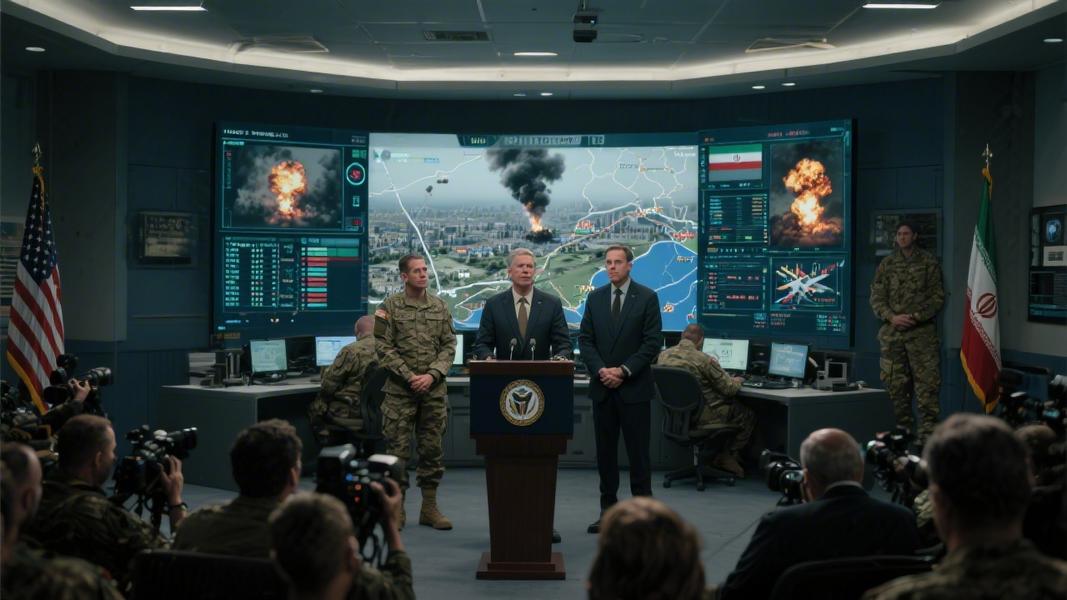
The Pentagon isn’t calling it a war of attrition. They’re calling it a rout — and they want Iran to know the worst is still coming.
Defense Secretary Pete Hegseth stood before reporters Tuesday alongside General Dan Caine and made one thing clear: the United States is not winding down its military campaign against Iran. It’s winding up. Hegseth declared that Tuesday would mark the most punishing day yet of American strikes inside the country, describing the operation as a deliberate, accelerating campaign designed to strip Iran of its military capacity — permanently. The remarks offered the most detailed public accounting yet of what the Pentagon is calling Operation Epic Fury and where it intends to go from here.
Three Goals, No Ambiguity
Hegseth laid out the mission in blunt terms that left little room for diplomatic interpretation. The operation, he outlined, has three core objectives: destroy Iran’s missile stockpiles, launchers, and defense industrial base; destroy their navy; and — the one that carries the most geopolitical weight — permanently deny Iran nuclear weapons forever. That last point wasn’t a condition or a negotiating chip. It was framed as a military endstate.
That’s an enormous mandate. Not just in scope, but in what it implies about the duration and depth of the campaign. Permanently denying a nation nuclear capability isn’t a weekend airstrike. It’s a structural dismantlement — of facilities, supply chains, expertise, and the infrastructure that supports all of it.
Uncontested Skies and Relentless Pressure
How does the Pentagon plan to get there? Hegseth offered a preview that was, by any measure, striking in its confidence. Within a week, he said, the U.S. and Israel expect to achieve “complete control of Iranian skies — uncontested airspace,” a condition he said would allow coalition forces to “fly all day, all night, day and night, finding, fixing and finishing the missiles and defense industrial base of the Iranian military.” Around the clock. Indefinitely. Until there’s nothing left to hit.
Still, it’s worth noting what that kind of claim requires: not just air superiority, but the sustained ability to identify, track, and destroy mobile and hardened targets across a country the size of Alaska. Whether the Pentagon can deliver on that timeline is a question the coming days will answer whether they want it to or not.
“Punching Them While They’re Down”
Hegseth didn’t dress it up. He acknowledged directly that the rules of engagement are designed to be overwhelming and asymmetric — not a fair contest. “This was never meant to be a fair fight,” he said, “and it is not a fair fight. We are punching them while they’re down, which is exactly how it should be.” It’s the kind of line that will echo in foreign capitals for a long time, both among allies trying to read American intentions and adversaries doing the same math.
On the question of timeline, Hegseth was equally direct: the U.S. is not operating on Iran’s schedule, or the international community’s, or anyone else’s. “We will not relent until the enemy is totally and decisively defeated,” he declared, adding that the campaign proceeds “on our timeline and at our choosing.” That framing — total defeat, American discretion — is a deliberate signal. It forecloses, at least rhetorically, the kind of off-ramp negotiations that might otherwise slow a campaign like this.
Iran’s Miscalculations and a Shifting Gulf
Hegseth also pointed to what he described as a strategic blunder by Tehran: its retaliatory strikes on neighboring states haven’t rallied regional support. They’ve done the opposite. Iran’s aggression toward Gulf neighbors has, according to Hegseth, driven those states further into alignment with Washington — a dynamic the Pentagon appears eager to exploit. And the escalation isn’t plateauing. “The amount of firepower over Iran and over Tehran,” he warned, “is about to surge dramatically.”
Dramatically. That’s the word he chose. Not incrementally. Not strategically. Dramatically — as if the last several days were just the prologue.
What Comes Next
The administration has framed Operation Epic Fury as a decisive, time-limited campaign with clearly defined military objectives. But campaigns described that way have a long history of outlasting their original timelines. The objectives Hegseth described Tuesday — dismantling an entire defense industrial base, sinking a navy, and permanently ending nuclear ambitions — are not the kind that get checked off a list in a few weeks. They are generational in their ambition, even if the strikes themselves are measured in days.
Whether Tuesday turns out to be the most intense day of this war, or merely the most intense day so far, may be the question that defines everything that follows.
