
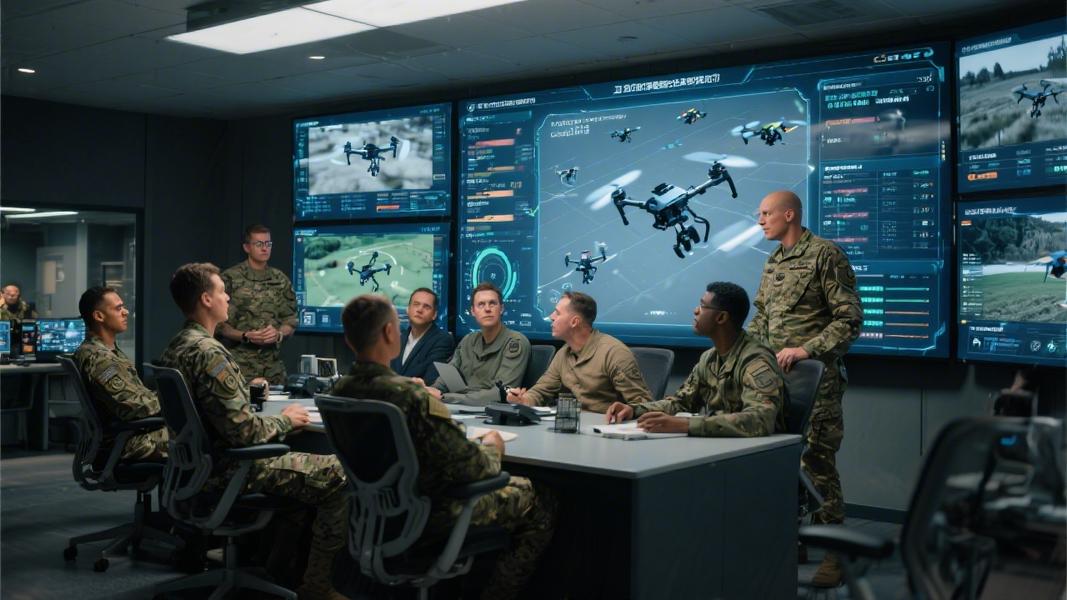
The U.S. military’s war on rogue drones just got a lot more organized — and a lot more aggressive.
Joint Interagency Task Force 401, the Pentagon’s dedicated counter-drone command, has rolled out a sweeping set of new policies, testing standards, and training expansions that collectively represent the most comprehensive overhaul of American counter-unmanned aircraft systems doctrine in years. The moves come as low-cost drones — wielded by everyone from hostile state actors to curious civilians — continue to probe the boundaries of military installations across the homeland and beyond.
A New Rulebook for Testing What Actually Works
On March 10, 2026, JIATF-401 formally adopted what it calls “The Standard Guidelines for Test and Evaluation of Counter-Unmanned Aircraft Systems Technologies” — a framework designed to bring consistency to what had been, by most accounts, a patchwork of evaluation methods across the Department of War. The goal is straightforward, if not exactly simple: make sure that when a C-sUAS technology gets tested, the data actually means something — and that it means the same thing no matter who’s running the evaluation.
“The JIATF’s one measure of effectiveness is to quickly deliver state of the art C-sUAS capabilities into the hands of warfighters,” said Brigadier General Matt Ross, Director of JIATF-401. “Achieving this outcome requires more than innovation; it demands a disciplined approach to testing, evaluation, and continuous improvement that translates promising technologies into operationally relevant solutions at scale.”
That’s not boilerplate. It’s a pointed acknowledgment that the defense industry’s counter-drone pipeline has, at times, moved faster than the military’s ability to vet what it’s actually buying. The new guidelines aim to fix that by standardizing evaluations, accelerating capability delivery, sharpening decision-making, and — critically — giving commanders and procurement officers a common language for what “good” looks like when a system is tested in the field.
Commanders Get More Room to Act
The testing guidelines didn’t arrive in a vacuum. They followed a major policy shift that Secretary Pete Hegseth signed on December 8, 2025 — updated counter-UAS guidance that significantly expanded commander authority under 10 U.S. Code § 130i. The old rules had what amounted to a fence-line problem: commanders couldn’t do much about a drone until it had already crossed into restricted airspace. The new framework tears that limitation down.
“With this new guidance installation commanders are empowered to address threats as they develop,” Ross explained, “and the guidance makes clear that unauthorized drone flights are a surveillance threat even before they breach an installation perimeter.” That’s a significant legal and operational shift. Threat determinations can now be based on the totality of circumstances — not just geography.
What does that look like in practice? Expanded defensive perimeters. Streamlined threat identification that explicitly includes unauthorized surveillance. Enhanced data sharing with DHS and DOJ. And — perhaps most notably — authorization for trained contractor personnel to serve as C-sUAS operators, a move that widens the talent pool considerably at a moment when demand for qualified operators is outpacing supply.
The guidance, released through official War Department channels, also directs commanders to issue installation-specific procedures within 60 days. Service Secretaries — with authority delegable to Service Chiefs — can designate covered facilities based on risk assessments, with an emphasis on vulnerability reviews, training drills, and layered defenses. It’s a decentralized approach with centralized standards, which is harder to pull off than it sounds.
Low-Tech Solutions Aren’t Being Ignored
Here’s something that might surprise people: not every answer involves a radar array or a directed-energy weapon. JIATF-401’s published guide on physical protection of critical infrastructure promotes hardening measures — think reinforced concrete structures — alongside techniques for obscuring visibility and physically extending defensive perimeters beyond traditional fence lines. Sometimes, the most effective counter-drone measure is making sure a drone can’t see anything worth reporting back.
It’s a grounded reminder that as sophisticated as the threat has become, not every solution needs to be a software problem. The task force appears to be pushing a layered philosophy: high-tech where it counts, physical resilience everywhere else.
Training Is Scaling Up — Fast
None of this policy architecture matters if the people operating these systems aren’t ready. Enter the Joint Counter-small UAS University, or JCU — JIATF-401’s training arm, which has been quietly expanding its footprint and curriculum in step with the evolving threat picture. Three specialized courses, updated regularly with current tactics, techniques, and procedures, are now available to counter-UAS operators across the joint force.
“Whether it’s in a classroom at Fort Sill or on an airfield in Guam, our job is to support JIATF-401’s priorities,” said a JCU official, as noted in recent coverage. “We are improving joint force training to ensure our service members have the skills they need to defend every inch of the homeland.” The curriculum is deliberately agile — built to absorb new threat data quickly rather than wait for a formal revision cycle.
Privacy, Surveillance Law, and the Public Trust Question
Still, expanding the military’s authority to monitor and engage drone activity near installations raises real civil liberties questions. JIATF-401 seems aware of that tension. The task force recently addressed it directly, publishing a guide on how counter-drone technologies comply with federal surveillance law. The key technical point: these systems use signal fingerprints to identify drones — without analyzing the content of any communications. It’s identification, not interception.
“This guide is part of our commitment to transparency, ensuring that as we deploy these critical technologies, we do so in a way that is responsible, respects privacy, and maintains public trust,” an official statement read. That framing matters. Counter-drone systems that vacuum up RF signals near populated areas could easily become a civil liberties flashpoint if the legal and ethical boundaries aren’t spelled out clearly — and publicly.
The Bigger Picture
Zoom out, and what JIATF-401 is building looks less like a single program and more like an entire ecosystem: standardized testing to vet technology, updated legal authority to act on threats earlier, physical hardening to reduce vulnerability, expanded training to build a capable workforce, and transparency guides to keep the public informed. “JIATF-401 is an entirely joint, interagency endeavor dedicated to defeating small UAS,” Ross underscored in remarks tied to the December guidance release.
That’s a broader mandate than it might appear. Small UAS threats — cheap, proliferating, and increasingly capable — have exposed a gap in American defensive doctrine that conventional air defense wasn’t designed to fill. The task force is racing to close it, and the flurry of policy activity in late 2025 and early 2026 suggests the urgency is real.
The question now isn’t whether the framework is ambitious. It clearly is. The question is whether it can move fast enough — because the drones certainly aren’t slowing down.
