
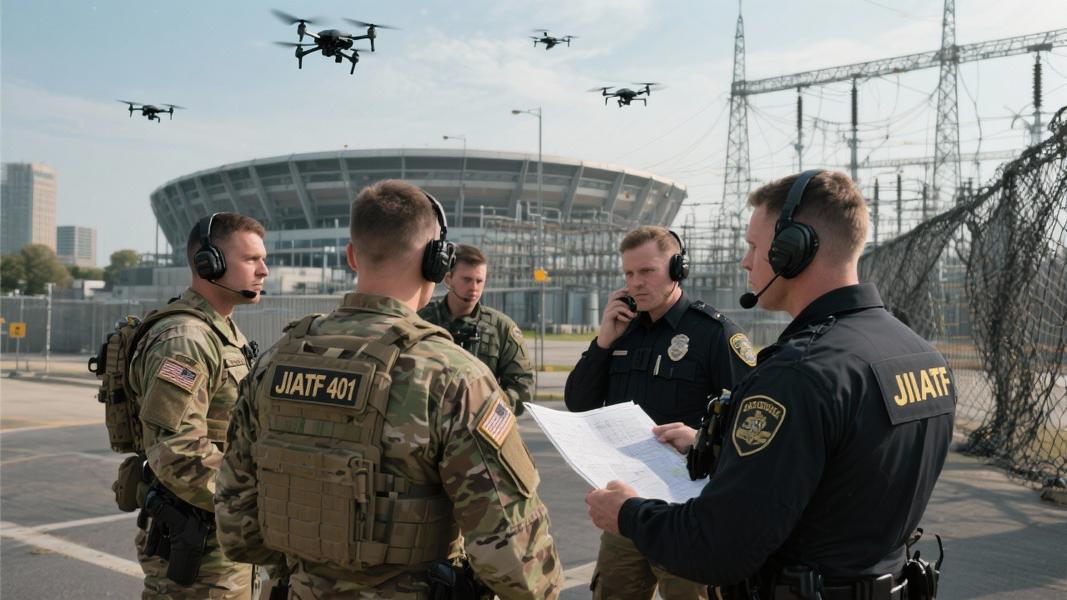
The Pentagon’s counter-drone task force has rolled out new guidance aimed at protecting America’s critical infrastructure using surprisingly low-tech solutions, marking a shift in how military and civilian agencies approach the growing threat from small unmanned aircraft.
JIATF 401, the Joint Interagency Task Force established in 2025, published its “Guide for Physical Protection of Critical Infrastructure” on January 30, introducing a framework that emphasizes passive defensive measures rather than expensive electronic countermeasures. The approach — dubbed “Harden, Obscure, Perimeter” — focuses on practical solutions like protective netting, visual camouflage, and extended security boundaries that can be implemented without specialized technology or expertise.
“The release of this guide demonstrates our whole-of-government effort to defend the Homeland,” said Army Brig. Gen. Matt Ross, Director of JIATF 401, in a statement accompanying the release.
Expanded Authority Beyond Base Boundaries
The guidance comes on the heels of a December 8 directive signed by Secretary of War Pete Hegseth that significantly expands counter-UAS authorities for military commanders. That directive allows them to address drone threats well before they breach installation perimeters — a major shift in defensive posture.
“With this new guidance installation commanders are empowered to address threats as they develop, and the guidance makes clear that unauthorized drone flights are a surveillance threat even before they breach an installation perimeter,” Ross explained in a briefing to reporters.
The task force isn’t just focused on military installations. It’s taking a broader view that includes civilian infrastructure and upcoming high-profile events. In fact, security for the 2026 World Cup has been identified as a priority, with JIATF 401 working to ensure tested counter-UAS capabilities will be available through the Defense Logistics Agency.
“We’re not there yet, but we’re making progress,” Ross admitted when discussing the World Cup preparations.
From Concept to Law
What began as a Defense Department initiative has now been enshrined in law. The FY2026 National Defense Authorization Act (NDAA) officially established JIATF 401 under Section 912, placing it within Title 10 of the U.S. Code. The legislation positions the Director to report directly to the Deputy Secretary of Defense as principal advisor on counter-small UAS matters, according to drone policy experts.
Why such a high-level reporting structure? The threat is evolving rapidly, and conventional bureaucratic channels might be too slow to respond.
The task force’s whole-of-government approach reflects a growing recognition that drone threats cross jurisdictional boundaries. “We’ve got to partner closely with our local law enforcement and other federal, state, local, tribal and territorial law enforcement to be able to counter this threat, see it before it starts to manifest and then to defeat it before an attack is successful,” Ross noted in a recent industry forum.
Border Security Success
JIATF 401 has already claimed early wins in deploying counter-drone capabilities to the southern border. In what would typically be a years-long procurement process, the task force delivered $18 million in counter-UAS solutions in under 60 days through the Pentagon’s Replicator 2 initiative.
“In less than 60 days — a process that traditionally takes two or three years — JIATF-401 assessed and validated capability gaps on the southern border and translated them into the Joint Task Force-Southern Border requirements document vetted through U.S. Northern Command and the services,” said Maj. Anthony Padalino, a JIATF-401 response team member, in an Army publication.
The new physical protection guide, available on the Defense Department’s website, represents a pragmatic turn in counter-drone strategy. Rather than relying solely on cutting-edge electronic warfare or detection systems, it emphasizes basic modifications that can significantly reduce vulnerability.
For a military accustomed to high-tech solutions, it’s an unusually practical approach to a 21st-century threat — one that acknowledges not every defense needs to come with a multimillion-dollar price tag.
