
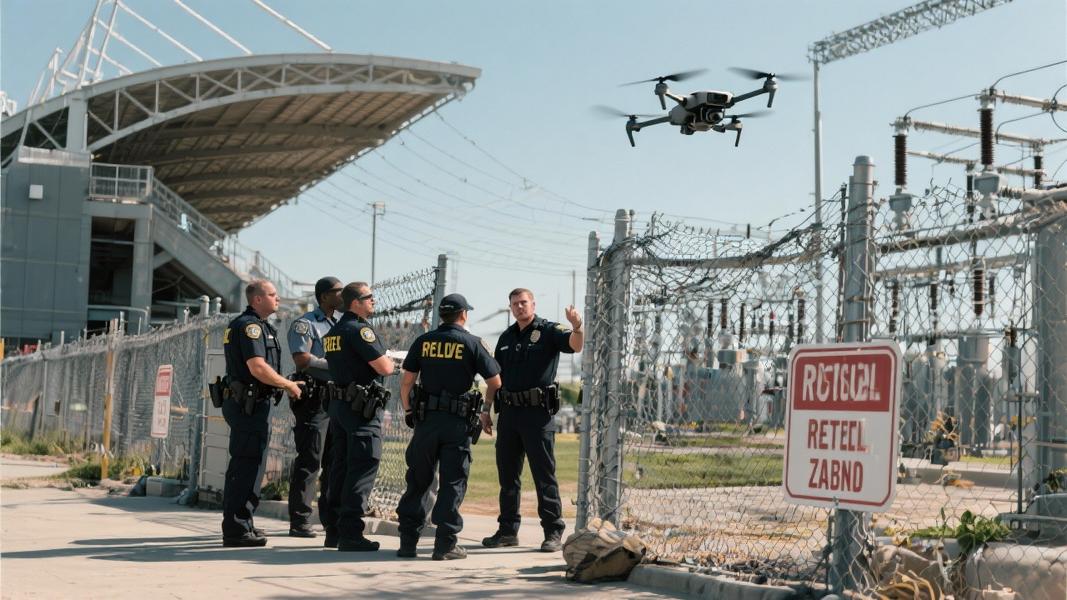
The Pentagon’s counter-drone task force has unveiled a new strategy for defending critical infrastructure against unmanned aerial threats — one that emphasizes physical barriers and expanded authorities over technological solutions.
On January 30, 2026, the Joint Interagency Task Force 401 (JIATF 401) published its “Guide for Physical Protection of Critical Infrastructure,” marking a significant shift in how military installations and other key facilities are expected to handle the growing threat of small unmanned aircraft systems (sUAS).
Low-Tech Solutions to High-Tech Problems
The guide introduces a surprisingly straightforward framework called “Harden, Obscure, Perimeter” that emphasizes layered passive defenses like netting, visual clutter, and expanded security perimeters. These measures don’t require the sophisticated electronic systems typically associated with counter-drone operations.
“Countering the drone threat is about more than exquisite systems. You can take steps now to prepare and protect critical infrastructure,” notes the guidance document.
Army Brigadier General Matt Ross, who directs JIATF 401, emphasized the collaborative nature of the initiative. “The release of this guide demonstrates our whole-of-government effort to defend the Homeland,” Ross stated, adding that “drones are a defining threat for our time. Technology is evolving fast, and our policies and c-UAS strategy here at home must adapt to meet this reality.”
Expanded Authority for Commanders
Perhaps more significant than the physical protection recommendations is the expanded authority granted to installation commanders. New guidance signed by Secretary of War Pete Hegseth on December 8, 2025, empowers military leaders to take counter-UAS actions beyond the boundaries of their installations.
“With this new guidance installation commanders are empowered to address threats as they develop, and the guidance makes clear that unauthorized drone flights are a surveillance threat even before they breach an installation perimeter,” Ross explained.
This expansion of authority comes in response to a January 2026 advisory from the Department of Defense Inspector General highlighting increasing domestic drone risks. The announcement represents a significant policy shift in how military installations can respond to potential aerial threats.
Rapid Response to Emerging Threats
How quickly can the military adapt to drone threats? JIATF 401’s track record suggests the answer is: very.
The task force, established just last year by the Department of Defense, has already demonstrated remarkable speed in deploying counter-drone capabilities. In one notable example, JIATF 401 delivered $18 million in counter-sUAS capabilities to the southern border in less than 60 days through the Replicator 2 initiative.
“In less than 60 days — a process that traditionally takes two or three years — JIATF-401 assessed and validated capability gaps on the southern border and translated them into the Joint Task Force-Southern Border requirements document vetted through U.S. Northern Command and the services,” said Major Anthony Padalino, a JIATF-401 response team member, in an article marking the task force’s first 100 days.
The task force is also prioritizing security for high-profile events, including the upcoming 2026 World Cup, ensuring access to tested counter-UAS capabilities through the Defense Logistics Agency. “We’re not there yet, but we’re making progress,” Ross acknowledged.
Beyond Military Installations
JIATF 401’s mission extends beyond protecting military bases. The task force is focused on a comprehensive approach to safeguarding all critical infrastructure against unmanned threats.
“…a whole-of-government effort to be able to protect our critical infrastructure against the threat of unmanned systems. We’ve got to partner closely with our local law enforcement and other federal, state, local, tribal and territorial law enforcement to be able to counter this threat, see it before it starts to manifest and then to defeat it before an attack is successful,” according to a statement quoted by the Inside Unmanned Systems publication.
The Pentagon’s evolving counter-drone strategy reflects a sobering reality: the technology that makes drones increasingly accessible to consumers also makes them potential threats in the wrong hands. By combining low-tech physical barriers with expanded authorities and rapid deployment capabilities, JIATF 401 is betting that sometimes the best defense against tomorrow’s threats begins with yesterday’s wisdom.
