
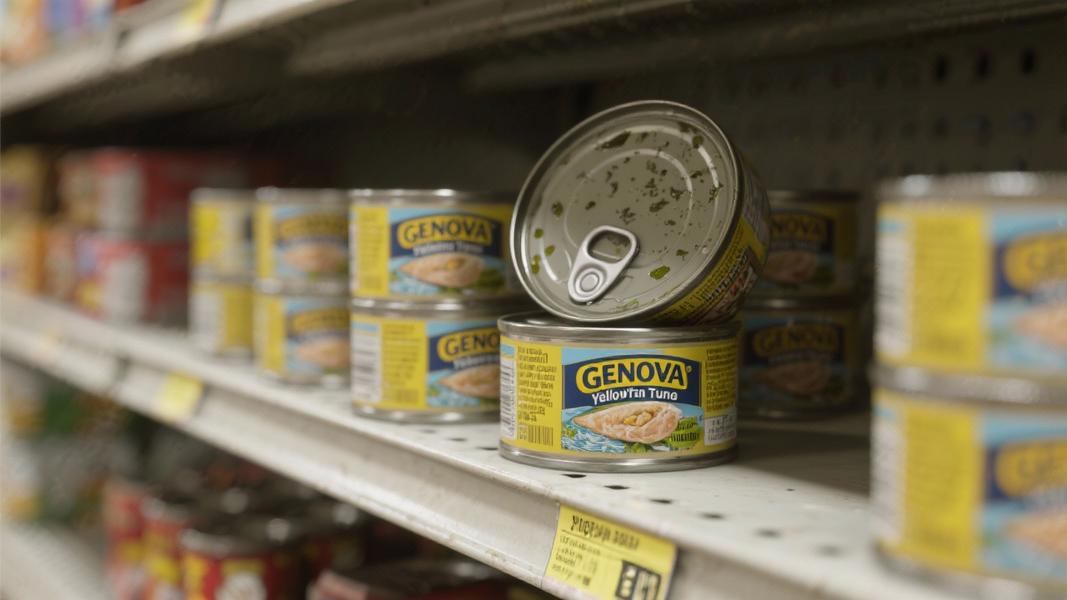
Recalled tuna that risked deadly botulism has accidentally made its way back to store shelves in nine states, according to a new FDA advisory issued Thursday.
The agency warned that certain Genova Yellowfin Tuna products—originally recalled in February 2025—were mistakenly redistributed by a third-party vendor to retailers across Illinois, Indiana, Kentucky, Michigan, Ohio, Wisconsin, Maryland, Virginia, and California. The advisory comes nearly a year after the initial recall, raising serious questions about supply chain controls for potentially dangerous food products.
What Products Are Affected?
The affected products include specific lots of Genova-branded yellowfin tuna that were part of a larger recall by Tri-Union Seafoods last February. Specifically at risk are Genova Yellowfin Tuna in Olive Oil 5.0 oz 4 Pack (UPC 4800073265) with can codes S84N D2L and S84N D3L, best by January 21 and 24, 2028, respectively. Also included is Genova Yellowfin Tuna in Extra Virgin Olive Oil with Sea Salt 5.0 oz (UPC 4800013275) with can code S88N D1M, best by January 17, 2028, according to health authorities who detailed the affected products.
The original February 7, 2025 recall was extensive. It included not just Genova products but also certain lots of Van Camp’s, H-E-B, and Trader Joe’s canned tuna items due to what the company described as a manufacturing defect in the easy-open pull tabs that could compromise the integrity of the cans, food safety experts reported.
“Tri-Union Seafoods has made the decision to voluntarily recall select lots of canned tuna products sold under the Genova®, Van Camp’s®, H-E-B and Trader Joe’s brand names,” the company said in its original recall notice. “This voluntary recall is out of an abundance of caution following the notification from our supplier that the ‘easy open’ pull tab can lid on limited products encountered a manufacturing defect that may compromise the integrity of the product seal (especially over time), causing it to leak, or worse, be contaminated with clostridium botulinum, a potentially fatal form of food poisoning,” the company stated at the time.
The Botulism Threat
Botulism is no small matter. The rare but serious illness caused by Clostridium botulinum bacteria can lead to paralysis and even death if not treated promptly. The toxin produced by these bacteria is one of the most potent known to science—a fact that makes the redistribution of recalled products particularly concerning for public health officials.
What’s particularly troubling about this situation is the time that has elapsed since the initial recall. The affected products have now been circulating for nearly a year since they were first identified as potentially dangerous, increasing the risk as the cans age and the manufacturing defect potentially worsens.
The FDA is advising consumers who purchased Genova tuna products in the affected states to check their pantries immediately and return any matching products to the place of purchase. Consumers should not eat these products under any circumstances, even if they appear normal, as botulinum toxin does not typically change the appearance, smell, or taste of food.
How did recalled products make it back to store shelves? That’s the question now facing regulators and the food industry. The FDA indicated that a third-party distributor mistakenly shipped the recalled products to retailers, highlighting potential gaps in recall verification procedures within the supply chain.
This isn’t the first time recalled food has made its way back into circulation, but the severity of the potential health risk makes this incident particularly concerning for food safety advocates.
As the investigation continues, this case serves as a stark reminder of the fragility of our food safety systems—and how a single breakdown in the recall process can put consumers at risk long after dangers have been identified and publicly announced.
