
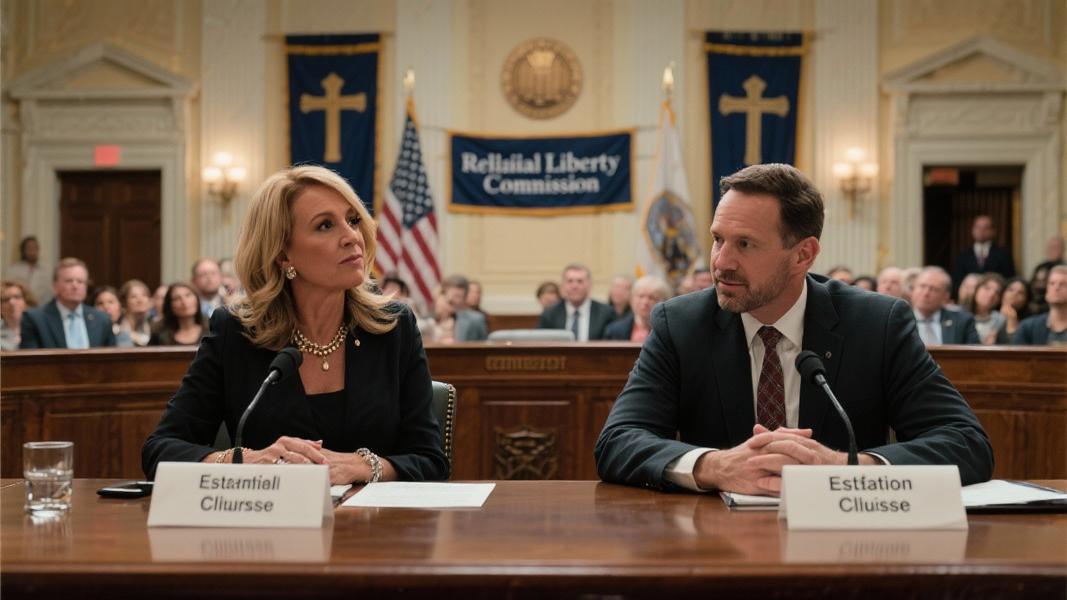
Religious liberty took center stage in Washington this week as the newly established Religious Liberty Commission held its inaugural hearing, tackling thorny constitutional questions about faith’s role in public life and signaling a broader push to reexamine religious freedom protections across American society.
The June 16 hearing, established under President Trump’s Executive Order 14291, brought together commissioners who, despite varied backgrounds, found common ground in their concern over what they view as the marginalization of religion in public spaces. The commission is tasked with producing a comprehensive report on religious liberty in America, raising awareness of religious pluralism, identifying threats to religious expression, and developing preservation strategies.
Lieutenant Governor Dan Patrick framed the commission’s work as a return to founding principles. “This commission, in part with the President’s guiding, is so that we all in America can reclaim that inheritance our founders gave us,” Patrick stated. “The Declaration of Independence is consistent with the Bible, and the Bible is consistent with the Declaration of Independence… Because this commission is about all faiths.”
Beyond the “Freedom to Worship” Paradigm
A recurring theme throughout the hearing was commissioners’ pushback against what they characterized as limiting religious expression to private spaces. Many expressed “dismay at common attempts by public figures and secular culture to frame religious freedoms using maxims such as ‘freedom to worship,’ which many believe relegates religion to the private sphere rather than uplifting it as a valid and invited form of action in public life.”
The first session specifically tackled the question “What Does the Establishment Clause Mean?” featuring presentations from Pastor Paula White and scholar Mark David Hall, as confirmed by the commission’s official documentation.
Is religion purely a private matter, or does it have legitimate standing in the public square? That’s precisely the tension the commissioners aim to address through their work, which will span multiple sectors of American life.
Broader Agenda Emerging
The commission isn’t limiting its scope to abstract constitutional questions. Its planned future hearings reveal an ambitious agenda tackling religious liberty in public education (September 8, 2025), religious liberty in education more broadly (September 29, 2025), and religious liberty in the military (November 17, 2025).
The first hearing also included a segment on “Faith, Family, and Society” featuring Dr. Phil McGraw, the well-known television personality, whose participation highlights the commission’s attempt to bridge academic constitutional discussions with broader cultural conversations.
Religious pluralism remains a stated priority, with commissioners emphasizing that their work encompasses protections for people of all faiths, not just Christianity. Still, some observers may question whether the commission’s composition and framing — particularly references linking biblical principles with founding documents — truly reflects America’s increasingly diverse religious landscape.
As the commission continues its work toward producing a comprehensive report, it enters territory that has long been contested in American jurisprudence and public life — where one person’s religious expression can sometimes conflict with another’s rights or sensibilities. Whether it can navigate these waters while maintaining its commitment to pluralism may ultimately determine the lasting impact of its recommendations.
