
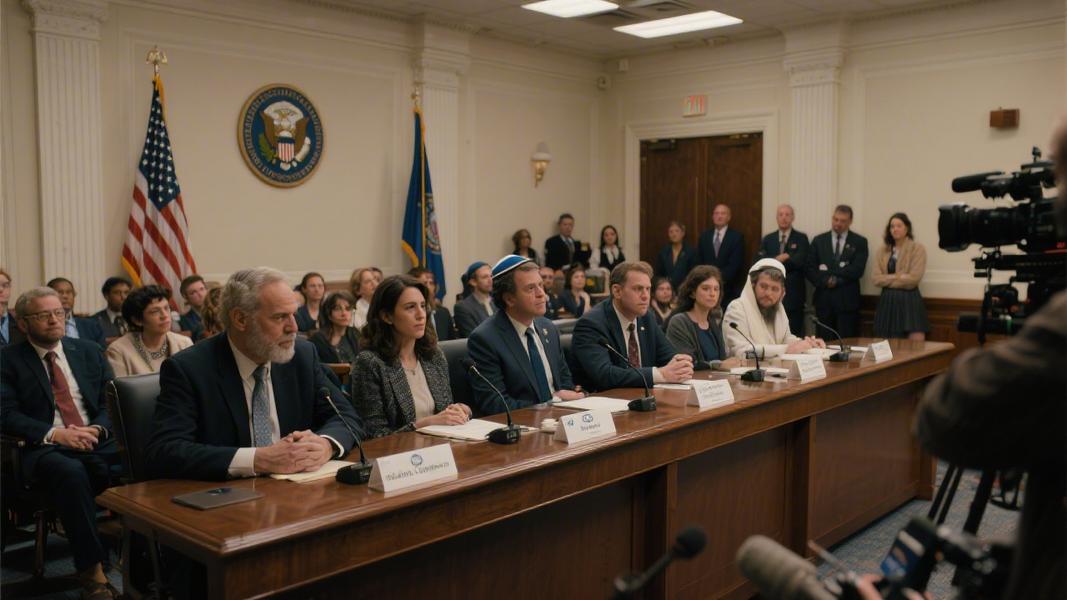
Religious Liberty Commission Holds Fifth Hearing on Anti-Semitism in the Private Sector
In a packed theater at the Museum of the Bible, a diverse array of voices — from Holocaust survivor relatives to college students caught in campus unrest — took the stage to testify about what many described as a troubling rise in anti-Semitism across American institutions.
The Religious Liberty Commission (RLC) convened its fifth public hearing on February 9, 2026, bringing together an unusual coalition of witnesses including university administrators, coaches, graduate students, and Department of Justice officials to discuss religious liberty issues facing Americans, with particular focus on anti-Semitism in the private sector.
“Religious liberty is our first and foundational freedom,” declared Chairman Dan Patrick in his opening remarks, setting the tone for a day of sometimes emotional testimony that stretched from early morning until mid-afternoon at Washington’s World Stage Theatre.
Campus Controversies Take Center Stage
Among the most compelling testimonies came from students who have become plaintiffs in high-profile lawsuits against prestigious universities. Yitzchok Frankel detailed his experience at UCLA where anti-Jewish protests allegedly created what he termed a “Jew Exclusion Zone” following the October 7, 2023 attacks. That case resulted in the University of California agreeing to a permanent court order and paying over $6 million in damages and fees.
Shabbos Kestenbaum, who sued Harvard University for failing to protect Jewish students from harassment, offered testimony that visibly moved several commission members. His account of campus life painted a picture of institutional failure that many witnesses suggested has become increasingly common at American universities.
Rabbi Ari Berman, President of Yeshiva University, brought an administrator’s perspective to the proceedings. Auburn men’s basketball head coach Bruce Pearl — founder of the Jewish Coaches Association and one of college basketball’s most recognizable figures — spoke about his experiences navigating dual identities as a prominent sports figure and Jewish community leader.
Private Sector Challenges
The hearing wasn’t limited to academic settings. Several witnesses described what they characterized as religious discrimination in employment contexts.
Lacey Smith recounted being terminated by Alaska Airlines in 2021 after expressing concerns about the Equality Act. Hermione Susana, a hospitality worker from New York, testified about losing her job when her religious beliefs weren’t accommodated during vaccine mandate implementations.
Seth Dillon, CEO of satirical news site The Babylon Bee, addressed issues of censorship, humor, and free speech — particularly as they relate to religious expression in digital spaces.
What connects these disparate experiences? According to several witnesses, it’s a growing discomfort with religious expression in public and private settings alike.
Interfaith Perspectives
The day’s testimony also highlighted interfaith efforts to combat religious intolerance. Liat Cohen-Reeis, founder of The Jewish-Christian Alliance in San Diego, appeared alongside Pastor JC Cooper of The Mission Church. Their joint testimony described violent protests their communities faced after holding joint worship events.
Rabbi Meir Soloveichik of Congregation Shearith Israel and Fr. Thomas Ferguson, author of “Catholic and American,” offered historical perspectives on religious liberty traditions in America.
“This isn’t just about one faith tradition,” noted Ambassador Sam Brownback, former Ambassador-at-Large for International Religious Freedom. “When anti-Semitism rises, it’s often a canary in the coal mine for broader threats to religious liberty.”
Justice Department Response
The commission also heard from those tasked with enforcing civil rights protections. Leo Terrell, who chairs the DOJ’s Task Force to Combat Antisemitism, and John Mertens, Acting Deputy Chief of the Education Section in the Civil Rights Division, outlined current enforcement priorities.
One case that drew particular attention was that of Dr. Moshe Glick, who received a pardon from New Jersey Governor Phil Murphy after facing charges related to aiding someone attacked by a pro-Hamas protester at Congregation Ohr Torah synagogue in November 2024. The Department of Justice had filed a complaint under the Freedom of Access to Clinic Entrances (FACE) Act in connection with the incident.
The Religious Liberty Commission, established by President Trump under Executive Order 14291, is tasked with reporting on religious liberty foundations, threats, and protections. Yesterday’s hearing was the fifth in a series examining different aspects of religious freedom in American life.
As the six-hour session concluded, Chairman Patrick announced that a comprehensive report integrating findings from all hearings would be forthcoming later this year. “What we’ve heard today,” he said, “suggests that religious liberty remains both a cherished ideal and a contested reality in American life.”
