
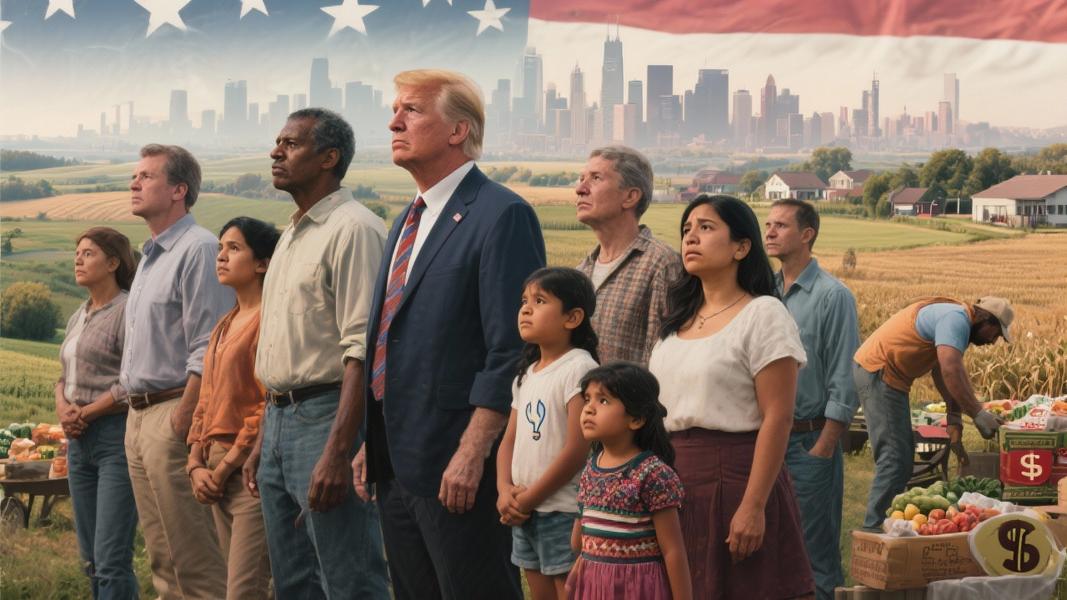
America’s urban-rural divide is taking a surprising twist, with optimism rising in rural communities while big-city residents grow increasingly pessimistic about the nation’s future, according to a comprehensive new survey.
The American Communities Project/Ipsos poll, conducted from August to September 2025, reveals a dramatic shift in national mood along geographic lines. Rural Middle America saw optimism jump to approximately 60% — up from 43% last year — while big cities experienced a 10-point decline, with only 45% of residents expressing hopefulness about America’s trajectory.
“It’s not just the economy, but the state of democracy and polarization. It’s a real worry. I try to be cautiously optimistic, but it’s very, very hard,” said one big-city resident interviewed for the study.
Economic Anxiety: The Great Unifier
Despite the diverging outlook, one sentiment bridges America’s deepening divisions. “Concerns about inflation are across the board. One thing that truly unites the country is economic angst,” researchers noted in their findings.
This widespread economic concern was echoed in the 2025 Community Perspectives Survey, which found housing affordability and personal finance conditions receiving the poorest ratings in low- and moderate-income communities, with wages consistently failing to keep pace with inflation.
Some rural residents, however, see potential relief on the horizon. “Right now, the president is trying to get companies who moved their businesses out of the country to move them back. So, maybe we’ll start to see prices come down,” one participant explained.
Crime Concerns Waning Despite Political Rhetoric
What about the crime wave we keep hearing about? Contrary to campaign messaging, residents of Big Cities and Middle Suburbs are now less likely to list crime or gun violence among their top concerns compared to 2023 — despite heightened political rhetoric about urban crime.
“I don’t want to say it’s overblown, because crime is a serious subject. But I feel like there’s an agenda to scare Americans, and it’s so unnecessary,” one urban resident remarked.
Hispanic Communities: A Sharp Decline in Hope
Perhaps most striking is the dramatic shift in sentiment within Hispanic communities, where optimism has plummeted from 78% to 58% in just one year. The outlook for the next generation appears even bleaker — only 55% of Hispanic respondents expressed hope for their children’s future, down from 69% in 2024.
“It’s not just hopelessness, but fear. My hopelessness comes from the fact that we are a large part of what makes up the United States, and sometimes I cry thinking about these families,” one respondent shared.
Immigration: Perception vs. Reality
The survey also highlighted stark differences in how communities perceive immigration. About 65% of Big Cities residents reported noticing immigration-related changes in their communities over the past year, compared to roughly 40% in Evangelical Hubs and Rural Middle America.
These perceptions often clash with complex realities on the ground. “Immigrants were not showing up there to commit crimes. They were showing up to help their families. But when ICE was in the parking lot, that’s all it took to scatter people who were just trying to find a job,” observed one participant.
The comprehensive survey, which interviewed 5,489 Americans between August 18 and September 4, carries a margin of error of plus or minus 1.8 percentage points.
As America’s mood continues to shift along geographic and demographic lines, one thing becomes clear: the country isn’t experiencing a single, unified reality, but rather multiple Americas moving in increasingly different directions — with hope and anxiety distributed unevenly across the landscape.
