
The Smithsonian Institution, America’s premier museum network and cultural cornerstone, has become the latest battleground in the nation’s ongoing culture wars, with its exhibitions increasingly reflecting divisive ideological perspectives rather than unifying historical narratives.
A comprehensive review of current Smithsonian programming reveals a pattern of exhibits and educational materials that critics say frame American history through lenses of identity politics, victimhood, and progressive activism. The National Museum of African American History and Culture, for instance, created a series educating visitors on what it calls “a society that privileges white people and whiteness,” defining “white dominant culture” as “ways white people and their traditions, attitudes, and ways of life have been normalized over time.”
Perhaps most controversially, this framework portrays “the nuclear family,” “work ethic,” and “intellect” as inherently white qualities rooted in racism, drawing heavily from the work of activist Ibram X. Kendi. Several Republican lawmakers have questioned whether such characterizations represent appropriate content for a taxpayer-funded institution.
Reframing American History
Visitors to the American History Museum encounter an exhibit claiming that the founding of America was not “a historic triumph of liberty” but rather a “profound unsettling of the continent.” Another display, “Upending 1620,” argues that Pilgrims are a “myth,” recasting them primarily as colonizers.
The museum’s treatment of Benjamin Franklin focuses heavily on slavery, noting that “his scientific accomplishments were enabled by the social and economic system he worked within” — language that critics say diminishes his contributions by contextualizing them primarily through modern racial frameworks.
What’s driving this shift in America’s most prestigious museum network? Museum leadership has increasingly embraced what they describe as more “inclusive” and “equitable” approaches to history and culture. But conservative critics argue these changes represent ideological capture of public institutions.
Identity Politics on Display
The National Portrait Gallery has conducted what internal documents describe as a campaign to stop being “wealthy, pale, and male” by featuring a choreographed “modern dance performance” examining the “ramifications” of the southern border wall. The gallery also commissioned an entire series to examine “American portraiture and institutional history… through the lens of historical exclusion.”
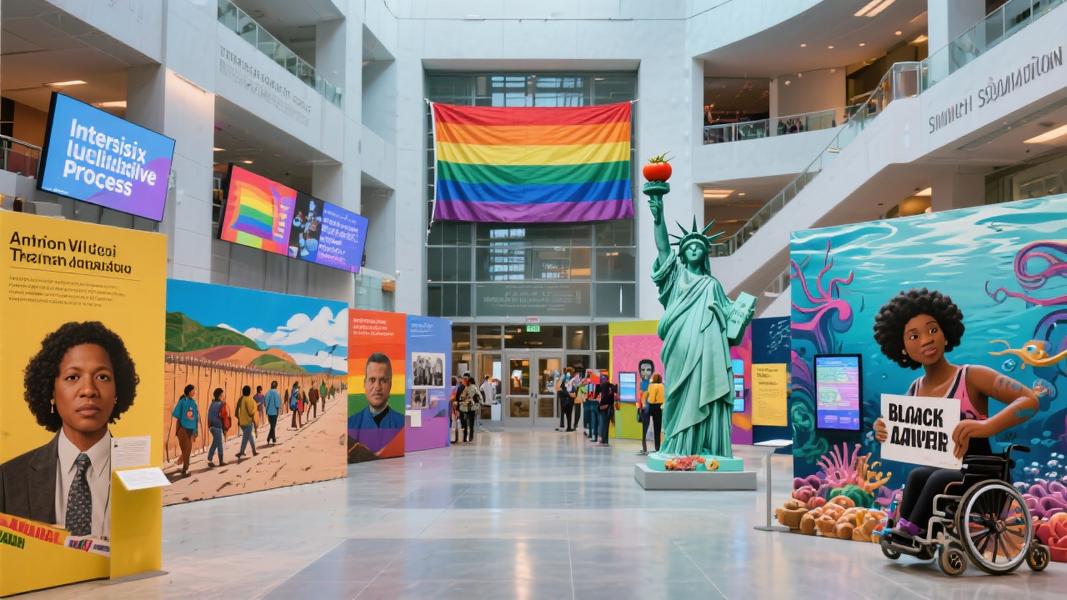
Visitors to the American History Museum are greeted at the entrance by the “Intersex-Inclusive Progress Pride flag,” which has also been flown alongside the American flag at multiple Smithsonian locations. The museum’s LGBTQ+ History exhibit aims to help visitors “understand evolving and overlapping identities” across a spectrum of sexual and gender expressions, including features on “LGBTQ+ inclusion and skateboarding” and “the rise of drag ball culture in the 1920s.”
Contemporary political issues feature prominently throughout the museums. The American History Museum’s “American Democracy” exhibit characterizes voter integrity measures as “attempts to minimize the political power” of “new and diverse groups of Americans,” while its section on demonstrations predominantly highlights progressive causes.
Border Politics and Immigration
Immigration and border security — hot-button political issues — receive particular attention. One exhibit depicts migrants observing Independence Day fireworks “through an opening in the U.S.-Mexico border wall” while claiming America’s founders “feared non-White immigration.”
Another striking display features what’s called the “Immokalee Statue of Liberty,” showing Lady Liberty holding a tomato instead of a torch and a basket of tomatoes instead of a tablet. The statue’s bronze skin tone, according to exhibit materials, represents “workers from Mexico and Central America.”
The National Museum of the American Latino has proven especially controversial, with exhibits that reframe the Texas Revolution not as a Texan war of independence but as “a massive defense of slavery waged by ‘white Anglo Saxon’ settlers against anti-slavery Mexicans fighting for freedom.” The same museum describes the Mexican-American War as “the North American invasion” that was “unprovoked and motivated by pro-slavery politicians.”
Curious about what unites Latino Americans? According to one museum display, it’s “the Black Lives Matter movement.”
Cultural Exhibitions and Representation
The National Museum of African Art has embraced speculative fiction with an exhibit based on the underwater legend of Drexciya, portraying “an immersive, feminist and sacred aquatopia” populated by “the children of pregnant women who had been thrown overboard or jumped into the ocean during the Middle Passage.”
The National Museum of the American Latino features programming about “animated Latinos and Latinas with disabilities,” including content from “a disabled, plus-sized actress” and an “ambulatory wheelchair user” who “educates on their identity being Latinx, LGBTQ+, and disabled.”
Even sports history hasn’t escaped controversy. The American History Museum’s 50th anniversary Title IX exhibit includes biological males competing in women’s sports and arguments supporting transgender athletes competing against the opposite biological sex. Meanwhile, the former interim director of the future Smithsonian American Women’s History Museum has declared the museum will be “inclusive” of biological men who identify as women.
And in what seems a nod to pandemic-era politics, the National Portrait Gallery commissioned a “stop-motion drawing animation” examining the career of Anthony Fauci.
The Future of America’s Museums
Where does this leave the Smithsonian? Defenders argue these exhibits simply represent a more complete telling of American history, one that centers previously marginalized voices and perspectives. Critics counter that the nation’s premier museum complex has abandoned objective historical presentation in favor of progressive activism.
The Museum of American Art uses American sculpture “to invite dialogue and reflection on notions of power and identity” — a statement that perhaps unintentionally captures the broader transformation
