
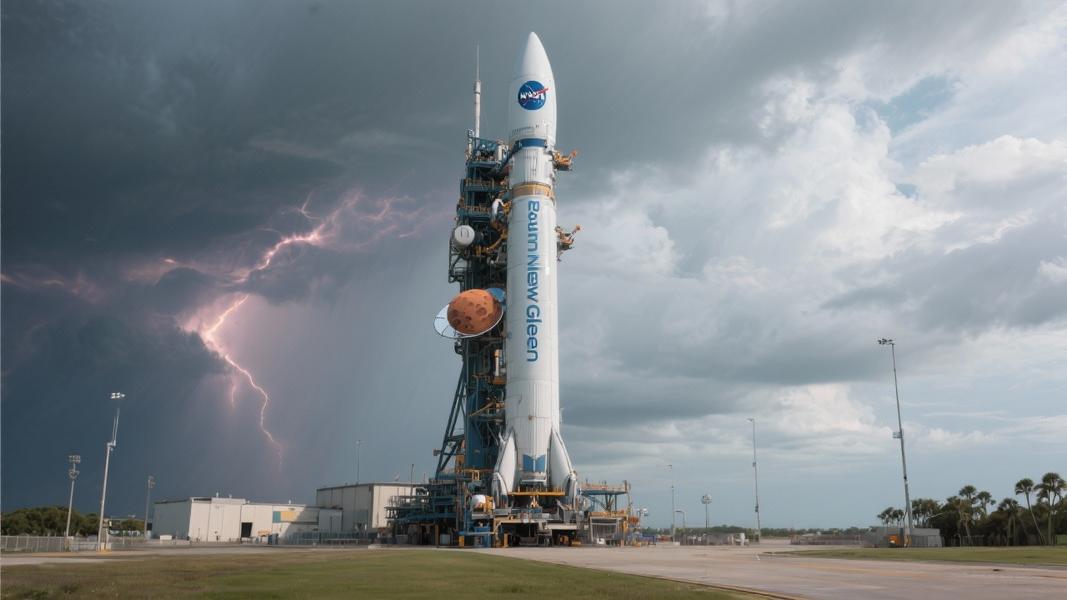
Blue Origin’s massive New Glenn rocket has been grounded by the sun itself, as NASA postponed the vehicle’s mission to Mars due to intense solar storms that could endanger the spacecraft it was set to launch.
The towering rocket was just hours away from liftoff at Cape Canaveral Space Force Station on November 9, 2025, when officials called off the launch of NASA’s twin ESCAPADE Mars orbiters. “Due to highly elevated solar activity and its potential effects on the ESCAPADE spacecraft, NASA is postponing launch until space weather conditions improve,” Blue Origin officials wrote in their announcement.
The cosmic weather delay is just the latest setback for a mission that has already faced multiple postponements since its original October 2024 target date, due to various technical and scheduling issues. Even the November 9 attempt had already been flagged for potential weather violations related to cumulus clouds before the solar activity became the primary concern.
A Giant Waiting for Its Moment
Standing 321 feet tall — nearly the height of a football field turned on end — New Glenn represents Jeff Bezos’ company’s big leap into heavy-lift spaceflight. The vehicle is substantially larger and more powerful than the company’s suborbital New Shepard rockets that have carried passengers on brief joyrides to the edge of space, as noted by multiple observers.
This would have been only New Glenn’s second flight. The rocket made its debut in January 2025, but that mission included a partial failure when the first stage — designed to land on a barge at sea for reuse — missed its target and was lost.
The launch window on November 9 had been scheduled to open at 2:45 p.m. EDT and extend for 2.5 hours, but officials scrubbed the attempt approximately five hours before the planned liftoff.
Mars Mission on Hold
What exactly is ESCAPADE? The mission — whose full name is Escape and Plasma Acceleration and Dynamics Explorers — consists of two spacecraft built by Rocket Lab under NASA management. The twin orbiters are designed to study Mars’ plasma environment and magnetic field interactions in unprecedented detail.
Ironically, it was concern about the very space phenomena these probes will eventually study — solar radiation and its effects — that led to the launch postponement. Solar storms can bombard spacecraft with high-energy particles that might damage sensitive electronics, especially during the vulnerable launch phase.
“We’re reviewing opportunities for our next launch attempt based on forecasted weather,” Blue Origin stated on social media, promising updates as the situation evolves.
Bezos’ Lunar Ambitions
The delay comes at a time when Blue Origin is attempting to position itself as a major player in deep space exploration. Beyond this Mars mission, the company has its sights set on something even bigger — the Moon.
Can Blue Origin compete with SpaceX in the new space race? That’s certainly the plan. The company eventually intends to use New Glenn to support lunar exploration, delivering both scientific equipment and eventually humans to the Moon aboard its still-in-development Blue Moon lander. This would make it a direct competitor to SpaceX’s Starship vehicle, which NASA has already selected for its Artemis program to return astronauts to the lunar surface.
For now, though, Blue Origin’s interplanetary ambitions remain grounded by the very star that makes our solar system possible — a reminder that even with all our technological advancement, space exploration remains at the mercy of cosmic forces beyond our control.
