
In the sweltering summer of 1765, as tensions between American colonists and their British rulers reached a boiling point, a secretive group of men gathered beneath a stately elm tree in Boston. They called themselves the Sons of Liberty, and within months, they would ignite a revolution.
The Birth of American Resistance
The Sons of Liberty formed in early 1765, emerging from a smaller group known as the Loyal Nine in Boston, as colonists grew increasingly resentful of British taxation and control. Their name came from an unlikely source — an Irish member of Parliament named Isaac Barre, who had declared that British mistreatment “has caused the blood of these sons of liberty to recoil within them.”
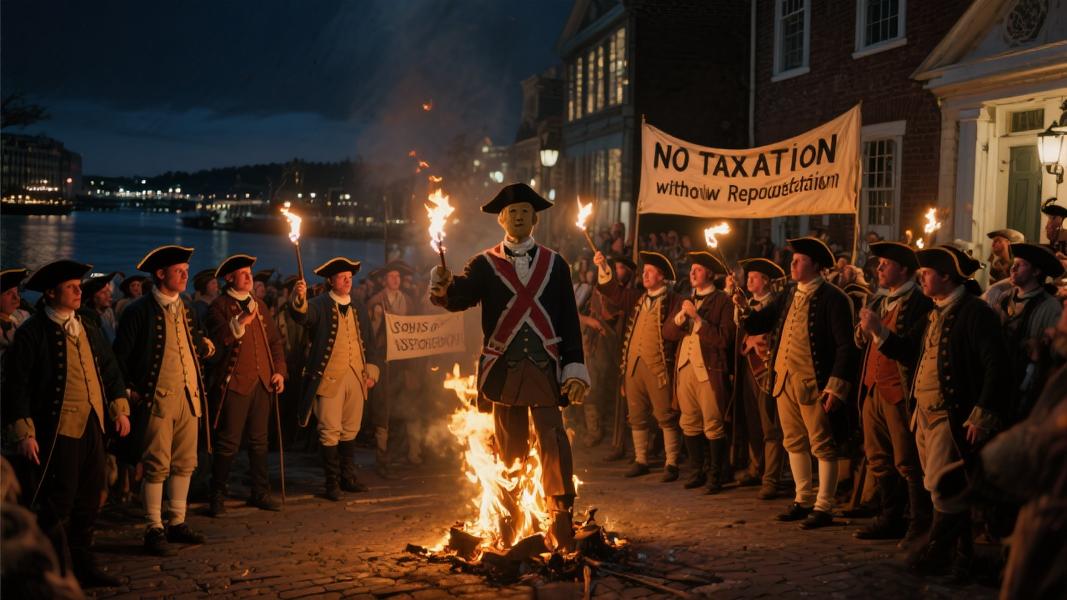
What began as whispered meetings soon erupted into public defiance. On August 14, 1765, the group orchestrated their first major action — a dramatic public protest against the hated Stamp Act. Under the cover of Boston’s “Liberty Tree,” the protesters hung an effigy of British tax collector Andrew Oliver, eventually burning it in a fiery demonstration of colonial anger. According to historical accounts, “the riotous, angry, and alcohol-fueled crowd paraded the effigy through the streets of Boston inciting supporters of the Patriot cause throughout the city. Soon mob rule was the order of the day, and the effigy was stomped-on, beheaded, and ultimately burned in a fit of anger.“
The protest worked. Oliver promptly resigned his commission as stamp master, marking an early victory for the revolutionary group.
From Secret Society to Revolutionary Force
How did this group grow from local rabble-rousers to revolutionary icons? By the end of 1765, the Sons of Liberty had expanded beyond Boston, establishing chapters throughout the colonies. Their meetings often took place in the shadows — the Boston chapter, as historians note, “often met under cover of darkness beneath the ‘Liberty Tree,’ a stately elm tree in Hanover Square.”
Their tactics weren’t always peaceful. In August 1765, the group attacked the mansion of Massachusetts Lt. Governor Thomas Hutchinson in a violent display of resistance. “The front door was smashed in with axes and the house was looted. Irreplaceable artwork and silver were destroyed or carried off by the Sons, while the mansion’s cupola was even knocked off the house and destroyed,” according to historical records.
By November 1765, the Sons of Liberty had formed organized committees across the colonies, creating a network of resistance that would ultimately help spark the American Revolution.
Tar and Feathers: The Price of Loyalty
The Sons didn’t shy away from brutal methods. Starting in 1767, they popularized the use of tar and feathering as punishment for government officials who remained loyal to the Crown — a painful and humiliating ordeal that involved pouring hot tar over the victim before covering them in feathers.
But their influence extended beyond street violence. The group organized the Stamp Congress, spread propaganda through newspapers, and coordinated with other revolutionary thinkers like Patrick Henry, whose Virginia Resolves further inflamed colonial resistance.
Their most famous act would come years later, when members disguised as Mohawk Indians dumped 342 chests of British tea into Boston Harbor in December 1773 — the Boston Tea Party.
A Legacy of Rebellion
Four years after their founding, on August 14, 1769, the Sons gathered at Boston’s Liberty Tree to celebrate their anniversary, cementing their place in colonial resistance. Their methods were controversial even then — some colonists considered them dangerous radicals, while others saw them as necessary freedom fighters against British tyranny.
The Sons of Liberty would eventually disband as the formal structures of revolution took shape, but their legacy lives on in American identity. From secret meetings beneath an elm tree to orchestrating one of the most famous acts of defiance in American history, these colonial rebels helped transform scattered discontent into organized resistance.
And perhaps that’s their most enduring contribution — turning the abstract concept of liberty into something colonists would fight and die for, one burning effigy at a time.
