
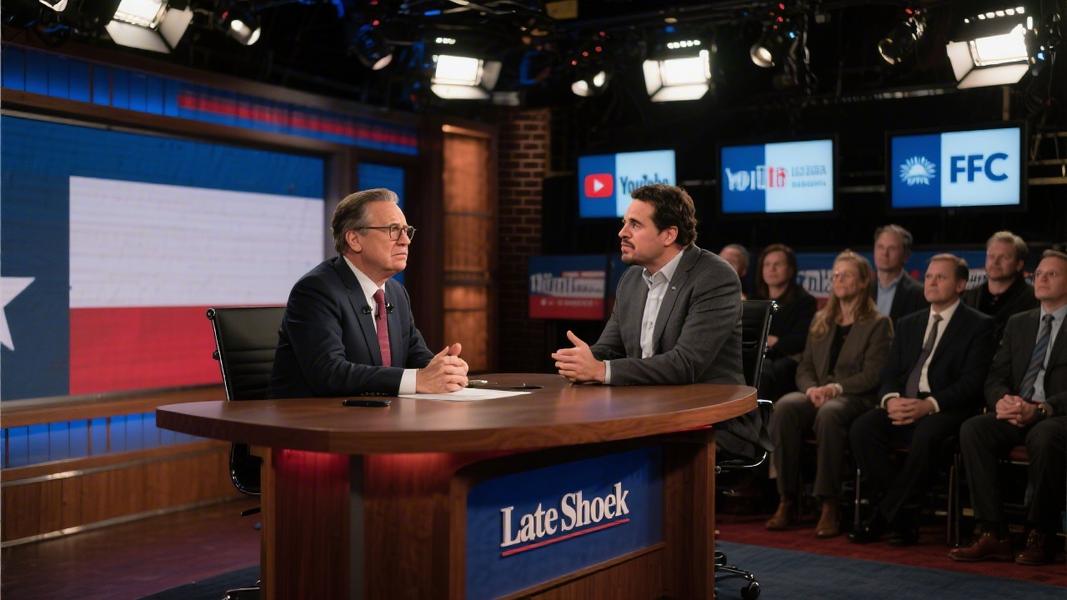
Stephen Colbert publicly challenged his own network this week after CBS attorneys blocked a scheduled interview with Democratic congressional candidate James Talarico, citing potential FCC equal-time violations — a decision that has ignited fresh debate about media censorship and political speech.
“Then I was told, in some uncertain terms, that not only could I not have him on. I could not mention me not having him on,” Colbert revealed to viewers in a candid on-air moment that quickly went viral.
The late-night host ultimately defied the network’s guidance by posting his interview with Talarico on YouTube instead, where it has already garnered over 3.3 million views within a day — nearly one million more than the show typically receives in an average week.
FCC Rules Tighten Around Political Appearances
At the heart of the controversy is a January 2026 FCC guidance issued under Chairman Brendan Carr that reversed a longstanding 2006 exemption which had previously shielded late-night talk shows from equal-time requirements for political candidates. The new rules now require broadcasters to file formal records when featuring political candidates, a regulatory shift that has television executives increasingly cautious about political content.
CBS quickly issued a statement after Colbert’s public disclosure, insisting their legal team had merely provided “legal guidance” about potential FCC violations rather than outright prohibiting Talarico’s appearance. The distinction, however, seemed lost on Colbert, who proceeded with the interview anyway — just not on broadcast television.
Is this the beginning of a chilling effect on political discourse in mainstream media? The situation appears to be escalating, as the FCC is now investigating ABC’s “The View” following Talarico’s appearance on that program, with the commission claiming Republicans weren’t given equal opportunity to appear.
Talarico Decries “Corporate Media Censorship”
During his YouTube interview with Colbert, Talarico didn’t hold back, addressing what he characterized as corporate censorship with pointed criticism of both media executives and his political opponents.
“This is the party that ran against cancel culture, and now they are trying to control what we watch, what we say, and what we read,” Talarico stated. “This is the most dangerous kind of cancel culture — the kind that comes from the top. Corporate media executives are selling out the First Amendment to curry favor with corrupt politicians.”
The wide-ranging conversation touched on several contentious topics, including Christian nationalism, separation of church and state, consolidated corporate-owned media, and the ongoing culture wars in Texas.
The fact that the interview found an even larger audience online than it might have received on broadcast television suggests an ironic backfire to any attempt at limiting the candidate’s exposure. But it also raises serious questions about how television networks will navigate political content as the election season intensifies.
For now, the standoff between Colbert and CBS executives stands as a high-profile example of how regulatory shifts can ripple through media organizations, creating tension between legal compliance and journalistic independence — and perhaps foreshadowing more conflicts to come as campaign season heats up.
