
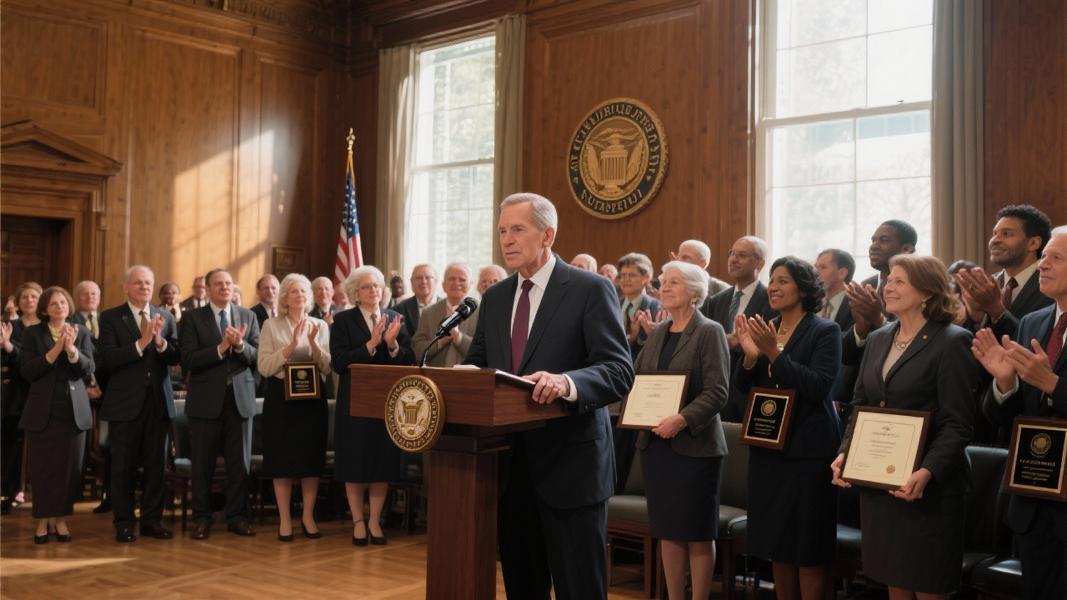
Supreme Court Adjourns 2021-22 Term, Honors Retiring Staff with Centuries of Combined Service
The U.S. Supreme Court concluded its 2021-22 term on June 30, 2022, officially entering its summer recess after resolving all cases submitted for decision. The Court will reconvene on the first Monday of October, as it has for generations.
“I am authorized to announce that the Court has acted upon all cases submitted to the Court for decision this Term,” read the official statement. “The Court will then be in recess from today until the first Monday in October 2022, at which time the October 2021 Term of the Court will be adjourned, and the October 2022 Term of the Court will begin, as provided by law.”
Half a Millennium of Service
Beyond the routine announcement of the Court’s schedule, Chief Justice John Roberts took a moment to acknowledge the extraordinary dedication of the Court’s employees during what has been, by any measure, a tumultuous term.
“On behalf of all the Justices, I would like to thank the Supreme Court employees for their outstanding work and dedication to their important responsibilities this Term,” Roberts stated. “I thank the members of the Court’s bar as well for their professionalism and cooperation.”
The statement highlighted an unprecedented wave of retirements from the Court’s staff. Together, these departing employees have contributed “more than five centuries of Supreme Court service” — a staggering figure that underscores the remarkable institutional memory walking out the Court’s doors.
Who are these long-serving staffers whose careers have spanned decades of American jurisprudence?
From the Clerk’s Office, Michael Duggan and Gary Kemp are retiring after more than 30 and nearly 30 years of service, respectively. The Marshal’s Office is losing several veterans, including Dannie Veney with more than 38 years, Earnest Hicks with over 36 years, and Willie Clayton with more than 25 years of service.
Perhaps most notable is Chief Deputy Marshal Richard Nelson, who retires after more than 18 years at the Court and an impressive 48-plus years of total federal service — a career spanning nearly half a century of American government.
From Chambers to Security
The chambers staff — those working directly with the justices — will see the departure of Michele “Shelly” Blincoe after more than 39 years, Janice Harley who retired with more than 36 years, and Toni Daluge who leaves after more than 14 years of service.
Security operations at the Court are also experiencing significant turnover. Six Supreme Court Police officers are retiring, including Jeff Banaszak (31+ years), Bernard Bishop (27+ years), Eliud Rodriguez (26+ years), Arthur Mackie (25+ years), and both Jeff Cooper and Casey Hills with more than 20 years each.
The Court also took a moment to remember those lost. The announcement noted the passing of Virginia Singletary after more than 41 years of service, Raymond Billeaud after more than 21 years as a Supreme Court Police Officer, and Moses Humes, who died shortly after retirement following more than 22 years at the Court and 47 years of federal service.
Technology and Knowledge Leadership
Two departmental leaders received special recognition in the Court’s statement. Robert J. Hawkins, Director of Information Technology, is stepping down after more than 27 years. His leadership was particularly crucial during the coronavirus pandemic, when the Court needed to adapt its operations to unprecedented circumstances.
Linda S. Maslow, who has served as the 11th Librarian of the Court since 2012, will retire after nearly 34 years. Under her stewardship, the Library has embraced digital tools while maintaining its vast traditional collection — balancing innovation with preservation in an institution where history and precedent remain paramount.
The Court’s statement closed with a simple but heartfelt sentiment for all those departing: “The Court thanks our retiring employees for dedicated public service to Court and Country. We wish each of you well in your retirement.”
Behind the marble columns and momentous decisions, it’s these career staff members who have kept the nation’s highest court functioning through decades of change — a human foundation supporting the constitutional superstructure that few Americans ever see.
