
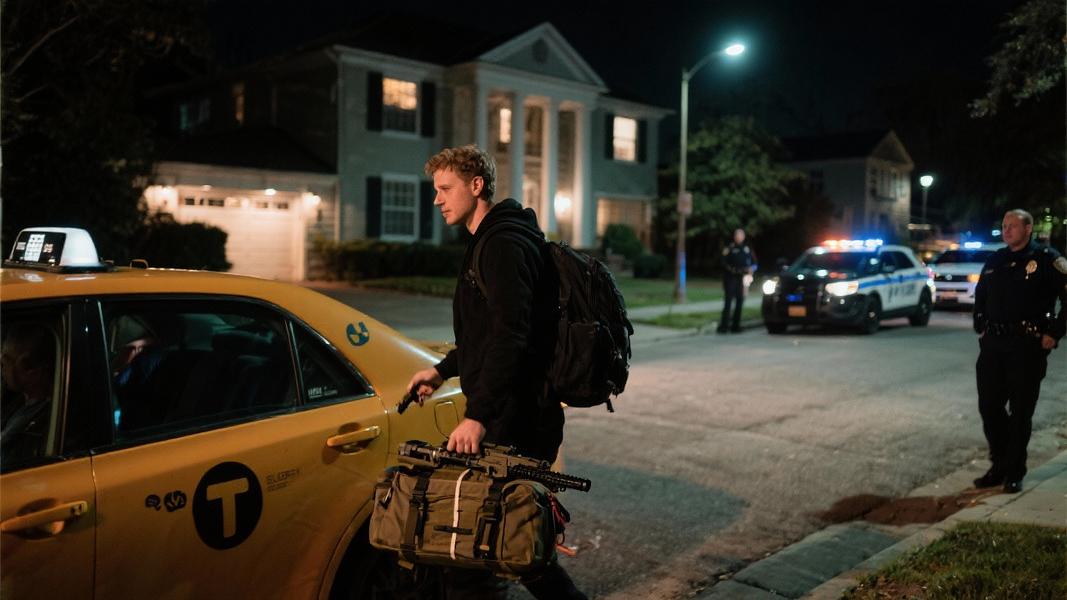
Nicholas John Roske, the California man who traveled across the country armed with a gun and tactical gear to assassinate Supreme Court Justice Brett Kavanaugh, has been sentenced to just over eight years in prison — a punishment immediately condemned by the Justice Department as “woefully insufficient.”
U.S. District Judge Deborah Boardman handed down the 97-month sentence on Thursday, followed by a lifetime of supervised release. The decision falls dramatically short of the 30-years-to-life sentence prosecutors had sought for what they characterized as an act of domestic terrorism.
A Plot Thwarted
The 29-year-old Simi Valley resident was arrested in the early hours of June 8, 2022, after taking a taxi to Kavanaugh’s Maryland home. Dressed in dark clothing and carrying a backpack and suitcase filled with weapons, Roske ultimately called 911 on himself after spotting U.S. Marshals outside the justice’s residence, telling the dispatcher he was suicidal and intended to kill the justice.
When questioned by police about his plan, Roske’s response was chillingly direct: “Break in [and] shoot” the Associate Justice, court documents revealed.
A search of Roske’s belongings uncovered a Glock 17 pistol, two magazines each containing 10 rounds of ammunition, additional ammunition, tactical gear, pepper spray, zip ties, and an array of burglary tools including a hammer, screwdrivers, a crowbar, and lock-picking equipment.
“Nicholas Roske will now pay the price for attempting to assassinate a Supreme Court Justice in a violent plot to alter the court’s composition and its rulings,” said FBI Director Kash Patel in a statement. “Violence against federal judges or other public officials is unacceptable and will be met by the full force of the law.”
A Much Broader Target
Perhaps most disturbing? Roske’s ambitions extended far beyond a single justice. Prosecutors revealed that he had actually targeted three Supreme Court justices, writing in an encrypted message just weeks before his arrest: “I am shooting for 3.”
The would-be assassin admitted to authorities that he was motivated by the leaked draft opinion that would eventually overturn Roe v. Wade, as well as the Uvalde school shooting. By his own calculation, killing at least one justice could change the decisions of the nine-member court “for decades to come.”
Why did Roske abandon his plan? The presence of security personnel outside Kavanaugh’s home apparently prompted a moment of hesitation. Instead of proceeding with his attack, he called emergency services and turned himself in — a decision that likely spared the justice’s life.
DOJ Vows Appeal
Attorney General Pamela Bondi didn’t mince words about the sentence. “The attempted assassination of Supreme Court Justice Brett Kavanaugh was a disgusting attack against our entire judicial system by a profoundly disturbed individual,” she said. “The Department of Justice will be appealing the woefully insufficient sentence imposed by the district court, which does not reflect the horrific facts of this case.”
In court, Judge Boardman acknowledged the “absolutely reprehensible” nature of Roske’s crime but cited his sincere remorse, lack of prior criminal history, and mental health background in her sentencing decision.
Roske himself offered an apology before learning his fate. “I sincerely apologize to the justice and his family for the considerable distress I put them through,” he said.
But prosecutors had characterized his actions in far more severe terms, describing the plot as a singularly heinous attempted act of domestic terrorism designed to “single-handedly alter the Constitutional order for ideological ends.”
Rising Threats to Judiciary
The case highlights an alarming trend of increasing threats against federal judges. According to the U.S. Marshals Service, “inappropriate communications” directed at federal judges and court employees more than quadrupled in just seven years — from 926 incidents in 2015 to 4,511 in 2021.
“Roske flew across the country armed with a gun and zip ties, prepared to kill at least one sitting Justice of the Supreme Court of the United States because of how he imagined the Justice would rule,” said Assistant Attorney General John A. Eisenberg. “No public servant, let alone a Justice, should have to consider his safety or that of his family’s in discharging his duty. Even in failure, Roske’s plot violated that basic tenet and threatened judicial independence, a critical component of the rule of law.”
U.S. Attorney Kelly O’Hayes echoed this sentiment: “Politically motivated violence has no place in our society,” she emphasized. “The attempt to assassinate a Supreme Court Justice is an extreme, unconscionable act that must be met with the full weight of the law.”
This case now joins a troubling roster of politically motivated attacks and threats against public officials, raising questions about whether the sentence delivered sends a strong enough message about the consequences of such actions — or whether, as the Justice Department contends, it falls far short of the mark.
