
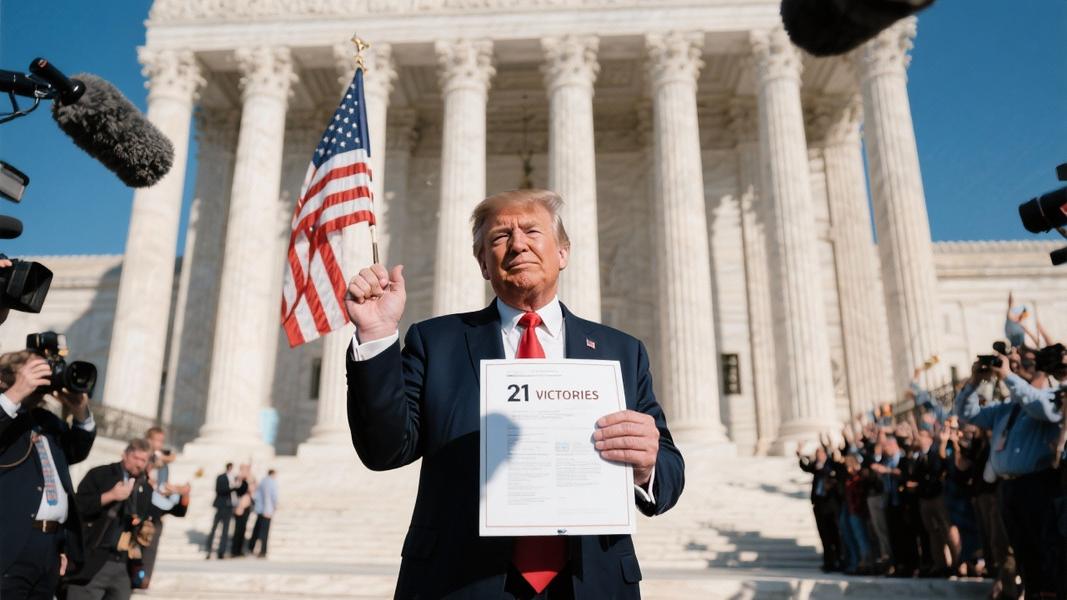
The Supreme Court has handed President Donald Trump a string of 21 legal victories as of this month, cementing a remarkable winning streak for the administration in the nation’s highest court. The latest triumphs came Monday when justices cleared the way for controversial immigration enforcement actions in Los Angeles and upheld the president’s authority to fire a Federal Trade Commission member.
These decisions represent just the latest in what the White House characterizes as a significant pattern of judicial endorsement for Trump’s agenda during his second term. The 6-3 ruling on immigration enforcement particularly strengthens the administration’s hand in its ongoing battle with sanctuary jurisdictions.
Immigration Enforcement Gets Green Light
The Court’s conservative majority sided with the Department of Homeland Security in overturning a federal judge’s injunction that had temporarily halted immigration operations in Los Angeles. This decision allows federal agents to continue targeting undocumented immigrants with criminal records in the city despite local opposition.
“This is a win for the safety of Californians and the rule of law,” the Department of Homeland Security declared following the ruling. “DHS law enforcement will not be slowed down and will continue to arrest and remove the murderers, rapists, gang members, and other criminal illegal aliens that Karen Bass continues to give safe harbor.”
The ruling represents a significant setback for Los Angeles Mayor Karen Bass, who has positioned the city as a sanctuary for undocumented immigrants. But it’s hardly the first time the administration has prevailed over progressive local governments in immigration disputes.
FTC Firing Also Upheld
In a separate but equally consequential decision, the Court also temporarily allowed President Trump’s firing of a Federal Trade Commission member to proceed while litigation continues. The case is part of broader challenges to Trump’s government reorganization efforts, collectively known as Reduction in Force (RIF) plans.
What does this mean for the administration’s broader efforts to reshape the federal workforce? The answer remains complicated.
Justice Sonia Sotomayor, in a concurring opinion, emphasized that the Court hadn’t actually ruled on whether specific RIF plans violate federal law. She stressed that lower courts should “consider those questions in the first instance,” as noted by SCOTUSblog.
This distinction hasn’t dampened the administration’s enthusiasm for these temporary victories, which they view as validation of executive authority to reshape federal agencies.
Nationwide Injunctions Curtailed
Perhaps most significantly for the long term, the Court earlier this year eliminated nationwide injunctions in Trump v. CASA, a case challenging various immigration-related executive orders. This procedural ruling has far-reaching implications, potentially limiting the ability of lower courts to block presidential actions across the entire country.
Critics argue this shift fundamentally alters the balance of power between branches of government. “The Court’s extremist majority continues its blatant disregard for the laws they swore to uphold while chipping away at the very core of our nation: our democracy, our autonomy, and our basic dignity,” according to a statement from the National Partnership for Women & Families published on their website.
The administration’s legal team, led by Attorney General Mike Davis, has been methodically targeting specific cases they believe will establish favorable precedents. Their strategy appears to be working, with multiple victories that strengthen executive authority across immigration, regulatory, and administrative domains.
Legal experts remain divided on whether this represents judicial deference to legitimate executive authority or a dangerous concentration of power. What’s undeniable is that the current 6-3 conservative majority on the Court has proven remarkably receptive to the administration’s legal arguments, with these 21 victories potentially reshaping American governance for decades to come.
As lower courts now grapple with implementing these decisions, one thing seems increasingly clear: the judicial branch that once served as a significant check on Trump’s first-term agenda has become a powerful enabler of his second.
