
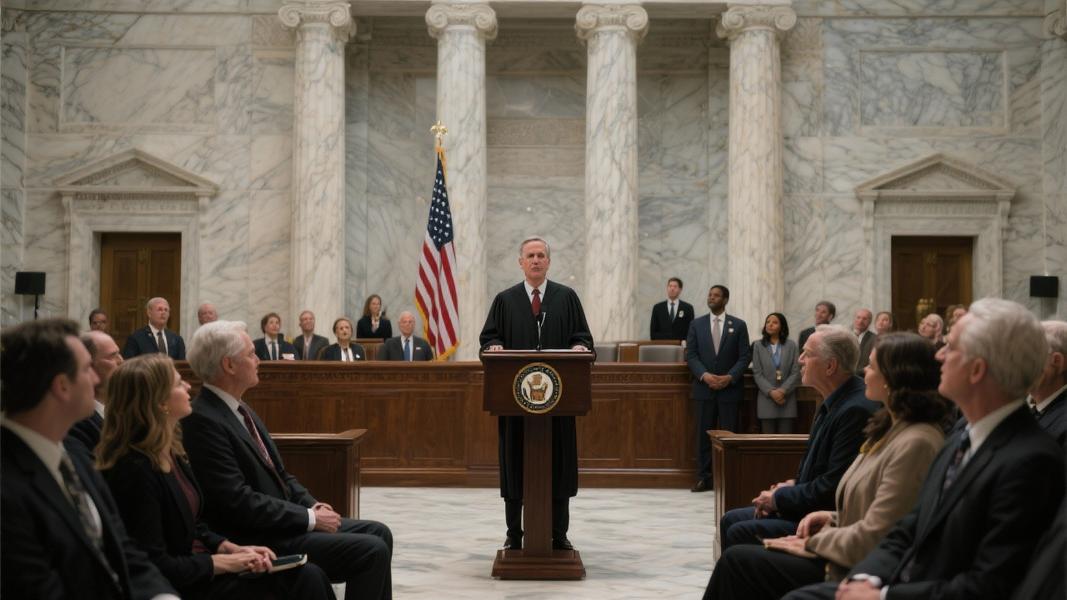
The Supreme Court wrapped up its final business Thursday, closing a tumultuous term that delivered landmark decisions on tribal sovereignty while bidding farewell to six veteran employees with more than 150 years of combined service.
Chief Justice John G. Roberts, Jr. announced the Court would recess until the first Monday in October, when the 2020 Term officially begins. The announcement came as the justices released their final Order List reflecting dispositions from Wednesday’s conference.
Historic Ruling on Tribal Rights Caps Term
In what may be remembered as one of the term’s most consequential decisions, the Court ruled in McGirt v. Oklahoma that the Creek Reservation in eastern Oklahoma remains “Indian country” under federal law. Justice Neil Gorsuch, writing for the 5-4 majority, emphasized that “only Congress can divest a reservation of its land and diminish its boundaries.”
The ruling effectively recognizes that roughly half of Oklahoma remains tribal territory for certain legal purposes — a decision that could reshape criminal jurisdiction across large swaths of the state.
Notable Retirements Mark Institutional Shift
Behind the high-profile cases, the Court is experiencing a significant changing of the guard. Six longtime employees are retiring, including Christine Luchok Fallon, the first woman to serve as Reporter of Decisions, who oversaw the publication of nearly 30 volumes of Supreme Court opinions during her nine-year tenure.
“Ms. Fallon, we thank you for your service, which you have performed with exemplary diligence and skill,” Roberts stated in the Court’s announcement.
Perhaps most notable among the departures is Pamela Talkin, who served as Marshal for 19 years. As the first woman to hold that position, Talkin supervised 260 employees and heard over 1,300 arguments during her tenure. Other retiring staff include James Baker from the Marshal’s Office with over 35 years of service, and Kathleen Tycz from the Clerk’s Office, who dedicated more than four decades to the Court.
In his statement, Roberts expressed gratitude on behalf of the justices. “On behalf of my colleagues, I would like to thank the Supreme Court employees for their outstanding work and dedication to their important responsibilities this Term,” the Chief Justice noted.
Tensions Beyond the Bench
The Court’s business this term unfolded against a backdrop of unusual political tension. Earlier this year, Roberts took the extraordinary step of publicly condemning remarks made by Senate Minority Leader Chuck Schumer at an abortion-rights rally outside the Court.
Schumer’s comments, which appeared to threaten Justices Gorsuch and Kavanaugh, prompted a rare rebuke. “Justices know that criticism comes with the territory, but threatening statements of this sort from the highest levels of government are not only inappropriate, they are dangerous,” Roberts declared in March.
What makes this public censure particularly unusual? The Chief Justice typically avoids engaging in political disputes, preferring to maintain the Court’s image as an institution above partisan fray.
The Court now enters its summer recess having completed one of its most consequential terms in recent memory — one that saw decisions with far-reaching implications for tribal sovereignty, religious liberty, and presidential power, all while navigating unprecedented operational challenges during a global pandemic.
As the justices prepare for October, they leave behind a term that will be remembered not only for its landmark decisions but also for the institutional transitions that signal an evolving Court in a divided era.
