
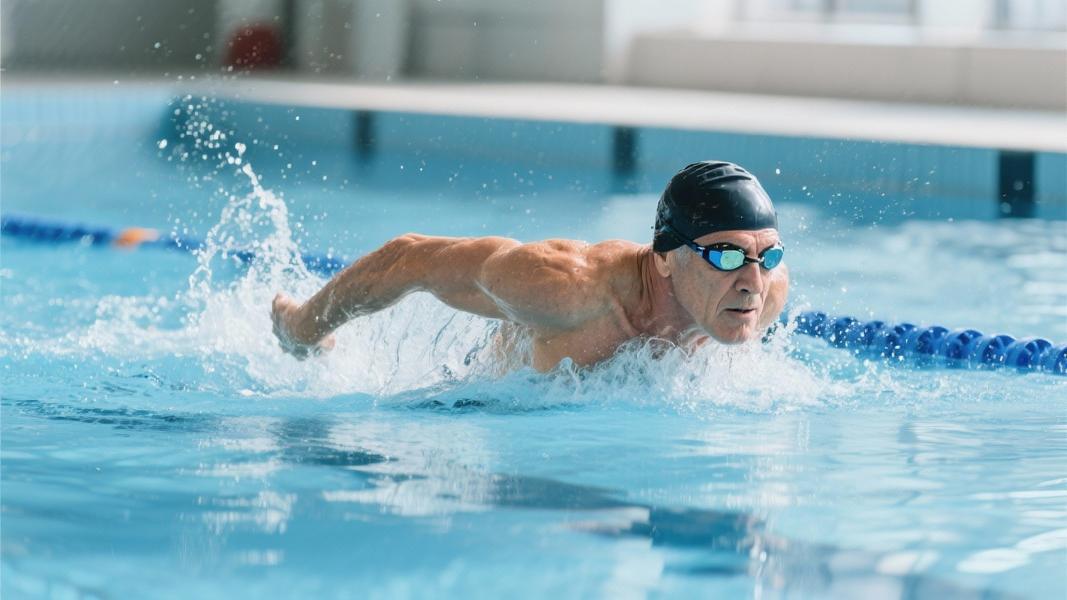
Slipping through water like a torpedo isn’t just for Olympic champions — it’s the fundamental skill that separates effortless swimmers from those battling against the current with each stroke. And who better to learn from than three-time Olympic gold medalist Rowdy Gaines?
“Water rewards efficiency. It has nothing to do with power,” explains Gaines, whose smooth technique helped him claim gold in the 100-meter freestyle and two relays at the 1984 Los Angeles Games. “I think a lot of first-timers feel like they have to power their way through the water and that is not true.”
The Perfect Streamline: Swimming’s Foundation
The key to swimming efficiency starts with mastering what coaches call “streamline” — the fundamental body position that minimizes resistance in water. “In streamline, you make your body as narrow as possible to help reduce drag as you dive in or push off the wall,” Gaines notes. “When in streamline, squeeze your biceps to your ears and keep your legs tight together. Any extra space creates resistance that can slow you down! Think like a torpedo.”
But streamlining isn’t just about that initial push-off. Proper body rotation becomes equally crucial for maintaining momentum. “Every time you take a stroke, keep your head in place and use your hips to rotate to the right and left,” Gaines advises. “Try to focus on rotating your body with your core, instead of leading with shoulder twists. The hips will initiate the movement, and your shoulders will follow.”
Wondering how to get started if you haven’t swum laps in years? Gaines recommends beginning modestly. “Start with a 200-yard (meter) workout. Swim 25 yards (meters) and rest until your heart rate slows. Do this eight to 10 times and then get the heck out of the pool,” he suggests. This approach prevents the frustration that often comes when returning swimmers try to do too much too soon.
Finding Your Rhythm in the Water
For those serious about improving, consistency trumps intensity. “Three days a week is the sweet spot. If you are doing less than three days a week, it’s really tough to develop the consistency you need,” Gaines states. This frequency allows swimmers to build technique while giving muscles time to recover between sessions.
Gaines himself maintains an impressive routine, swimming six days weekly and covering 2,000-2,500 yards per session. His workouts typically consist of 40% freestyle with the remaining distance split equally among backstroke, breaststroke, and kicking drills for variety, according to reports.
The man known as the “voice of swimming” for his work on NBC’s Olympics coverage emphasizes the importance of listening to your body. “You have to listen to any pain. Pain is a lot different than fatigue or strain,” he cautions. “Pain is real. If you are feeling fatigue and strain, that’s good. If you are feeling pain, that’s bad.”
A Lifetime in the Water
What makes swimming unique among physical activities? Its accessibility across the lifespan, according to Gaines. “Of course I’m biased, but I will stack swimming against any other exercise out there, especially as we age. And swimming is one of the few sports you can do forever,” he affirms.
The low-impact nature of swimming protects joints while providing full-body resistance, making it particularly valuable for older athletes or those recovering from injuries. Between 1978 and 1984, Gaines set 10 world records using techniques he still employs today.
Beyond the physical benefits, Gaines highlights swimming’s mental rewards. “Learn to feel the water. The small goal of just feeling the water is much more important than many other things,” he shares. “Swimming is not easy. You are not always going to feel good swimming. But you are going to feel great when you’re done.”
That post-swim endorphin rush? It might just be worth pushing through those first challenging laps — especially when you’re gliding through the water with the efficiency of a champion rather than fighting against it stroke by stroke.
