
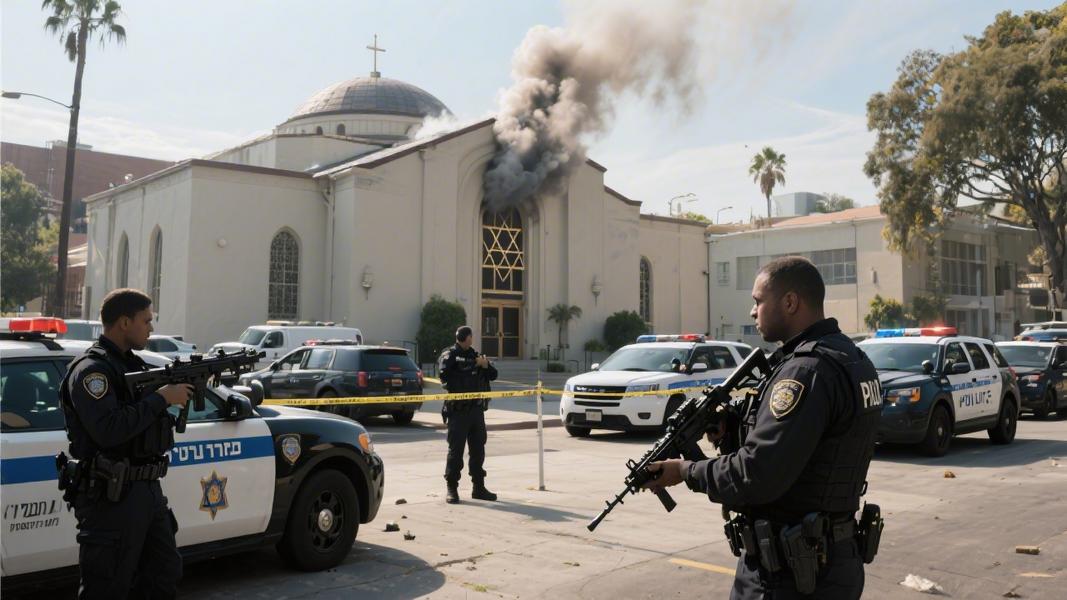
A suspected attacker rammed a truck into Temple Israel synagogue in West Bloomfield, Michigan on Wednesday and opened fire — only to be shot dead by security before anyone else was hurt.
The incident unfolded at 5725 Walnut Lake Road, home to what’s widely considered the nation’s largest Reform Jewish congregation. Authorities issued an immediate shelter-in-place advisory as a massive law enforcement presence descended on the property. The attack combined two tactics increasingly familiar in threat assessments: a vehicle ramming followed by gunfire. That it ended without civilian casualties is, by any measure, remarkable.
What Happened on the Ground
The sequence of events, as pieced together from multiple sources, was fast and violent. A truck crashed deliberately into the synagogue building, sparking a fire that sent smoke billowing from the structure. Before the suspect could escalate further, temple security intervened. As one source put it, “It appears at least one individual came to the temple, security saw him, engaged him in gunfire.” The suspect was killed at the scene.
Security engaged the shooter swiftly enough that, as of early reports, no injuries to worshippers or staff had been reported. That detail — no civilian casualties in an attack of this scale and coordination — speaks to how prepared the security team apparently was.
Federal Authorities Move In
It didn’t take long for the situation to draw federal attention. The FBI confirmed its involvement in stark, direct terms: “FBI personnel are on the scene with partners in Michigan and responding to the apparent vehicle ramming and active shooter situation out of Temple Israel Synagogue in West Bloomfield Township, Michigan.” The bureau’s rapid response signals this is being treated as more than a local criminal matter.
A motive has not yet been publicly confirmed. But the choice of target — a prominent Jewish institution, one of the largest of its kind in the country — will inevitably draw scrutiny from investigators examining whether this constitutes a hate crime or an act of domestic terrorism. Those are not mutually exclusive categories, and federal law enforcement will likely be exploring both.
The Broader Picture
How prepared can any house of worship really be? Temple Israel, it turns out, may have had an answer to that question ready. The response from on-site security — engaging an armed suspect who had already rammed a vehicle into the building — was the kind of action that security trainers rehearse for and hope never to use. On Wednesday, they used it.
Still, the fact that this happened at all is jarring. West Bloomfield is a suburban community with a large Jewish population, and Temple Israel isn’t some obscure target — it’s a landmark. The attack follows a years-long pattern of violence and threats directed at Jewish institutions across the United States, a trend that law enforcement agencies have repeatedly flagged as one of the most pressing domestic security concerns in the country.
Michigan authorities are continuing to investigate alongside federal partners. The suspect’s identity and background had not been publicly released as of initial reporting, and officials have not yet addressed whether there were any known prior warnings or threats against the synagogue.
What’s clear is this: the attack failed, the suspect is dead, and an entire community is now left to reckon with the fact that on a Wednesday afternoon in suburban Michigan, someone decided a synagogue was a target worth dying for.
