
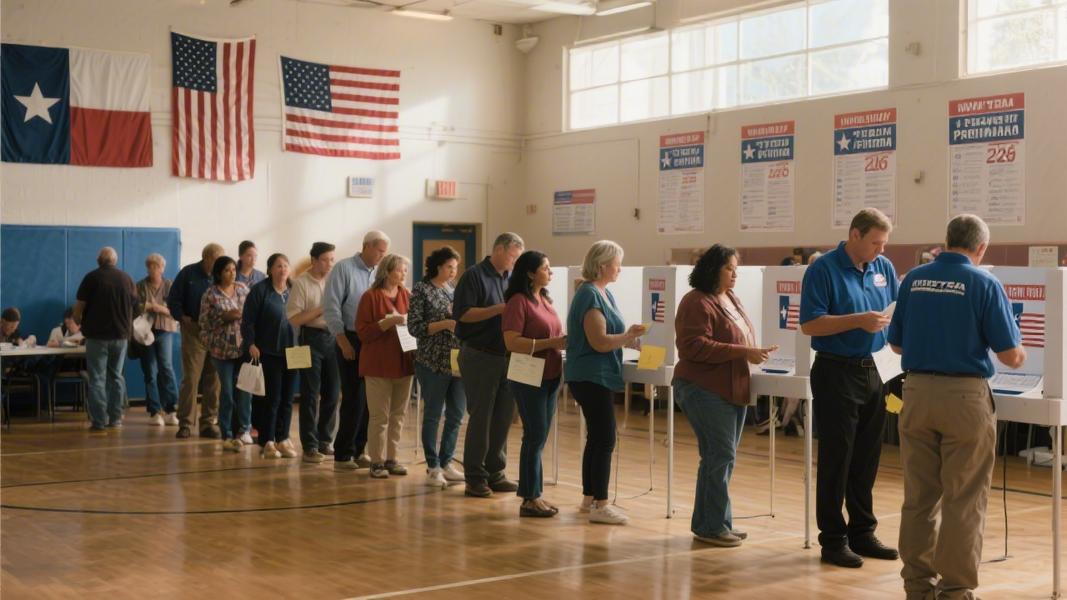
Texas voters head to the polls Tuesday in what’s shaping up to be one of the most consequential primary days the state has seen in years — and at least one U.S. Senate race looks almost certain to end without a winner.
Polls open statewide at 7 a.m. and close at 7 p.m. on March 3, 2026, with races stretching from the U.S. Senate down to hotly contested congressional districts across the Dallas-Fort Worth metroplex. The results could reshape Texas’s political landscape heading into the November 3 general election — but for some races, Tuesday is just round one.
The Senate Race Nobody Can Call
The marquee contest is the Republican primary for U.S. Senate, and it’s genuinely a mess — in the most compelling way possible. Incumbent Senator John Cornyn is fighting off a fierce challenge from former Attorney General Ken Paxton, with Congressman Wesley Hunt pulling enough support to complicate everything.
The polling splits are striking. Cornyn leads among early voters, 38% to 34%, while Paxton holds a 12-point advantage among likely Election Day voters, 44% to 32%, according to Emerson College polling. That kind of split — where who votes and when matters enormously — makes projections nearly impossible.
In the broader polling average, Paxton holds a 39% to 36% edge over Cornyn, with Hunt averaging around 18%. That math, as analysts at 270toWin note, “all but ensures this contest will go to a May runoff.” Texas requires a candidate to clear 50% to avoid one. Nobody’s close.
Still, don’t count anything out. Election Day turnout could scramble the numbers entirely — and Paxton’s strength among in-person voters is the kind of variable that tends to surprise people.
What You Need to Know Before You Vote
Here’s something a lot of Texans don’t realize: you don’t have to be a registered Republican to vote in the Republican primary, or a Democrat to vote in the Democratic one. Texas is one of just 15 states with completely open primaries, meaning any registered voter can walk in and choose whichever party’s ballot they want, no party membership required, as reported by Fox 4.
That’s not a loophole — it’s the law. And it matters in races this close.
Voters can also bring printed sample ballots or written notes into the polling place. Just don’t plan on scrolling through your phone for guidance once you’re inside — that’s not allowed. Download the sample ballot from your county’s election website ahead of time and print it out if you want a reference.
Run into trouble? The Texas Secretary of State’s office operates a toll-free election hotline at 1-800-252-VOTE (8683), and questions can also be sent to [email protected].
A Reshuffled Map, Familiar Names
Congressional redistricting has turned several DFW-area House races into something of a political chess match. In U.S. House District 30, Representative Jasmine Crockett is vacating her seat to chase the Democratic Senate nomination, leaving three Democrats and four Republicans competing for a district that now spans mostly southern Dallas County and a sliver of Tarrant County.
Meanwhile, the newly drawn District 33 has produced a genuinely unusual matchup: current Representative Julie Johnson — who holds the 32nd district seat — is running against former Representative Colin Allred, who gave up the 33rd seat to run for Senate in 2024. Redistricting, in other words, has put two members of the same party on a collision course.
And then there’s District 25, where Dione Sims is making a run for Congress. Sims is the granddaughter of Fort Worth legend Opal Lee — the activist whose decades of advocacy helped make Juneteenth a federal holiday. It’s the kind of biographical detail that doesn’t come along often in a down-ballot primary race.
Looking Ahead
Whatever Tuesday brings, it’s unlikely to bring resolution — at least not everywhere. A Senate runoff in May looks almost inevitable, and the downstream effects of redistricting will keep shaking out for months. The general election on November 3 is still the finish line, but the road there just got a lot more interesting.
Texas has a way of making primaries feel like the main event. This year, it’s not hard to see why.
