
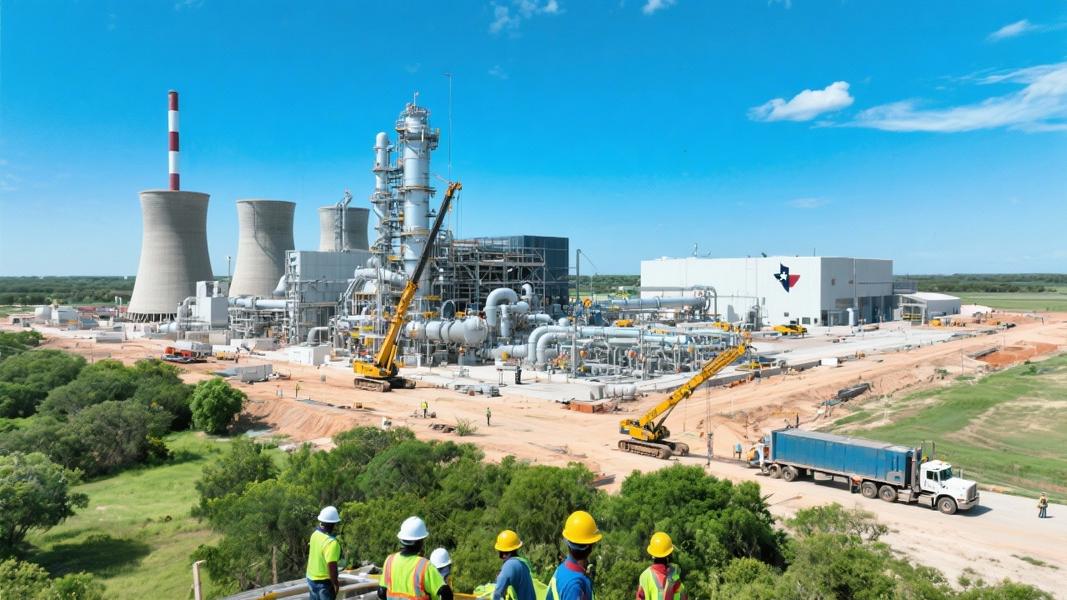
Texas is powering up — again. Governor Greg Abbott announced the fourth major loan agreement through the state’s Energy Fund, this time for a 460-megawatt natural gas power plant in Fairfield that promises to bolster the sometimes-strained ERCOT grid before summer 2026.
The new facility, to be built by Calpine Corporation in Freestone County, represents another significant step in Texas’ aggressive push to expand its power generation capacity amid soaring energy demands and lingering concerns about grid reliability following the catastrophic 2021 winter storm.
“Texans across our great state are benefiting from the reliable, affordable power that the Texas Energy Fund is helping add to the state grid, with hundreds of megawatts coming online,” said Governor Abbott. “This 460 MW investment will further grow our power supply and keep prices affordable for homes and businesses in North Texas. We will ensure continued reliability for all Texans as we add more power and fortify the state grid,” he added.
Growing the Grid, One Plant at a Time
The Calpine project isn’t just a one-off effort. It’s part of a broader strategy that has already yielded impressive results, according to state officials. Public Utility Commission Chairman Thomas Gleeson highlighted that the Texas Energy Fund has now facilitated nearly 1,800 megawatts of new, reliable power generation — with more projects already in the pipeline.
“We are investing in the future of every region of our state and strengthening the foundation for continued electric reliability and growth,” Gleeson stated.
The financial details underscore the scale of the investment. The total cost for the 460 MW project is estimated at $464 million, with the Texas Energy Fund providing a $278.3 million loan at a favorable 3% interest rate. This covers roughly 60% of the project costs, with repayment scheduled from October 2026 through December 2045.
Calpine Executive Vice President Caleb Stephenson emphasized the plant’s quick-response capabilities. “This 460-megawatt, state-of-the-art facility is designed to start within minutes and will deliver safe, reliable power exactly when Texans need it most,” he explained. “We’re grateful for the leadership of Governor Abbott and the Texas Legislature and for their dedication to keeping energy reliable and affordable for all Texans.”
Ambitious Plans, Growing Challenges
But is Texas’ energy expansion plan working as smoothly as officials suggest?
The Texas Energy Fund, created through Senate Bill 2627 and approved by voters in November 2023, has an impressive $9 billion appropriated for the 2025-2028 fiscal years. The program’s central goal is to strengthen ERCOT’s supply of on-demand power through competitive awarding of loans.
Previous recipients include a 456 MW natural gas plant by NRG and a 122 MW plant by Kerrville Public Utility Board. Currently, 13 additional applications representing over 7,200 MW of proposed new generation capacity are under due diligence review.
That said, the program hasn’t been without setbacks. As of August 2025, seven of the 25 loan applications that advanced to due diligence have been withdrawn by the companies that filed them. These withdrawals stem from various issues including supply chain disruptions and concerns about future profitability, according to a recent Texas Tribune report.
The PUC describes the fund’s purpose as providing “grants and loans to finance the construction, maintenance, modernization, and operation of electric facilities in Texas” — a broad mandate that reflects the state’s determination to avoid repeating the widespread outages that left millions without power during Winter Storm Uri.
The Road Ahead
For Calpine and other energy producers, the Texas Energy Fund represents a significant opportunity. The Pin Oak Creek Energy Center in Freestone County joins a growing roster of dispatchable power sources — facilities that can be turned on and off as needed, unlike wind and solar which depend on weather conditions.
As Texas continues to grow at a breakneck pace, with massive data centers and manufacturing facilities adding unprecedented demand to the grid, the state’s ability to bring new generation online quickly has become an economic imperative as much as a public safety concern.
“The Texas Energy Fund is accomplishing exactly what the Governor and the Texas Legislature envisioned,” Chairman Gleeson has noted. But with rising costs, supply chain issues, and the complex economics of power generation, the path to a fully fortified Texas grid remains a work in progress — albeit one that’s now 460 megawatts closer to completion.
