
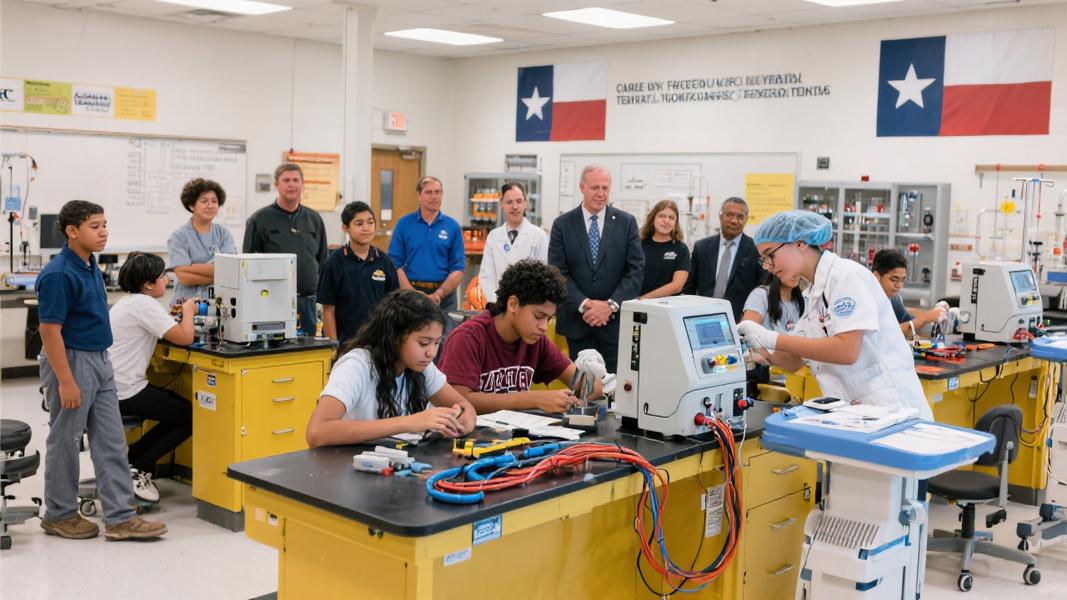
Texas just doubled down on its commitment to career readiness with a significant financial boost for South Texas schools. Governor Greg Abbott announced over $1.6 million in Jobs and Education for Texans (JET) grants awarded to seven educational institutions, targeting high-demand occupational training for nearly 500 students.
“Texas continues to support career and technical training programs to ensure young Texans have the tools necessary to be competitive in high-demand industries,” said Governor Abbott. “The over $1.6 million in job training grants will help prepare students in South Texas to go directly from graduation into good-paying careers.”
The funding, administered by the Texas Workforce Commission (TWC), aims to equip 482 students with skills for critically needed occupations including licensed practical and vocational nursing, registered nursing, electrical work, automotive service, and chemical plant operations. It’s part of a broader push to align education with workforce demands in a state known for its economic growth and business-friendly environment.
Building a Skills Pipeline
TWC Chairman Bryan Daniel emphasized the practical impact of these investments. “Today’s JET grants will help more than 480 young Texans build the confidence, skillset, and experience for critically in-demand careers,” Daniel noted. “TWC is investing in a dynamic workforce system that will continue to energize our growing economy by making businesses more competitive.”
The grants primarily cover startup costs for equipment in Career and Technical Education (CTE) programs. This approach ensures students train on industry-standard technology, making the transition from classroom to workplace more seamless. Each piece of purchased equipment must be directly used for training students in these high-demand occupations.
What’s driving this investment? Texas faces significant workforce gaps in several sectors, with employers consistently reporting difficulties finding qualified candidates for technical positions. The JET program attempts to address this mismatch by creating direct pathways from education to employment.
Part of a Larger Workforce Strategy
The South Texas announcement follows a similar initiative in May 2025, when Abbott allocated over $1.5 million to five San Antonio area schools. Those funds targeted training for more than 650 students in fields including software development, nursing, and welding.
“The JET program provides cutting-edge technology for students to train for high-demand occupations,” Chairman Daniel explained during that announcement. “TWC continues to support valuable CTE training across the state to develop the workforce needed to meet the demands of Texas’ diverse industries.”
But these regional investments pale in comparison to the statewide push announced in December 2024. That’s when Abbott unveiled a massive $15 million in career training grants awarded to 60 higher education institutions and independent school districts across Texas, aiming to train nearly 7,000 students in the first year alone.
“This $15 million in career training grants will support career and technical training programs for thousands of Texas students across our great state,” the governor remarked at the time. “The work being done at the Texas Workforce Commission and in our educational institutions across Texas ensures Texans have opportunities that lead to a better job and a bigger paycheck.”
Economic Growth Driving Demand
The JET program, funded biennially by the Texas Legislature, has become an increasingly important tool as the state’s economy continues to diversify and grow. Chairman Daniel has repeatedly connected economic expansion with workforce development needs.
“As the Texas economy grows, so does the demand for a skilled workforce,” he stated. “The JET grant program helps meet that demand by providing opportunities for Texans to gain valuable, hands-on experience that will prepare them to step into those high-demand careers.”
For the 482 South Texas students who will benefit from this latest round of funding, the grants represent more than just educational equipment. They offer a concrete path toward stable careers in industries hungry for qualified workers – and potentially, a ticket to economic mobility in a state that prides itself on opportunity.
