
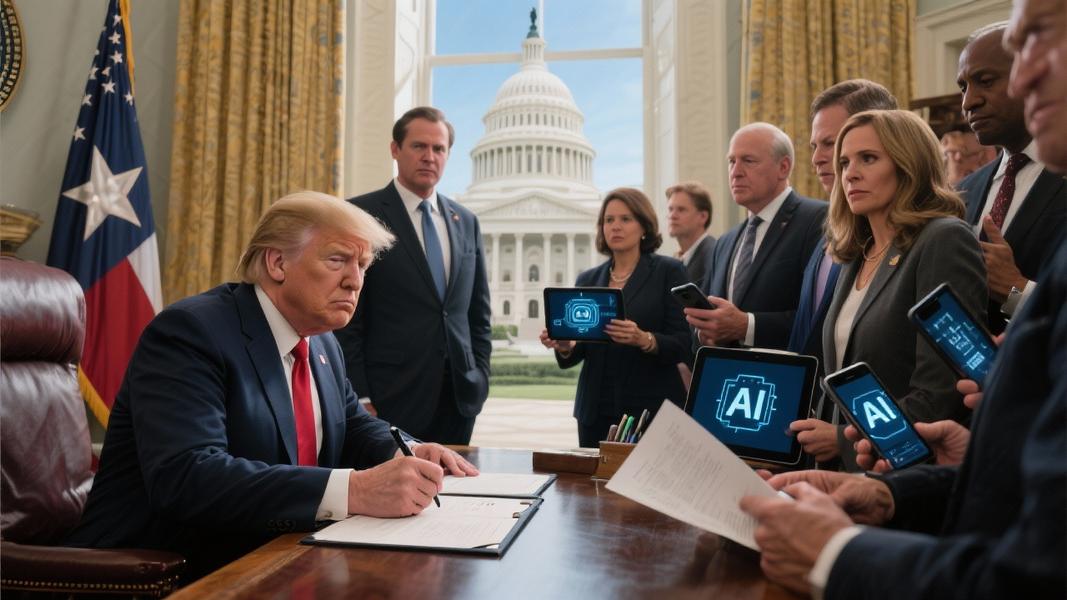
Texas State Sen. Angela Paxton is leading a rebellion against the Trump administration’s executive order that would strip the state of billions in federal broadband funding over its artificial intelligence law, setting up a stark battle over states’ rights in the emerging AI landscape.
The conflict erupted after President Trump signed an executive order on December 11 that threatens to withhold $3.3 billion in federal funding from Texas due to its recently enacted Responsible AI Governance Act (TRAIGA). The state law, which takes effect January 1, 2026, aims to regulate AI systems to prevent discrimination, protect children, and maintain privacy standards — measures Paxton and other Texas lawmakers insist they won’t abandon.
“I don’t think we should stop moving on our policies to protect our kids, consumers, privacy, and infrastructure the way we see fit in Texas before there is meaningful federal legislation,” Paxton stated. “We can’t be handcuffed by the federal government.”
States’ Rights vs. Federal Control
The showdown highlights growing tensions between state-level AI regulation efforts and the federal government’s push for unified national standards. Texas lawmakers, led by Paxton, have sent a letter to U.S. Senators Ted Cruz and John Cornyn warning that a federal AI moratorium would effectively nullify the state’s progress on critical issues.
“If an AI moratorium is put in place, our important work on preventing child pornography, protecting data privacy, preventing discrimination, and holding Big Tech accountable in Texas will be rendered moot,” the letter reads. “Surely we can all agree that these kinds of state protections do not interfere with legitimate innovation and are reasonable and appropriate.”
What’s particularly striking about this conflict? It pits Republican state officials against a Republican president, with Senator Ted Cruz surprisingly siding with Trump despite his typical defense of states’ rights.
Cruz has publicly supported withholding federal funding from states with AI regulations and stood beside Trump during the executive order signing. “We don’t want China’s values of surveillance and centralized control by the communist government governing AI. We want American values of free speech of individual liberty and respecting the individual,” Cruz declared.
Inside Texas’s AI Law
TRAIGA, formally known as House Bill 149, was signed into law on June 22, 2025, after passing with bipartisan support in the Texas legislature. The comprehensive legislation prohibits AI systems from being used to incite self-harm, crime, discrimination, create child pornography, generate deepfakes, or misuse biometric data, according to legislative documents.
The law also establishes a Texas Artificial Intelligence Council and creates a regulatory sandbox allowing companies to test AI innovations for up to 36 months under controlled conditions. Enforcement is limited to the state attorney general, who can impose fines of up to $200,000 for violations, as outlined in the legislation.
Its broad definition of AI systems covers technology that “performs tasks that would otherwise require human intelligence” and applies to developers and deployers doing business in Texas or serving its residents, with specific exceptions for child safety measures, according to legal analysis.
Brendan Steinhouser, CEO of The Alliance for Secure AI, has emerged as another vocal critic of federal preemption. “Federal preemption would undo this good work, restricting lawmakers from making good policy decisions for Texans,” he warned. “This would be a massive disservice to our children, families, and workers. Federalism is a core constitutional principle of this country.”
Constitutional Showdown Looms
The Trump administration’s executive order doesn’t just threaten funding — it also establishes an AI Litigation Task Force that could potentially challenge state laws like Texas’s in court. This sets the stage for what could become a significant constitutional battle over federalism and states’ rights in the digital age.
Texas state senators made their position clear in their letter to Cruz and Cornyn: “The states must not be handcuffed during a crisis, awaiting the federal government to do what states can and should do for themselves,” they wrote.
With $3.3 billion in broadband funding hanging in the balance and the January 1 implementation date approaching, neither side appears ready to back down. The clash underscores the challenges of regulating rapidly evolving technology in America’s federal system — where innovation, safety concerns, and constitutional principles all compete for priority in shaping the artificial intelligence landscape.
