
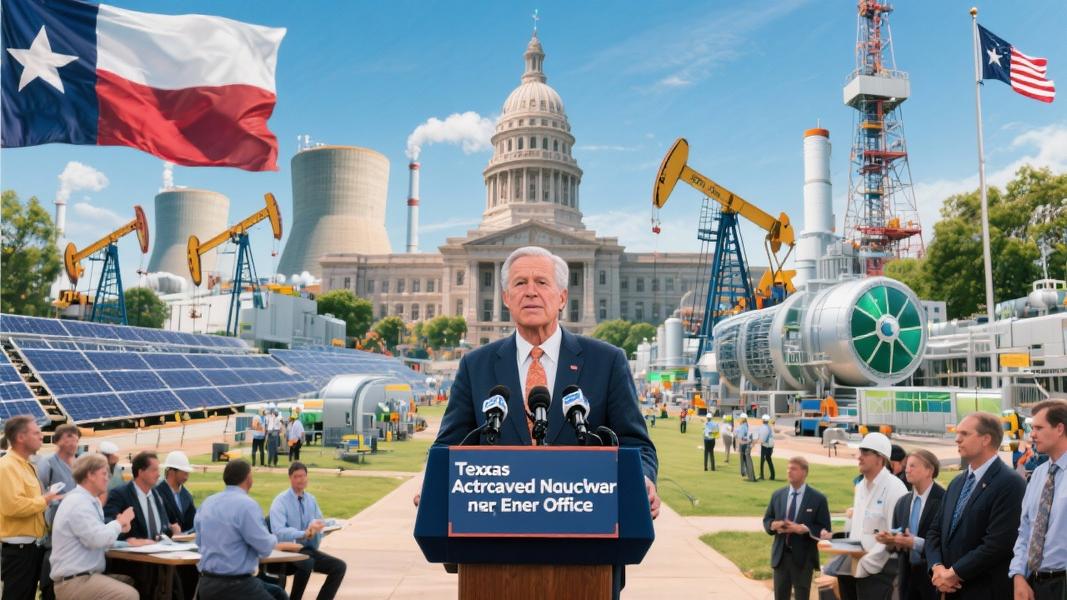
Texas, long known for its oil and gas industry, is rapidly transforming into America’s renewable energy powerhouse, with explosive growth in solar capacity and an increasingly diverse electricity generation portfolio that’s reshaping the nation’s energy landscape.
The Lone Star State now accounts for a staggering 13% of total U.S. electricity generation in 2024, producing more than twice as much electricity as Florida, the second-largest generating state, according to data from the U.S. Energy Information Administration (EIA) shows.
Solar Surge Leads Renewable Revolution
Texas’s transformation is perhaps most visible in its solar sector, which has experienced meteoric growth. Solar generation reached 48 terawatt-hours (TWh) in 2024, adding a remarkable 16 TWh year-over-year — the fastest growth among all generation types, the Dallas Federal Reserve reports.
“Solar power has generated 45 terrawatt hours of electricity so far this year—50 percent more than the same period in 2024 and nearly four times more than the same period in 2021,” Inside Climate News notes regarding the first nine months of 2025.
This explosive growth has pushed solar to account for 8% of Texas’s total electricity generation in 2024, exceeding nuclear power generation for the first time, according to EIA data.
Wind Dominance Continues
While solar grabs headlines for its rapid growth, Texas maintains its dominant position in wind energy. The state “leads the nation in wind electricity generation, accounting for 28% of the U.S. total in 2024,” the EIA confirms.
As of the end of 2024, Texas boasted an impressive 42,000 megawatts (MW) of wind power capacity, alongside 22,000 MW of solar farms and 6,500 MW of utility-scale battery storage, the Power Alliance revealed.
Together, these renewable resources are providing an increasingly significant portion of Texas’s electricity. “Wind and solar farms generating roughly 30% of the state’s electricity in 2024,” up from around 18% in 2019, according to Power Alliance figures.
And the trend is accelerating. “Together, wind and solar generation met more than one third of ERCOT’s electricity demand in the first nine months of this year,” Inside Climate Power states, referring to the Electric Reliability Council of Texas, which manages about 90% of the state’s electric load.
Natural Gas Still Dominates, But Losing Share
Despite the renewable surge, natural gas remains Texas’s largest electricity source. It met 43% of demand in 2025, though that’s down from 47% in the first nine months of 2023-2024, Inside Climate News indicates.
The shift is particularly noteworthy given Texas’s reputation as an oil and gas stronghold. But economics and practicality, rather than purely environmental concerns, appear to be driving the transition.
Unprecedented Growth Since 2019
Just how dramatic has Texas’s renewable transformation been? Since 2019, Texas power companies have increased solar generation capacity by an astonishing 800%, wind capacity by 50%, and battery storage capacity by an eye-popping 5,500%, the Power Alliance calculates.
And developers aren’t slowing down. “Power plant developers plan to add 11,600 megawatts of utility-scale solar generating capacity in the state during 2025 and 13,100 megawatts in 2026,” according to the EIA projection.
For perspective, new additions to Texas power generation in 2025 are forecast to be 54% solar and 35% battery storage, the Dallas Fed predicts.
Skyrocketing Demand Creates Challenges
But can even this explosive growth keep up with Texas’s equally dramatic increase in electricity demand?
Unlike the rest of the country, Texas’s energy consumption rose 21% between 2007 and 2023, while U.S. overall energy use fell 5% during the same period, Mansfield Energy highlights.
The EIA “expects Texas’s electricity use to grow rapidly through 2025 and 2026, driven by new data centers and cryptocurrency operations connecting to the grid,” Mansfield adds.
This creates a concerning outlook. “BloombergNEF’s forecasts show that in 10 years, Texas’ supply will no longer be able to keep up. There will be an imbalance if demand continues to march on at the same pace,” Inside Climate News cautions.
Some analysts believe the timeline could be even shorter. “The Texas Power Grid capacity is expected to be eclipsed by demand within the 2026-2027 timeframe without massive increases in infrastructure spending and new construction,” Native Solar warns.
As Texas continues its remarkable renewable energy expansion, the question isn’t whether wind and solar will play a major role in the state’s energy future — they already do. The real challenge is whether even Texas-sized ambitions for clean energy growth can keep pace with the state’s equally outsized appetite for electricity.
