
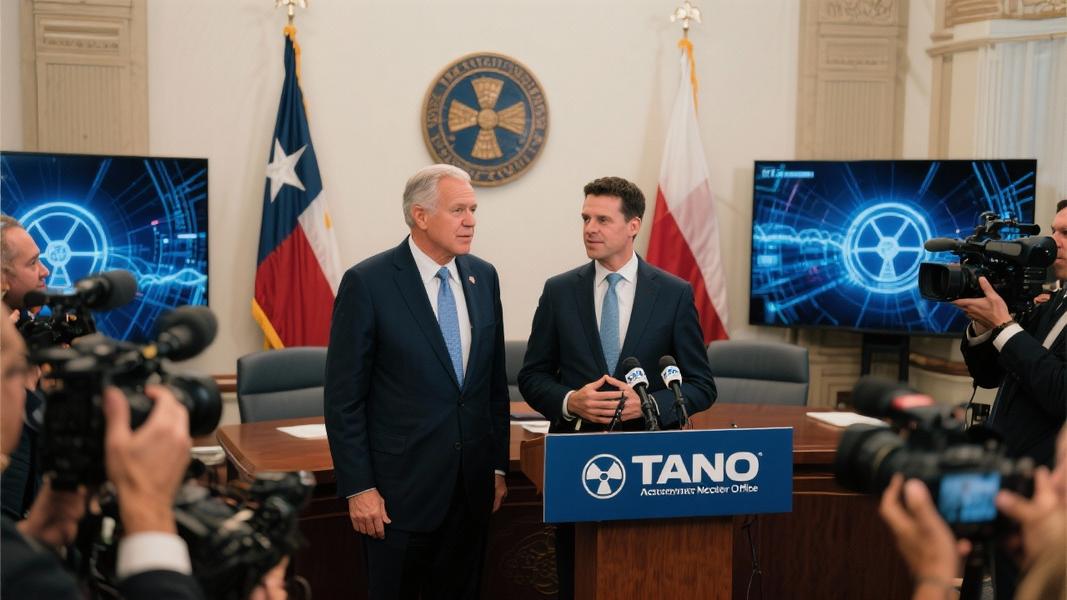
Texas has placed its biggest bet yet on nuclear energy, with Governor Greg Abbott appointing Jarred Shaffer to lead the newly established Texas Advanced Nuclear Office (TANO) — a move that positions the Lone Star State to spearhead what officials are calling a “nuclear renaissance” in America.
The appointment comes as Texas implements House Bill 14, which created both TANO and an unprecedented $350 million Texas Advanced Nuclear Development Fund to jumpstart next-generation nuclear projects. It represents the largest state-level financial commitment to advanced nuclear development in the nation, according to officials.
“The State of Texas continues to build the world’s most robust and diverse energy sector,” Governor Abbott stated when announcing the initiative. “TANO and the Texas Advanced Nuclear Development Fund will increase Texas’ investment in an all-of-the-above energy approach to solidify Texas as the world’s energy hub.”
Big Money, Big Ambitions
Just how serious is Texas about nuclear? The legislation provides grants of up to $200 million for eligible advanced reactor construction projects — a figure that dwarfs similar initiatives in other states. The bill also creates a nuclear permitting coordinator position tasked with streamlining the notoriously complex approval process for new facilities, as reported by industry observers.
For a state facing rapidly increasing electricity demands amid population growth and industrial expansion, nuclear power offers what supporters see as an ideal solution: reliable, carbon-free baseload power generation that doesn’t depend on weather conditions.
The Texas Nuclear Alliance has applauded the initiative, noting that it aligns with Governor Abbott’s vision to position “Texas to lead a nuclear power renaissance in the United States.” The organization points to advanced nuclear reactors as providing the reliability Texas needs as electricity demand surges.
Building an Industry From Scratch
Perhaps most remarkable is how quickly the nuclear sector is taking root in Texas. Industry membership has exploded from zero members in 2023 to over 50 members today, according to Shaffer, who called the development fund “the largest of its kind in the nation.”
But what good is investment without workers? That’s where Senate Bill 1535 comes in, establishing the framework for a skilled nuclear workforce through educational programs and public-private partnerships. The bill authorizes the Texas Workforce Commission to develop higher education curricula and certificate programs specifically designed to “prepare students for high-wage jobs in the advanced nuclear energy industry.”
When Abbott signed the legislation, he emphasized the economic potential: “This initiative will also strengthen Texas’ nuclear manufacturing capacity, rebuild a domestic fuel cycle supply chain, and train the future nuclear workforce.”
A Nuclear Summit on the Horizon
Looking ahead, industry stakeholders are planning the Texas Nuclear Summit for October 2025, intended to unite the growing ecosystem of companies, officials, and advocates under the shared goal of advancing nuclear energy in the state. The summit’s website prominently features Abbott’s rallying cry: “It’s time for Texas to lead a nuclear power renaissance in the United States,” as highlighted on promotional materials.
While other states like Wyoming, Washington and Tennessee have made moves to embrace advanced nuclear technologies, none have matched Texas in terms of financial commitment or institutional infrastructure. The $350 million fund represents serious skin in the game from a state known for its traditional energy dominance.
For Shaffer, who now takes the helm at TANO, the challenge will be translating this ambitious vision into concrete projects on the ground. Nuclear projects are notoriously slow and expensive to develop, even with streamlined permitting. And despite the enthusiasm, questions remain about how quickly these next-generation reactors can be deployed at scale.
Still, in a state that prides itself on energy leadership, the nuclear push represents more than just diversification — it’s a declaration that Texas intends to dominate the energy landscape of tomorrow just as it has today.
