
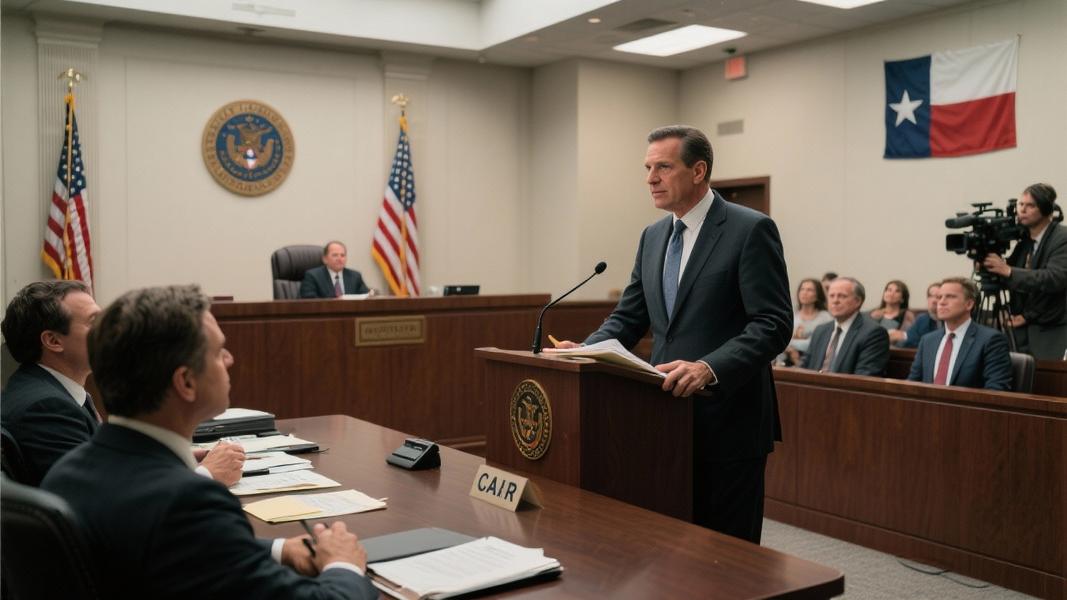
Texas Attorney General Ken Paxton has fired back against a lawsuit challenging Gov. Greg Abbott’s controversial designation of the Council on American-Islamic Relations (CAIR) as a terrorist organization, setting the stage for what could become a protracted legal battle over state powers and civil liberties.
In a legal filing this week, Paxton denied nearly every allegation made by the DFW and Austin CAIR chapters, arguing that federal courts lack jurisdiction because Abbott’s November proclamation is strictly a state matter. The designation effectively prohibits CAIR from purchasing land in Texas and subjects the organization to heightened enforcement measures under state law.
“Radical Islamist terrorist groups are anti-American, and the infiltration of these dangerous individuals into Texas must be stopped,” Paxton declared in a statement defending the governor’s action. “My office will continue to defend the Governor’s lawful, accurate declaration that CAIR is an FTO, as well as Texas’s right to protect itself from organizations with documented ties to foreign extremist movements.”
Escalating Tensions
Abbott’s November 18 proclamation specifically classifies CAIR as a “successor organization” of the Muslim Brotherhood and designates it as a Foreign Terrorist Organization under Texas Penal Code. The move represents a significant escalation in what has become a series of legal confrontations between the Republican governor and the Muslim civil rights organization.
The governor didn’t stop at the proclamation. He also requested that U.S. Treasury Secretary Scott Bessent investigate CAIR and suspend its 501(c)(3) tax-exempt status, citing documents that allegedly identify it as a subsidiary of the Muslim Brotherhood and a front for Hamas.
But CAIR isn’t backing down. The organization has sued Florida Governor Ron DeSantis over a similar executive order, framing its legal challenge as a defense of constitutional rights. “This is still America, where due process, free speech and other rights guaranteed by the Constitution matter,” CAIR Litigation Director Lena Masri said in a statement accompanying that lawsuit.
A Pattern of Conflict
Is this just the latest chapter in an ongoing political saga? According to CAIR, Abbott’s actions represent a pattern of targeting the organization for its criticism of Israeli policies.
Masri claims the organization has successfully defeated Abbott three previous times for attempting to violate First Amendment protections by punishing critics of the Israeli government. These legal victories appear to have done little to deter the governor’s latest efforts.
CAIR representatives have vigorously pushed back against the terrorist designation. “CAIR is an independent American civil rights organization that has spent 31 years speaking up against all forms of unjust violence, including hate crimes, terrorism, war crimes, ethnic cleansing, and genocide,” CAIR spokesman Ibrahim Mitchell stated, adding that “CAIR condemned terrorism so often that ISIS called for the assassination of our leadership.”
Mitchell further emphasized what he described as the organization’s moral consistency: “CAIR has strongly condemned the Israeli government’s decades of violent oppression against the Palestinian people, and CAIR has also condemned Hamas violence against Israeli civilians, from suicide bombings in the 1990s to attacks on Oct. 7th.”
Constitutional Questions
The case raises fundamental questions about state authority to designate domestic organizations as terrorist groups and the constitutional protections afforded to such organizations. Legal experts suggest that courts will need to weigh competing claims of state security interests against First Amendment protections.
For now, the battle lines are drawn. Abbott’s administration appears determined to enforce its designation, while CAIR has signaled it will fight what it characterizes as government overreach and retaliation for protected speech.
As the legal process unfolds, the case could potentially establish important precedents regarding the limits of state power in national security matters traditionally reserved for federal authorities — and whether a governor can effectively declare an American civil rights organization an enemy of the state.
