
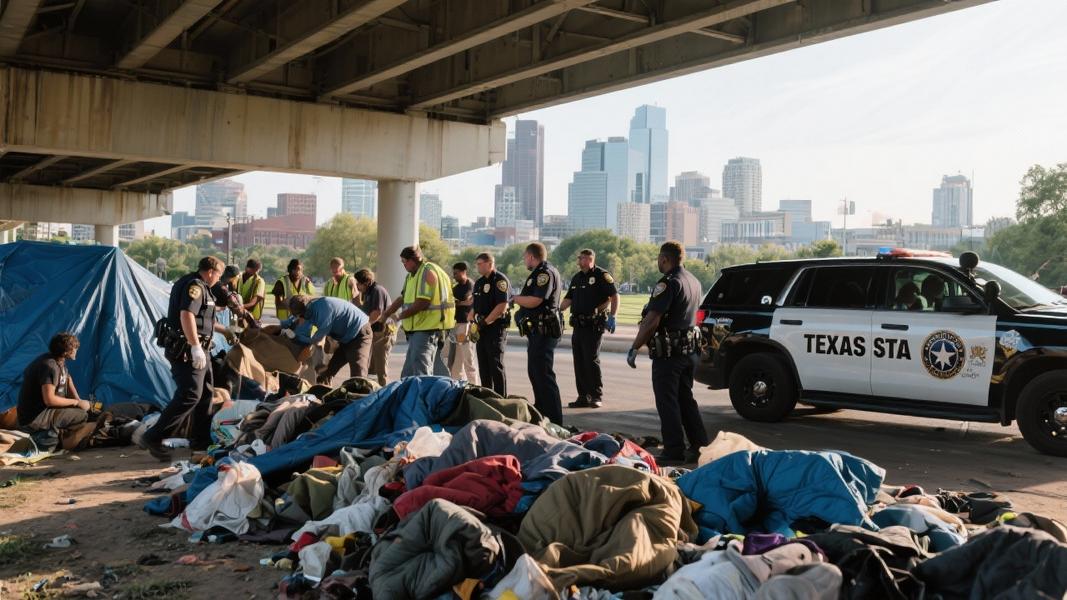
Texas Governor Greg Abbott has launched a sweeping state operation to clear homeless encampments throughout Austin, resulting in dozens of camp removals, multiple felony arrests, and the confiscation of drugs and weapons in just the first week.
The initiative, which began late last week, mobilizes several state agencies including the Texas Department of Public Safety, Texas Department of Transportation, Texas State Guard, and the Texas Department of Criminal Justice to address what the governor describes as “public safety risks” posed by homeless encampments on city and state property.
“Texans should not endure public safety risks from homeless encampments and individuals,” Abbott declared in a statement announcing the operation. “Weapons, needles, and other debris should not litter the streets of our community, and the State of Texas is taking action.”
Immediate Impact and Arrests
The operation has moved quickly. State officials have already removed 48 encampments and cleared more than 3,000 pounds of debris from public areas across Austin, according to the governor’s office. But it’s the law enforcement aspect of the operation that’s drawing particular attention.
During the cleanup efforts, authorities have arrested 24 individuals identified as repeat felony offenders and seized over 125 grams of narcotics. Ten people were found with outstanding warrants — some flagged as “armed and dangerous” with violent tendencies — including one person wanted for aggravated escape from custody in another state, the governor’s office revealed.
Abbott has emphasized that the state’s involvement is primarily focused on public safety concerns, particularly addressing crime associated with homeless encampments. “I directed state agencies to address this risk and make Austin safer and cleaner for residents and visitors to live, travel, and conduct business,” he said.
A Cycle of Displacement?
What happens to those displaced by these sweeps?
Previous reporting suggests that while state cleanups remove property and debris — including larger items like tents and chairs — there’s no law preventing people from returning and reestablishing camps after authorities leave. This has led to criticism that such operations merely displace vulnerable populations without addressing root causes.
“We’ve lost it all before. Years of tools, years of time,” said Ray, a homeless resident, in earlier coverage of similar sweeps. “Everybody out there is one mortgage payment away from being out here with us.”
This isn’t Abbott’s first attempt to address homelessness in Austin. In a previous initiative, the governor established an encampment on state-owned land called “Esperanza Community” to provide housing for people experiencing homelessness. However, that site has reportedly reached capacity, forcing some to live beyond its designated borders.
“The residents have organized and christened the encampment ‘Esperanza Community,’ and another nonprofit, The Other Ones Foundation, has started providing services for the people who live there,” according to Texas Tribune reporting.
State vs. Local Approaches
The governor’s intervention comes amid ongoing efforts by Austin’s local authorities to address homelessness through their own initiatives. The city’s Homeless Strategy Office continues to implement funding, prevention programs, shelter activation during cold weather, and what they describe as compassionate relocation from encampments, according to city officials.
Abbott has repeatedly signaled his willingness to intervene in Austin’s policing and homelessness policies. “Gov. Greg Abbott has said over and over that the State could get involved in Austin’s policing and homeless policies,” as one local news outlet noted, with the governor insisting “it’s all about safety.”
The tension between state and local approaches highlights the complex nature of addressing homelessness — balancing immediate public safety concerns with long-term solutions for those experiencing housing insecurity.
For now, as state agencies continue their sweeps across Austin, the question remains whether this approach will produce lasting change or simply move vulnerable populations from one location to another, leaving both the displaced individuals and the underlying issues to resurface elsewhere.
