
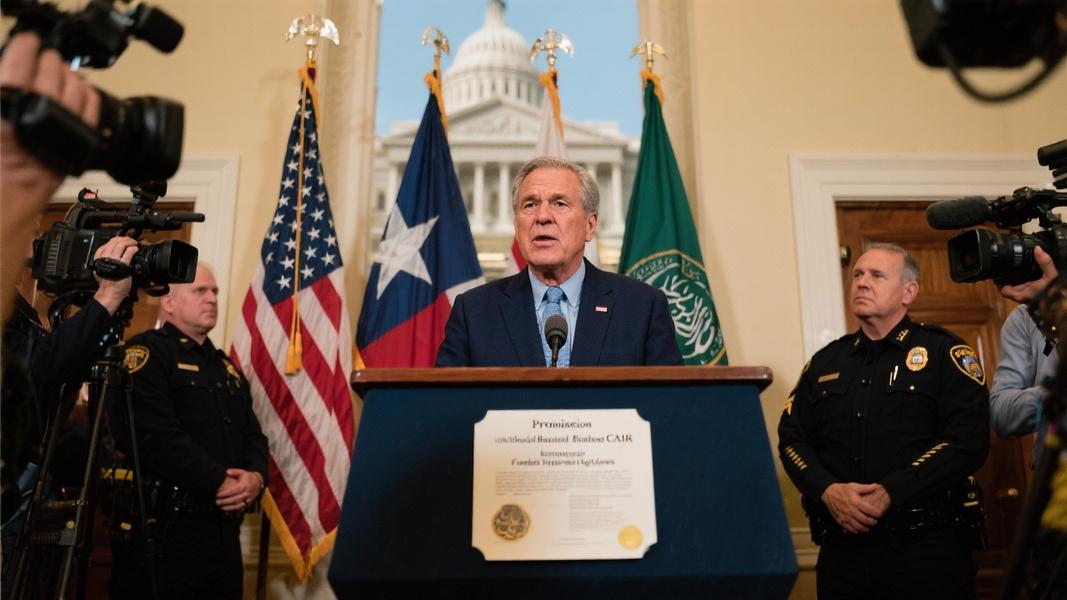
In a sweeping move that sent shockwaves through religious and civil rights communities, Texas Governor Greg Abbott has officially designated the Muslim Brotherhood and the Council on American-Islamic Relations (CAIR) as foreign terrorist organizations and transnational criminal organizations in the state, effective November 18, 2025.
The executive action, announced through the governor’s office, prohibits both organizations from purchasing or acquiring land in Texas and grants state authorities expanded powers to target their operations. It represents one of the most aggressive state-level actions against Islamic organizations in recent memory.
Political and Legal Ramifications
“The Muslim Brotherhood and CAIR have long made their goals clear: to forcibly impose Sharia law and establish Islam’s ‘mastership of the world,'” Abbott declared in his statement. “The actions taken by the Muslim Brotherhood and CAIR to support terrorism across the globe and subvert our laws through violence, intimidation, and harassment are unacceptable.”
The legal framework for this designation stems from Senate Bill 17, which empowers the governor, after consulting with the Department of Public Safety, to classify foreign groups or transnational criminal organizations as prohibited entities in Texas. Once designated, these organizations are barred from acquiring real property in the state and may face legal action under Texas’ anti-gang and anti-terrorism statutes.
Why now? The timing comes amid heightened scrutiny over Islamist influence in Texas, including recent controversies surrounding proposed Islamic communities like EPIC City (since rebranded as The Meadow). The designation also aligns with federal efforts, including the Muslim Brotherhood Terrorist Designation Act of 2025, sponsored by Texas Senator Ted Cruz, which would require the President to designate the Muslim Brotherhood as a foreign terrorist organization nationally.
Organizations Under Fire
CAIR describes itself as an organization dedicated to “enhance understanding of Islam, protect civil rights, promote justice, and empower American Muslims.” But the group has faced intense scrutiny over the years, including being named an unindicted co-conspirator in what federal prosecutors called the largest terrorism financing case in U.S. history. The FBI severed formal ties with the organization in 2008, a fact Abbott’s office highlighted in their rationale.
The Muslim Brotherhood, meanwhile, is an international movement that has advocated for the application of religious law in Muslim-majority countries. Critics point to its influence in Middle Eastern politics, though evidence of significant organizational presence in the United States has been disputed by many scholars and terrorism experts.
The Texas Attorney General’s office now has authorization to initiate legal action to shut down operations of these designated organizations within state borders — a power that could dramatically reshape the landscape for Muslim advocacy groups across the state.
Reactions and Implications
Reaction to Abbott’s decision has been swift and polarized. Supporters praise it as a necessary security measure, while critics see it as potentially unconstitutional overreach targeting religious minorities.
What happens next? Legal challenges are all but certain, with constitutional questions about religious freedom, due process, and states’ authority to make terrorism designations independently of federal authorities likely to feature prominently.
The designation takes effect immediately, though its practical enforcement remains to be seen as the state develops protocols for implementation. With the Texas Attorney General now empowered to take action against these organizations, the coming weeks will likely see increased scrutiny of Muslim advocacy groups across the Lone Star State.
For now, Abbott’s declaration stands as one of the most aggressive state-level actions against Islamic organizations in recent American history — and a test case for how far states can go in designating and restricting organizations they deem threatening, even without corresponding federal action.
