
Texas Democrats have their tickets — and they’re not waiting around to define the fight.
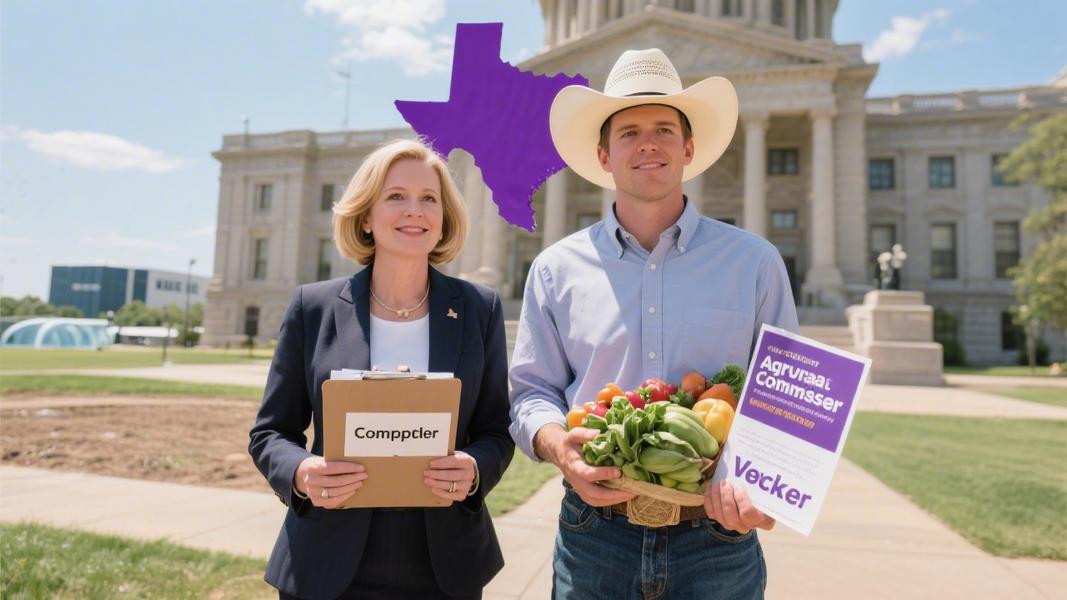
Following the March 3, 2026 primary, the Democratic Party has nominated Sarah Eckhardt for Texas Comptroller and Clayton Tucker for Texas Agriculture Commissioner, setting up two of the most closely watched down-ballot races of the cycle. Both candidates emerged from competitive fields, and both are already sharpening their contrasts with the Republican nominees ahead of November.
Eckhardt Wins Big, Sets Sights on One-Party Rule
Eckhardt, a state senator from Austin, captured the Democratic Comptroller nomination with a commanding 64 percent of the vote in a three-way race — a margin that signals real enthusiasm, or at least a clear lack of it for her opponents. She’ll face Don Huffines, the Republican nominee who won his primary outright, defeating acting Comptroller Kelly Hancock along the way.
Eckhardt’s pitch isn’t subtle. She frames the race less as a partisan contest and more as a referendum on what happens when one party holds the reins of state government for thirty straight years, unchallenged and largely unaccountable. “One-party rule for three decades is not healthy,” she said. “Whether it’s Republican or Democrat. One-party rule, at the very least, tolerates a level of inefficiency and at the worst, it tolerates a level of abuse and is completely resistant to any kind of accountability.”
She’s not pulling punches on Huffines either. While the Republican nominee has leaned into rhetoric about slashing government waste — invoking the so-called DOGE framework — Eckhardt argues that framing masks something more troubling. “While (Republican nominee) Don Huffines talks about ‘DOGE-ing’ and rooting out fraud, waste and abuse, really, he’s talking about destroying government, actually, so that it’s survival of the richest,” she argued. “It is important that we have a level playing field for all Texans, not just for the wealthiest.”
Her policy agenda, if elected, centers on auditing the state’s school voucher program, repatriating federal dollars back to Texas taxpayers, and ending what she describes as the quiet siphoning of public money into private hands through corporate tax breaks and no-bid contracts. It’s a populist argument dressed in fiscal clothing — which, for a Comptroller’s race, might actually be the right wardrobe.
Still, she’s careful not to cast this as a Democrat-versus-Republican culture war. “I think that a purple Texas is a healthy Texas,” Eckhardt noted, “and we can’t expect that a Republican comptroller will be able to speak truth to power and actually say, ‘listen, we need to rebuild this back, y’all.'”
Tucker Takes On Monopolies, Data Centers, and a Surprising Republican Primary
Over on the Agriculture Commissioner side, Clayton Tucker — a farmer by trade — won the Democratic nomination outright on March 3. His opponent in November is Nate Sheets, who pulled off a notable upset in the Republican primary by ousting three-term incumbent Sid Miller. That’s the kind of primary result that scrambles assumptions, and Tucker seems to know it.
Tucker’s platform is built around three words: food, land, and water. Simple enough. But his targets are specific — corporate monopolies driving up grocery costs, and the rapid expansion of data centers onto Texas farmland. He’s not shy about where he thinks the blame lies. “It is not the farmers making the money, it’s the corporate monopolies in Texas,” he declared.
On data centers, Tucker wants a moratorium — a pause on new construction until the state can get a handle on what these facilities are actually consuming. And he’s blunt about what he thinks is driving the buildout. “The ones that are taking our farmland, that are taking our water are nothing,” he said. “They’re not meant to help you, AI. They’re not meant to help our country. They’re meant to enrich the greedy few.”
That’s a pointed message in a state that has aggressively courted the tech industry. Whether Texas voters — including rural ones who’ve watched land values and water tables shift around them — respond to that framing remains to be seen. Tucker’s argument is essentially that the Agriculture Commissioner’s office should be a watchdog for actual Texans who grow things, not a welcome mat for outside investment that extracts resources and leaves.
The Road to November
Two Democrats. Two very different offices. But something connects their campaigns beyond party affiliation — both are running, explicitly, against the idea that Texas’s current trajectory benefits ordinary people. Eckhardt frames it through fiscal accountability. Tucker frames it through soil and water. Together, they’re making a case that Democratic governance isn’t just a partisan preference but a structural corrective.
Whether that argument lands in a state that hasn’t elected a Democrat to statewide office since 1994 is, of course, the question. Texas’s political geography is shifting — but slowly, and not always on schedule with the expectations of national observers who’ve been predicting a purple Texas for years.
Still, Tucker’s own words might be the most honest summary of the bet both candidates are making: “Purple Texas is a healthy Texas.” It’s a slogan. But it’s also a theory of the race — and come November, they’ll find out if enough Texans are buying it.
