
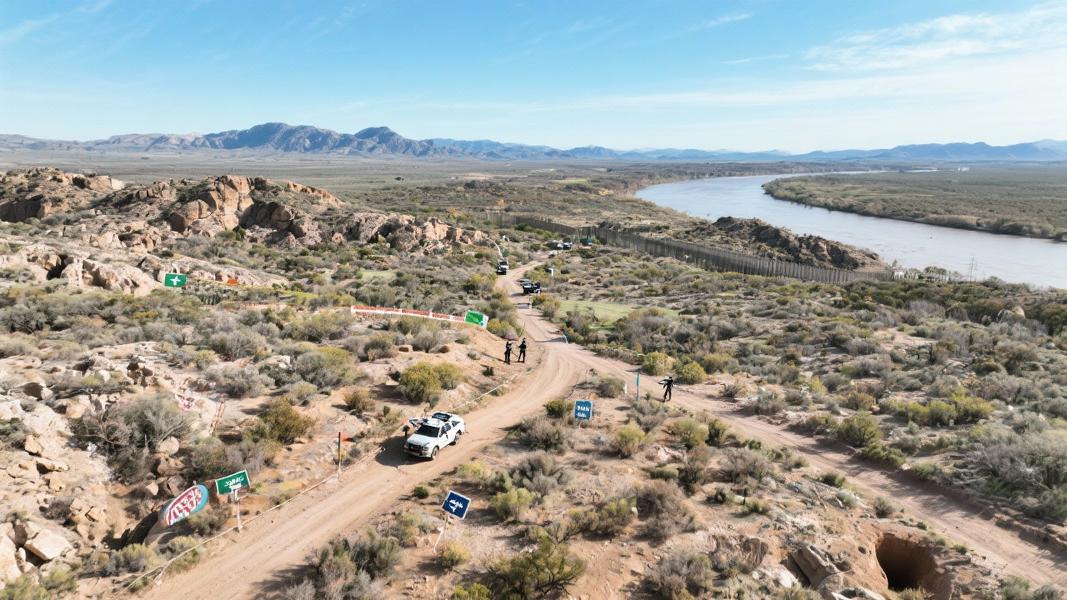
Texas is digging deep — literally — in its latest border security offensive. Land Commissioner Dawn Buckingham has directed staff to hunt for cartel tunnels along the state’s border with Mexico, deploying drones and aerial surveillance to detect underground smuggling routes on state-managed lands.
The initiative, announced by the Texas General Land Office (GLO), focuses particularly on Hudspeth County and other areas deemed vulnerable to subterranean cartel activity. It comes after sophisticated tunnels were discovered in both San Diego and El Paso within the past year, revealing the evolving tactics of transnational criminal organizations.
“Texas stands on the front lines of America’s fight for border security,” Buckingham said. “The cartels are constantly adapting, moving from the skies and waterways to underground networks of tunnels, and we will not cede an inch of land to these violent illegal criminals.”
The El Paso tunnel, discovered earlier this year, wasn’t just some hastily dug hole. Border agents found a sophisticated passage measuring six feet high and four feet wide, complete with wooden support beams, ventilation systems, and electrical lighting. The tunnel entrance had been cleverly concealed beneath a 36-by-36-inch metal plate, according to officials.
Federal Response Ramps Up
The Texas initiative aligns with expanded federal efforts. The Department of Homeland Security has committed over $100 million to enhance its Persistent Surveillance and Detection System along high-risk sections of the southwest border. This technology, managed by Customs and Border Patrol (CBP), began deployment on November 10, 2025, and is expected to be fully operational by 2026.
Contractors are currently being sought to help implement the new detection systems. The federal project comes after President Trump’s administration designated Mexican cartels as foreign terrorist organizations, granting broader authority for law enforcement and intelligence operations against these groups.
Why the urgency? Beyond enabling drug and human smuggling, these tunnels pose significant infrastructure risks. Officials warn that poorly constructed passages could collapse, potentially disrupting water systems and roadways above them.
Texas Takes the Lead
The tunnel detection program represents just the latest in a series of aggressive border security measures undertaken by Commissioner Buckingham’s office. In 2023, she declared the 170-acre Fronton Island state land and coordinated with Texas law enforcement to clear vegetation, dramatically reducing criminal activity in what had been a notorious border hotspot.
Last October, the GLO acquired a 1,402-acre ranch along the Rio Grande in Starr County explicitly for border wall construction. Within 24 hours, Buckingham had signed an agreement authorizing the Texas Facilities Commission to begin building. By January 2025, 1.5 miles of border wall had been completed on the property.
“We’re going to step up surveillance, engage with new technologies, and partner with federal officials to detect and eliminate these tunnels,” Buckingham explained of the latest initiative. Her office has also offered newly acquired land for deportation facilities to support federal immigration enforcement.
The state’s efforts complement Governor Greg Abbott’s Operation Lone Star, which has deployed thousands of Texas National Guard troops and Department of Public Safety officers to the border region since 2021.
Underground or above, Texas officials appear determined to seal every possible entry point. “The safety and sovereignty of our state are non-negotiable,” Buckingham insisted. “Texans overwhelmingly expect action—and that’s exactly what they’re getting.”
