
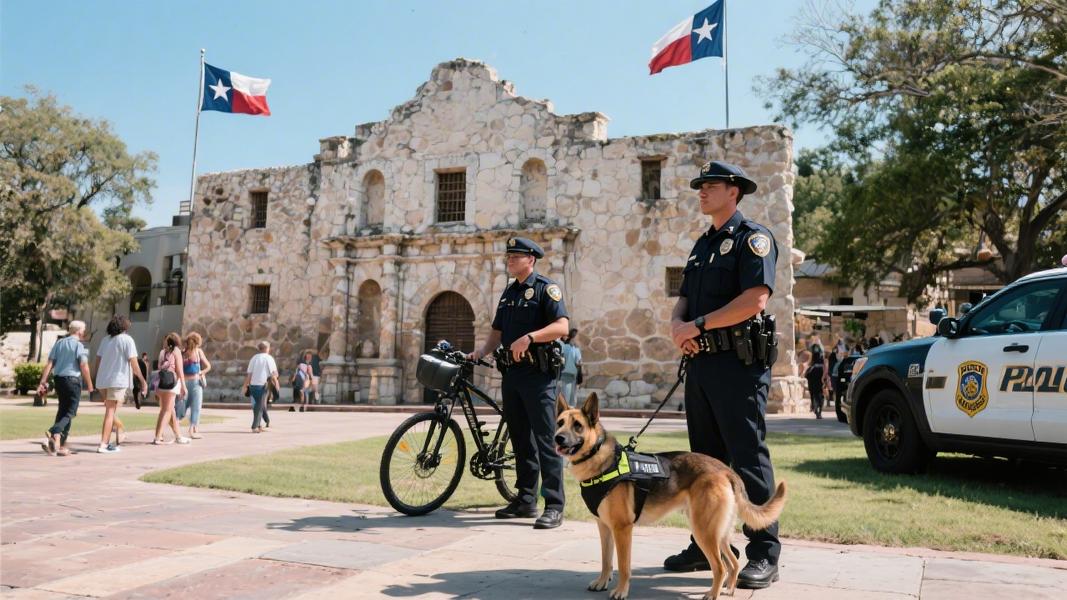
For nearly half a century, the Alamo had its own guardians. Now, it has the state’s.
The Texas Department of Public Safety officially assumed full security responsibilities at the Alamo on December 4, 2025, ending an era defined by the private Alamo Rangers — a force that had protected the San Antonio landmark for close to 50 years. The transition, rooted in a sweeping legislative overhaul of how Texas manages its most iconic historical site, marks one of the most significant operational shifts in the Alamo’s modern history.
A New Law, A New Era
The change didn’t happen overnight. Senate Bill 3059 set the wheels in motion, shifting oversight of the Alamo away from the General Land Office and placing it under a newly created Alamo Commission composed of state leaders. That structural shake-up made the security transition not just possible — it made it inevitable. The Alamo Trust confirmed the handover on December 4th, with DPS stepping in to fill a role the Rangers had held since the 1970s.
Still, the groundwork had been laid months earlier. Beginning in September 2025, members of the Texas Highway Patrol had already begun walking the grounds, quietly establishing a DPS footprint at the site well before the formal transition was complete. By December, that presence had evolved into something considerably more robust.
Who’s Watching the Walls Now
So what does DPS security at the Alamo actually look like? Dozens of personnel, for starters — drawn from multiple divisions including the Texas Highway Patrol, the Criminal Investigations Division, and the Homeland Security Division. The department has also assigned an Explosives Detection K-9 to the site, with a second dog slated to join the detail. Several commissioned and non-commissioned vacancies are still being filled, meaning the operation is very much still scaling up.
Around-the-clock coverage is now standard. DPS personnel are tasked with protecting visitors and the grounds themselves from vandalism, trespassing, and physical damage — the unglamorous but essential work of keeping a 300-year-old mission intact in the middle of a major American city. The department has also deployed a select number of bicycle troopers, which gives officers greater mobility during large events and adds a visible, community-facing presence that squad cars simply can’t replicate.
More Than Just a Post
That’s the catch with securing a place like the Alamo — it isn’t just a building. It’s a symbol. And DPS leadership seems acutely aware of the weight of that.
DPS Colonel Freeman F. Martin didn’t mince words when describing the assignment. “It is a tremendous honor to oversee the department’s transition in taking over security operations for the Alamo,” he said, “helping to preserve one of the greatest symbols in Texas history.” Whether that sentiment translates into the kind of long-term institutional care the site demands remains to be seen — but the early operational commitment suggests the agency is treating this as considerably more than a routine patrol assignment.
Beyond the Alamo’s walls, DPS is also working with local law enforcement partners to extend security patrols into the surrounding area — a practical acknowledgment that a site drawing millions of tourists annually doesn’t exist in isolation from the city around it.
What Comes Next
The Alamo Commission, the newly empowered body now steering the landmark’s future, will be watching closely. So will San Antonio residents, historians, and the legions of visitors who make the pilgrimage to Alamo Plaza each year. The Rangers served faithfully for decades. DPS has the resources, the personnel, and — if Colonel Martin’s words are any indication — the motivation to do the same.
But there’s something quietly poignant about all of this. The Alamo is, at its core, a story about what people are willing to fight to protect. The state of Texas just decided it wanted a direct hand in answering that question itself.
