
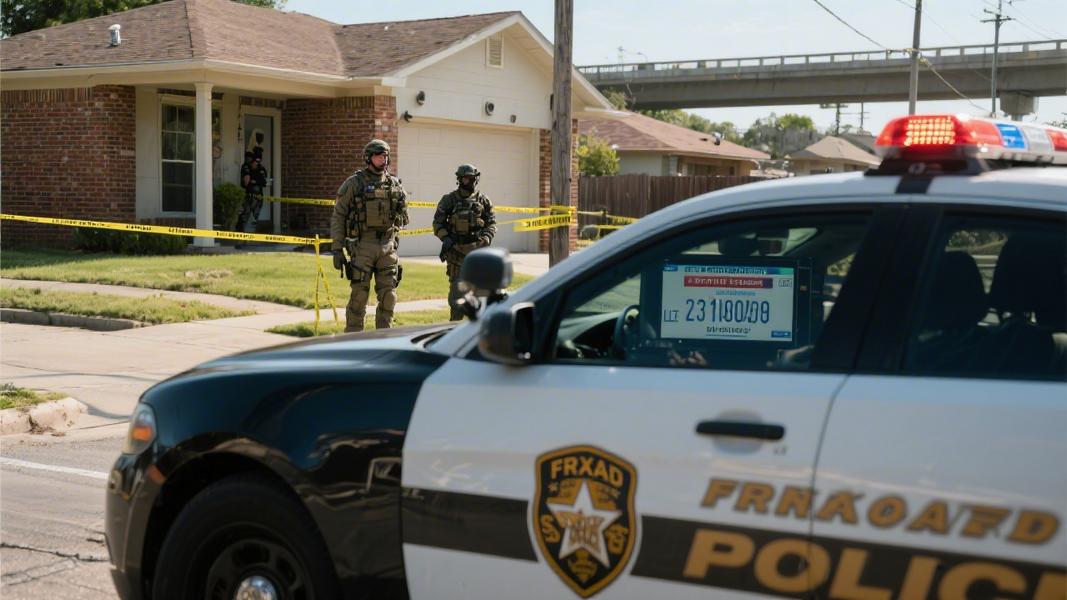
A routine traffic alert. A fugitive. A barricade. And somewhere underneath it all, a quiet but rapidly expanding surveillance network that’s reshaping how Texas law enforcement does its job.
On March 3, 2026, a Texas Department of Public Safety trooper was patrolling near Frankford Road and the Dallas North Tollway when an automated license plate reader pinged a vehicle whose owner had active felony and misdemeanor warrants. What followed was a pursuit that ended in a barricade situation at the 4100 block of Firebrick Lane in Dallas — no shots fired, no one hurt, but a wanted man cornered by technology before a single officer had even run his plates manually.
The Arrest
Justin Givens, 29, of Dallas, didn’t make it to March 5 a free man. DPS Criminal Investigations Division arrested him the following morning, March 4, without incident. He was booked into Dallas County Jail on two felony warrants for Manufacture and Delivery of a Controlled Substance, along with misdemeanor warrants for evading arrest — charges stemming from both the Dallas County Sheriff’s Office and DPS. By most measures, a clean collar. The kind that makes the technology look good.
And that’s increasingly the point. Texas DPS has been quietly — and then not so quietly — building out one of the most expansive automated license plate reader networks in the country. In February 2026, the agency installed new readers across Austin within state right-of-ways, framing the effort squarely around public safety. The department says the readers help investigators stated that the systems serve as “a resource for investigators working to locate suspects or missing persons, recover stolen property, identify suspicious vehicles and develop timelines in criminal investigations, among other public safety efforts.”
A Network That’s Only Getting Bigger
More than 120 agencies across Texas now have access to the DPS license plate reader database. That list includes departments in Cedar Park, Hutto, Marble Falls, New Braunfels, Round Rock, Elgin, Kyle, Bastrop, and Burnet — smaller communities that, not long ago, might have had little more than a radar gun and a dispatcher to work with. Michael Bullock, president of the Austin Police Association, doesn’t mince words about what that means on the ground. “They’ve historically been a very powerful tool for law enforcement, for obtaining leads, for tracking stolen vehicles, and for solving sometimes violent crime,” he explained. “And helping us also overcome some of our staffing challenges as a force multiplier.”
The results, at least the ones DPS publicizes, are hard to dismiss. The system has contributed to the arrest of a kidnapping suspect, the seizure of six pounds of methamphetamine, and the recovery of a stolen vehicle connected to both a sexual assault and a shooting. Those aren’t minor statistics. They’re the kind of outcomes that make it difficult for critics to gain traction — until, sometimes, they do.
Force Multiplier. But at What Cost?
Dr. Roy Taylor, a police procedure expert, uses the same phrase Bullock does. “It is a force multiplier and allows more eyes to be on the lookout,” he noted. But Taylor also acknowledged the anxiety that trails this technology everywhere it goes. “If they make the policy restrictive enough,” he added, “hopefully that’ll negate some of these public fears.”
That’s the catch. Because the same infrastructure that caught Justin Givens on Frankford Road is also capable of logging the movements of people who’ve done nothing wrong — building a quiet, timestamped record of where you’ve been, when, and how often. Privacy advocates have raised these concerns repeatedly, and they’re not entirely theoretical.
In Johnson County, Texas, a sheriff used Flock Safety’s automated plate reader system in what officials initially described as a missing person investigation. It wasn’t. According to a detailed investigation by the Electronic Frontier Foundation, the search was connected to an abortion-related death inquiry — a revelation that landed with particular weight in a state where abortion law has reshaped the legal landscape in ways that are still unfolding. The incident illustrated, with uncomfortable clarity, that the stated purpose of a surveillance tool and its actual use don’t always match.
Where This Is Headed
None of that changes what happened on Firebrick Lane. Givens is in custody. The technology worked exactly as advertised. But as Texas continues expanding this network — more readers, more agencies, more pings — the question isn’t really whether license plate readers are effective. They clearly are. The question is who gets to decide what “effective” is being used for, and whether the policies governing that answer will ever keep pace with the hardware.
As Dr. Taylor put it: hopefully restrictive enough. It’s a thin wire to walk — and Texas is moving fast.
