
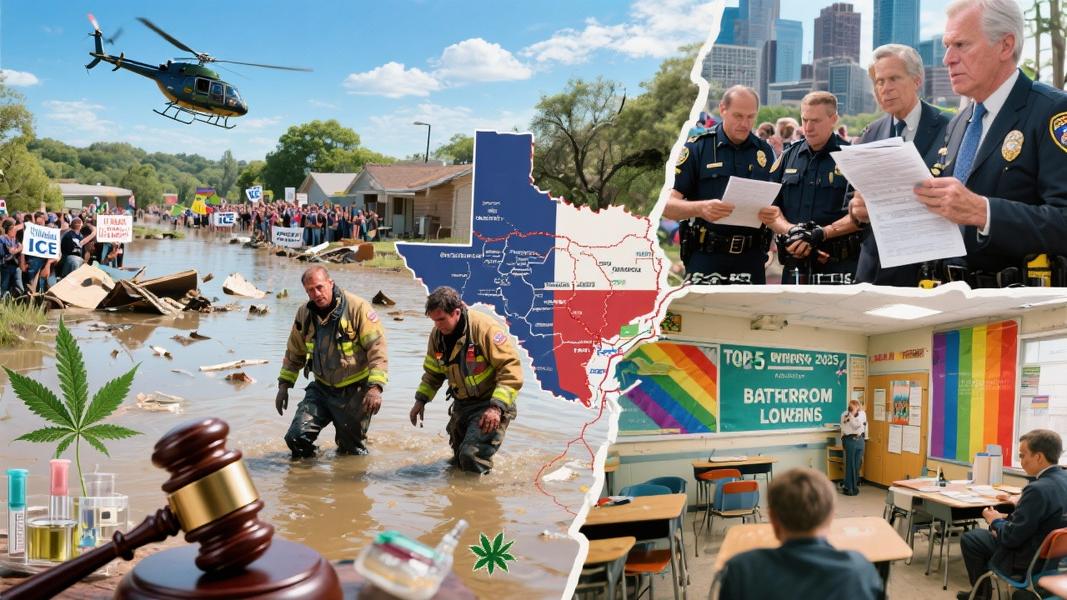
Texas weathered a perfect storm of crises in 2025, with a catastrophic Hill Country flood claiming over 130 lives and political battles reshaping the state’s landscape from voting maps to cannabis policy.
The devastating flash floods that swept through Central Texas on July 4th stand as the year’s most tragic event, becoming the sixth-deadliest freshwater flooding disaster in U.S. history, according to NASA data. The Guadalupe River rose a staggering 26 feet in less than an hour, unleashing destruction that would ultimately cause an estimated $18-22 billion in damage across the region, Britannica documented.
Hill Country Tragedy
Kerr County bore the brunt of the disaster, with the majority of deaths concentrated there. Among the 135 confirmed fatalities were 27 girls and staff members from Camp Mystic, who were swept away when the Guadalupe River overran its banks without warning. Governor Greg Abbott confirmed the death toll while noting that 97 people remained missing from the Kerrville area alone in mid-July, with the total missing across all affected counties reaching 101.
The tragedy prompted swift legislative action, with new safety regulations for youth camps being fast-tracked through the legislature by summer’s end. But for many families, these measures came too late.
Political Battlegrounds
Beyond natural disaster, Texas became ground zero for several contentious political fights. A controversial congressional redistricting map, reportedly suggested by former President Donald Trump to gain five GOP seats, dominated much of the political oxygen. Governor Abbott championed the redrawn districts through two special sessions, despite Democratic lawmakers’ attempts at a quorum break to block the vote, Fox4 reports.
The map, which critics called a blatant partisan gerrymander, was ultimately upheld by the U.S. Supreme Court and will be in effect for the 2026 elections, potentially reshaping Texas’s congressional delegation for years to come.
Immigration Enforcement Intensifies
What began as stepped-up ICE operations quickly escalated into one of the year’s most divisive issues. Thousands of undocumented immigrants were arrested in operations that included workplace raids and, controversially, court stakeouts where individuals appearing for unrelated matters found themselves detained.
Two shootings at North Texas immigration facilities further inflamed tensions. Did officials go too far? That question fueled massive street protests in Austin, Dallas, and Houston throughout the summer and fall, with demonstrators facing off against counter-protesters in increasingly tense confrontations.
The THC Tug-of-War
In a rare public split between Texas’s top Republican leaders, Lieutenant Governor Dan Patrick saw his Senate Bill 3 — aimed at banning hemp-derived THC products — pass both legislative chambers only to be vetoed by Governor Abbott. Rather than signing the ban into law, Abbott directed the Department of Public Safety to step up enforcement against the products, creating confusion for businesses and consumers alike.
The state-level battle became somewhat moot when similar restrictions were included in a national spending plan, effectively establishing federal limits on hemp-derived products that had operated in a legal gray area.
LGBTQ+ Rights Rollbacks
Texas lawmakers pressed forward with several measures targeting LGBTQ+ rights, including a contentious transgender bathroom bill that established a tip line for reporting violations, with potential fines reaching as high as $125,000. The state also used funding leverage to pressure municipalities into removing pride flag road markings in several cities.
Perhaps most controversially, Texas A&M University saw multiple faculty firings over LGBTQ+ course content deemed inappropriate by state officials, sparking academic freedom concerns and protests across multiple campuses.
As 2025 comes to a close, Texas remains a state defined by both natural extremes and political polarization — a microcosm of broader national tensions playing out on a grand scale. Whether next year brings healing or deeper divisions remains an open question for the Lone Star State’s nearly 32 million residents.
