
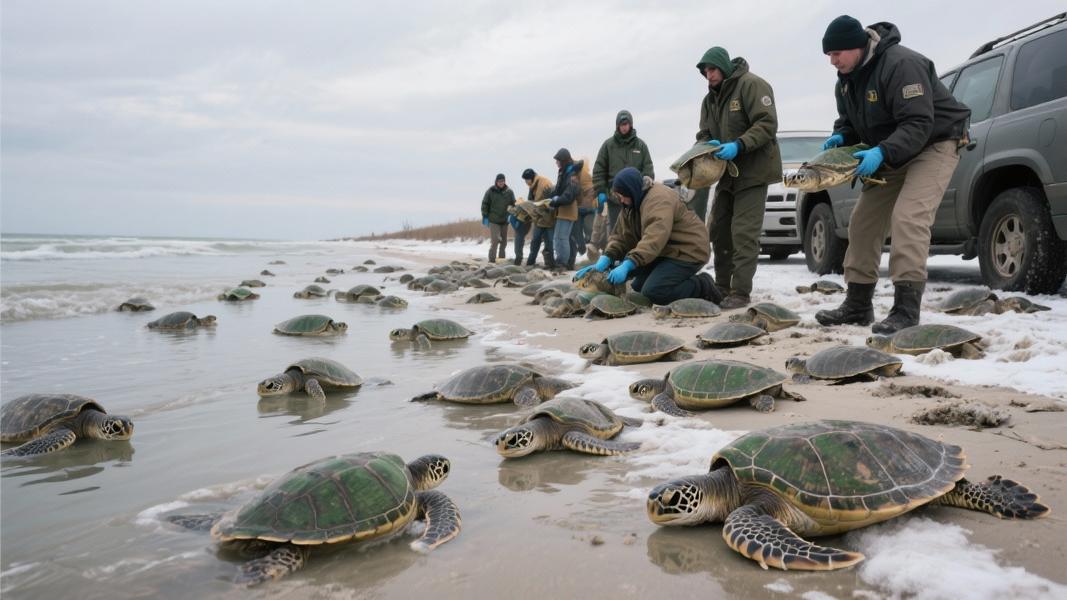
Hundreds of sea turtles are fighting for their lives along the Texas coastline as frigid temperatures turn the normally temperate Gulf waters into a potentially deadly trap. Wildlife officials and volunteers have mobilized in what has become an urgent rescue operation to save cold-stunned turtles before it’s too late.
When water temperatures plummet below 50°F, as they have in recent days around Padre Island National Seashore and Laguna Madre, sea turtles become hypothermic and lethargic — a condition known as “cold-stunning.” Unable to swim properly, many float helplessly at the surface, while others wash ashore.
“He needs immediate help,” one volunteer exclaimed upon discovering a distressed turtle during a patrol. The race against time is all too real for these rescuers, who know that each minute matters when turtles can’t surface for air.
Coordinated Response Underway
Rescue teams have launched boat and foot patrols throughout Laguna Madre, with Sea Turtle Inc. leading efforts on South Padre Island, where volunteers have already rescued at least 20 cold-stunned turtles. The organization’s CEO Wendy Knight emphasized that “timing is everything in these events. The faster we can get these turtles out of the water and into a controlled environment, the higher their chance of survival.”
What makes cold-stunning so dangerous? The turtles become virtually immobilized, often showing minimal signs of life. “They are still alive, but a lot of the time they don’t have any type of response,” explained Lindsey Czopek, a conservation technician with Sea Turtle Inc. “They might not even be blinking, and they can’t surface for air so they may be drowning,” she added.
Officials are urging the public to report turtle sightings to the designated hotline (956-243-4361) but warn against touching or moving the animals without proper training. Even well-intentioned help can sometimes do more harm than good.
State-of-the-Art Rescue Center Activated
The Texas State Aquarium’s Center for Wildlife Rescue has activated its Wildlife Response Operations Center to coordinate the massive rescue effort. Opened just last year, it’s now facing one of its first major tests.
“It has, you know, we’ve had a rescue program at the aquarium since really the mid-90s, but when the rescue center opened in 2023, it was opening as one of the largest programs in the country, the largest capacity in the country,” Jesse Gilbert noted.
That capacity is being put to good use. The center is working hand-in-hand with state and federal agencies to prepare for what could potentially be hundreds of affected turtles before temperatures rise again.
This isn’t the first cold-stunning event to hit Texas, but each one presents unique challenges. The 2021 winter storm led to the rescue of nearly 5,000 sea turtles along the Texas coast — an event that taught valuable lessons about coordination and response that are being implemented now.
For the turtles lucky enough to be found, recovery involves gradual warming in controlled environments, medical assessment, and rehabilitation before eventual release back into warmer waters. Some will spend days or even weeks in recovery.
As another frigid night approaches, rescue teams are preparing for more patrols at first light. For Texas’s threatened sea turtle populations, their survival may depend on the dedication of these volunteers willing to brave the cold themselves — all to ensure these ancient mariners get another chance to swim free in the Gulf’s warmer days ahead.
