
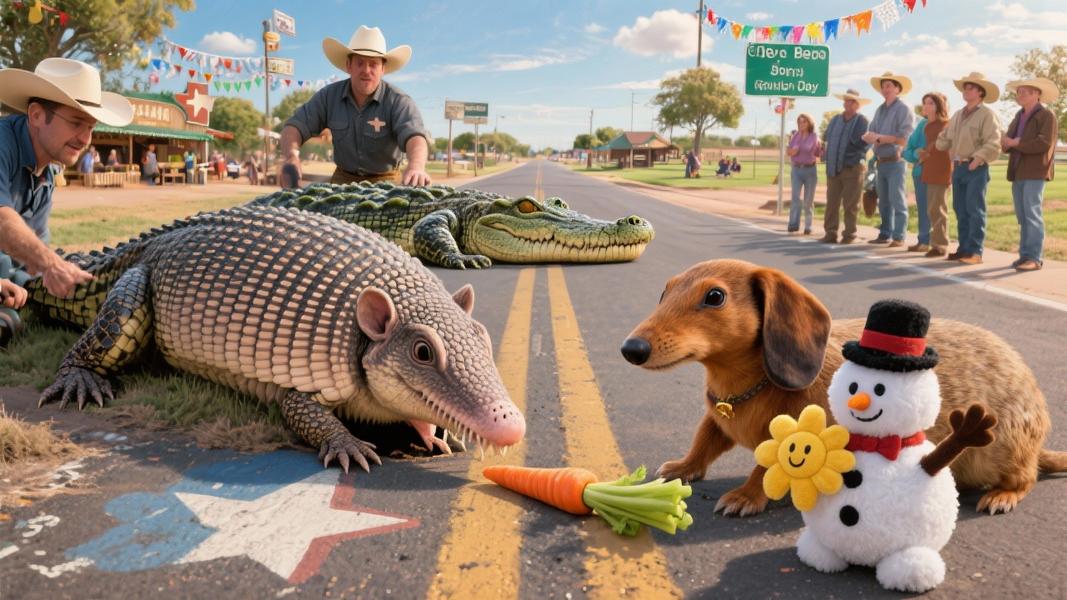
While Pennsylvania’s famous groundhog Punxsutawney Phil may get all the national spotlight, Texas has taken the Groundhog Day tradition and given it a decidedly Lone Star State makeover, complete with armadillos and alligators stepping in as unlikely meteorologists.
The centuries-old tradition, which falls on February 2nd each year, originated from a 19th-century Pennsylvania superstition where a groundhog seeing its shadow supposedly predicts six more weeks of winter, while no shadow signals an early spring. But Texas, true to form, has created its own bigger, bolder, and some might say weirder versions of the weather-predicting ritual that originated in European Candlemas Day beliefs.
Meet Texas’ Weather-Predicting Wildlife
In Bee Cave, Texas, residents have been gathering since 2010 to witness the prognostications of Bee Cave Bob, a nine-banded armadillo who serves as the state’s homegrown answer to Punxsutawney Phil. Unlike his Pennsylvania counterpart, Bob makes his prediction by emerging onto a concrete slab designed to resemble a highway. The shadow rules remain the same – shadow means more winter, no shadow signals an early spring – but the Texas twist gives the event its unique flavor.
Not to be outdone, Beaumont boasts perhaps the most intimidating weather forecaster in the nation. Big Al, a 94-year-old alligator stretching 14 feet long and weighing over 1,000 pounds, has been making predictions since 2006. His method? Rather than shadows, Big Al’s appetite determines the forecast: if he eats the food offered to him, spring will arrive early; if he refuses, winter will continue. This unusual approach actually has scientific backing – alligators enter a state called brumation during cold weather, reducing their appetite.
“If he sees it, he regards it as an omen of six more weeks of bad weather and returns to his hole,” explains the traditional groundhog lore. But in Texas, the rules are as varied as the wildlife making the predictions.
Competing Forecasts
Last year’s dueling predictions highlighted the friendly rivalry between Texas’ animal oracles. Bee Cave Bob predicted an early spring, while Big Al’s refusal to eat signaled a longer winter ahead. Who was right? That depends on who you ask and where in Texas you were standing during those unpredictable spring months.
How accurate are these critter climatologists anyway? While Punxsutawney Phil’s inner circle insists on a perfect 100% accuracy rate, independent tracking puts the famous groundhog’s success rate at a much more modest 39%. Texas’ predictors haven’t been subjected to the same rigorous analysis, though many locals swear by their forecasts.
The tradition, regardless of accuracy, continues to draw crowds in both Pennsylvania and Texas. It’s a midwinter celebration that marks a milestone in the season, bringing communities together around a bit of folklore that’s equal parts whimsical and weather-obsessed.
Whether you put your faith in a groundhog, an armadillo, or a thousand-pound alligator, there’s something quintessentially American about gathering on a chilly February morning to let wildlife tell us when we can finally put away our winter coats. And in Texas, they’re just doing it with a bit more bite.
