
A Texas courtroom is deep into one of the most charged domestic terrorism trials in recent memory — and the evidence, by most accounts, is piling up fast.
Nine defendants are currently on trial in connection with a July 4, 2025, attack on the Prairieland Detention Facility in Alvarado, Texas — an ICE immigration detention center that prosecutors say was deliberately targeted in a coordinated ambush. Alvarado Police Lt. Thomas Gross was shot in the neck during the incident. Now, as the trial enters its second week, the courtroom battle lines are drawn sharply: a calculated act of political violence, or a protest that spun dangerously out of control? The answer, depending on who’s talking, couldn’t be more different.
The Defendants and the Charges
The nine individuals currently facing trial are Daniel Estrada, Ines Soto, Elizabeth Soto, Maricela Rueda, Bradford Morris, Savanna Batten, Benjamin Song, Zachary Evetts, and Cameron Arnold. Prosecutors allege the attack was carried out under Song’s direction and driven by antifa ideology. In total, nineteen people have been arrested in connection with the July 4 shooting, with ten additional individuals — including Dario Emmanuel Sanchez, Janette Goering, John Thomas, and others — swept up in subsequent arrests. At least eleven defendants have been formally indicted on charges of rioting and attacking the facility, according to a statement from the U.S. Attorney’s Office for the Northern District of Texas.
What Happened That Night
The picture prosecutors have painted is unsettling in its detail. According to accounts of the incident, eleven individuals dressed in black clothing or body armor arrived at the facility late on the Fourth of July. They set off fireworks — apparently as a diversion — and vandalized vehicles and a guard structure with slogans like “Ice pig” and “traitor.” Then, prosecutors say, a single shooter fired eleven shots. One of them hit Lt. Gross in the neck.
Gross himself took the stand and testified that he knew something was wrong the moment he approached. He saw people dressed in black, one wearing a green mask and carrying what appeared to be an AR-style rifle. He described the feeling plainly — he believed he was walking into an ambush. Then the shots rang out.
What the Defense Is Arguing
That’s the catch, though. Defense attorneys aren’t conceding the narrative. They’ve questioned whether Lt. Gross would have been shot at all if he had kept his weapon holstered — essentially suggesting the confrontation escalated in ways that weren’t entirely one-sided. They’ve also pushed back on the legality of searches conducted on backpacks that contained guns, body armor, and anti-government materials, arguing those searches were improper.
The defendants maintain they were participating in a noise demonstration — a form of protest intended to let detainees inside hear voices of support from outside. Outside the Tarrant County Jail during the second week of trial, that sentiment echoed literally. Protesters gathered and chanted, “You are not forgotten. You are not alone. We will fight to bring you home,” as reported by KERA News. Whether the jury finds that framing credible is another matter entirely.
The Evidence FBI Agents Laid Out
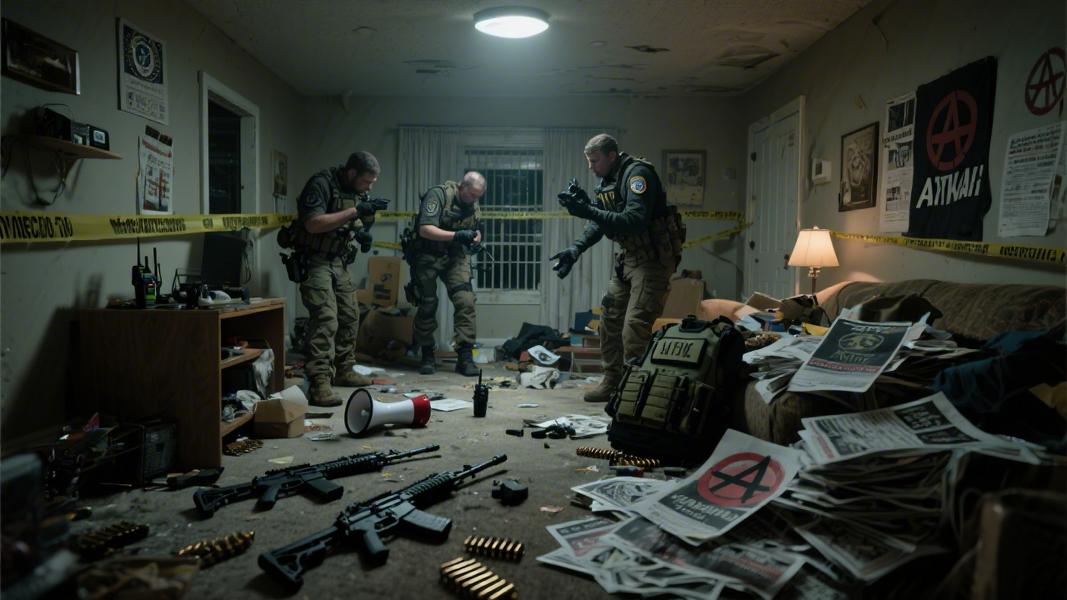
On Day 5 of the trial, FBI agents testified about what investigators found when they searched defendants’ residences and vehicles across Dallas, Garland, and Denton. The inventory was extensive: pistols, long guns, ammunition, bulletproof vests, handheld radios, a bullhorn, and printed propaganda materials. During cross-examination, a defense attorney zeroed in on the reading materials specifically. “So, your understanding was you were looking for reading materials, printed materials?” the attorney asked. “Yes,” the FBI agent replied — a moment that seemed designed to reframe the ideological evidence as something more benign. Whether the jury sees it that way remains to be seen.
One officer, captured on body camera footage, didn’t mince words after finding AR-15-style rifles, magazines loaded with 25 to 30 rounds, and body armor in a vehicle. “It appeared to be a targeted terror attack on the facility,” he said. That phrase — targeted terror attack — is likely to echo through closing arguments.
The Judge Draws a Hard Line
Self-defense? Not an option. U.S. District Judge Mark Pittman ruled definitively that the defendants cannot invoke self-defense as a justification for shooting Lt. Gross. The reasoning was direct: the defendants themselves set the chain of events in motion by setting off fireworks and vandalizing property. They prompted the police response. You don’t get to claim self-defense against a situation you created. Judge Pittman also specifically identified Benjamin Song as the shooter — a designation that carries enormous weight as the trial progresses.
What Comes Next
Still, it’s worth remembering how much road is left in this trial. Testimony is ongoing, more witnesses are expected, and defense attorneys have shown they’re not going down quietly. The broader political context — the contentious debate over immigration enforcement, ICE detention, and the nature of protest in America — hangs over every moment of these proceedings, whether the court acknowledges it or not.
Nine people on trial. Nineteen arrested. One officer with a bullet wound to the neck. And a country that can’t quite agree on what to call what happened on the Fourth of July — a protest, an ambush, or something in between. The jury will have to decide. But the verdict, whatever it is, won’t settle that argument.
