
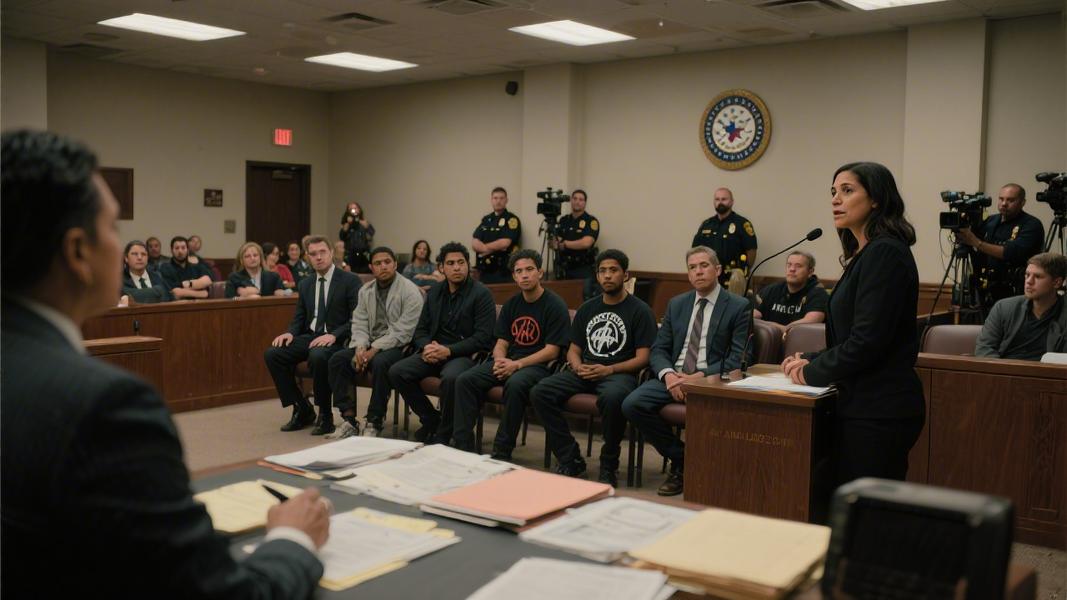
A witness took the stand this week and described helping one of the alleged ringleaders of a July 4th attack on a Texas immigration detention facility flee into the woods — and what she says he told her about the target has become one of the trial’s most damning details.
Susan Kent testified that she assisted Benjamin Song in evading authorities following the July 4, 2025, assault on the Prairieland ICE Detention Facility in Alvarado, Texas. According to Kent’s account, Song wasn’t exactly modest about why the facility was chosen. “It’s as easy a target as you can get,” Song allegedly told her. “The guard shack is often unmanned.” That line, delivered casually after a federal officer had been shot in the neck, tells you something about how these defendants allegedly viewed the whole operation — not as a protest, but as a mission with a calculated target, reported Fox4 News.
Nine Defendants, One Alleged Plan
The trial centers on nine defendants: Daniel Estrada, Ines Soto, Elizabeth Soto, Maricela Rueda, Bradford Morris, Savanna Batten, Benjamin Song, Zachary Evetts, and Cameron Arnold. All nine face federal charges stemming from the attack, which prosecutors say was directed by Song and left Lt. Thomas Gross with a gunshot wound to the neck. Gross survived. The defendants, however, are now looking at charges that could define the rest of their lives, detailed in earlier coverage.
The indictment is sweeping. Charges include providing material support to terrorists under 18 U.S.C. § 2339A, attempted murder of U.S. government employees under 18 U.S.C. § 1114, and discharging a firearm during a crime of violence under 18 U.S.C. § 924. Federal prosecutors have also leveled counts of rioting, conspiracy involving explosives, and additional firearms violations, noted Jurist.
A Party Chat That Wasn’t About Fireworks
How does a group of people coordinate an ambush on a federal detention facility? Apparently, with a Signal group chat called “4th of July Party!” — which, prosecutors say, was anything but festive. Messages in the chat discussed bringing rifles, scouting a Ring camera’s field of view, mapping out nearby police department locations, monitoring weather conditions, and plotting exit routes. It had the logistical texture of a military operation, not a cookout, according to trial coverage. Members also reportedly discussed packing medical kits and conducting prior reconnaissance of the facility’s security setup, documented in public records.
Still, defense attorneys have yet to fully present their case, and the legal presumption of innocence remains. But the prosecution’s narrative — meticulous planning, encrypted communications, a holiday chosen for cover — doesn’t leave much ambiguity about the government’s theory of the crime.
“This Was Not a Peaceful Protest”
Federal officials were blunt from the start. Then-Acting U.S. Attorney Nancy Larson addressed reporters in the days following the attack and didn’t mince words. “It was a planned ambush with the intent to kill ICE corrections officers,” she said. “Make no mistake, this was not a so-called peaceful protest.” That framing — deliberate, lethal intent — has anchored the prosecution’s case ever since.
Prosecutors have described the alleged cell as a North Texas Antifa group, and this case carries a distinction that makes it historically significant regardless of how the jury ultimately rules: it represents the first federal indictment tied to alleged Antifa-related domestic terrorism charges in U.S. history. The government’s decision to pursue that label has drawn scrutiny from civil liberties observers, even as the underlying facts — gunfire, property destruction, fireworks deployed against federal officers — are not in serious dispute, outlined in court proceedings.
What Comes Next
The trial is ongoing, and testimony is still unfolding. Susan Kent’s account — placing Song in the woods, recounting his casual assessment of the facility’s vulnerability — may prove to be among the most viscerally affecting moments for the jury. It’s one thing to hear about encrypted chats and firearms charges. It’s another to hear an alleged leader describe a federal detention facility as an easy mark, moments after a man was shot.
Whatever the verdict, this trial has already forced a reckoning with questions American courts haven’t had to answer quite this way before: where does political violence end and terrorism begin, and who gets to draw that line?
