
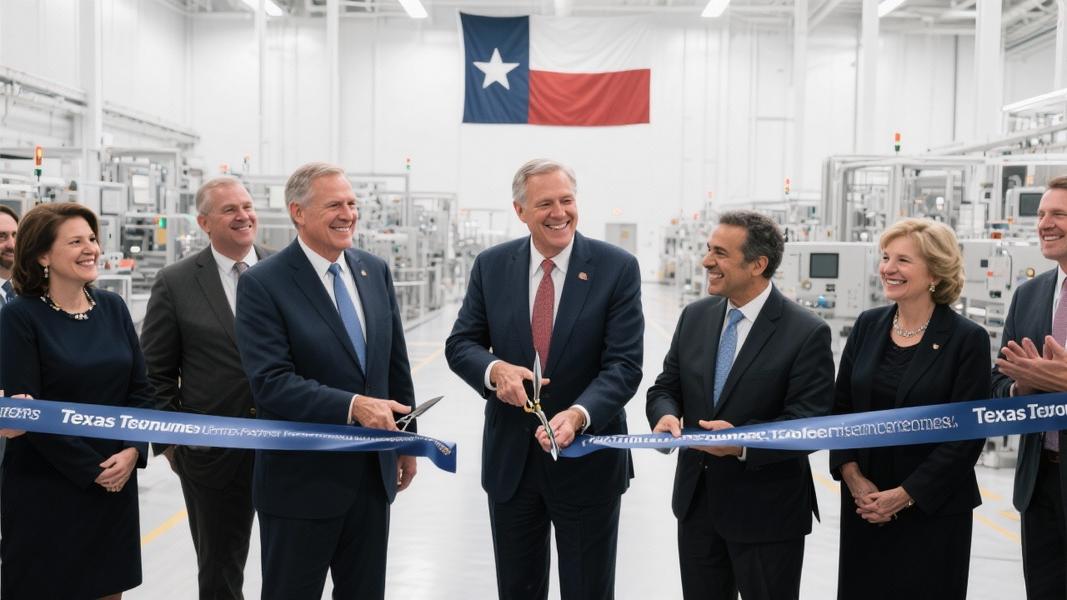
Texas Instruments has officially unveiled its cutting-edge semiconductor manufacturing facility in Sherman, Texas, marking a significant milestone in the state’s growing dominance in chip production. Governor Greg Abbott was on hand Wednesday to celebrate the ribbon cutting of the company’s new 300mm wafer fabrication plant, the first of potentially four fabs planned for the massive 1,200-acre site.
The $40 billion mega-project represents one of the largest manufacturing investments in Texas history and comes at a crucial moment for domestic semiconductor production. “Semiconductors are essential to building the space and artificial intelligence infrastructure that will define our future,” said Governor Abbott at the ceremony. “Today’s announcement by Texas Instruments helps Texas to expand our No. 1 ranking and helps lead the semiconductor manufacturing boom we have here in Texas.”
The new facility, designated SM1, is already in production just three and a half years after breaking ground—an impressive timeline for a project of this scale. It’s now churning out tens of millions of chips daily, primarily analog power products that are fundamental components in everything from smartphones to electric vehicles, according to company statements.
Ambitious expansion plans
What’s remarkable about the Sherman project isn’t just its current scale, but its future potential. Texas Instruments has outlined plans for up to four connected 300mm wafer fabs at the site—labeled SM1 through SM4—with a staggering total investment that could reach $40 billion when fully realized.
The semiconductor giant isn’t stopping there. The Sherman complex is part of a broader $60 billion investment across seven U.S. semiconductor facilities in Texas and Utah, a commitment that the company projects will support more than 60,000 new American jobs. It’s a massive bet on domestic chip production at a time when supply chain security has become a national priority.
Haviv Ilan, president and CEO of Texas Instruments, emphasized the company’s vertically integrated approach: “Sherman represents what TI does best: owning every part of the technology development and manufacturing process to design and deliver the best, most innovative products for our customers.”
The timing couldn’t be better for the region. After years of semiconductor manufacturing shifting overseas, companies like Texas Instruments are bringing production back to American soil—a trend accelerated by pandemic-era supply chain disruptions and increased federal incentives for domestic manufacturing.
Economic ripple effects
Can a single manufacturing facility transform a regional economy? In Sherman’s case, it appears the answer is yes. The new fab has already brought thousands of jobs to the area, from highly specialized engineering positions to manufacturing roles. Local reports indicate that Texas Instruments has completed construction of the first plant and is actively moving in employees and installing equipment.
Governor Abbott highlighted the broader impact during his remarks: “With help from Texas Instruments, Texas will remain the home for cutting edge semiconductor manufacturing and the home of more job opportunities than any other state in the United States of America.”
The Sherman facility isn’t operating in isolation. The site has attracted complementary businesses, including GlobalWafers, which produces the silicon wafers that serve as the foundation for semiconductor manufacturing. This clustering effect is creating what some industry observers are calling a “chip corridor” in North Texas.
Still, challenges remain. The semiconductor industry is notoriously cyclical, and building such massive facilities requires enormous amounts of water and energy—resources that will need careful management as the complex grows.
For now, though, the mood in Sherman is decidedly optimistic. With the first fab up and running and more on the horizon, the city of roughly 45,000 is positioning itself as a key player in America’s semiconductor renaissance—one silicon wafer at a time.
