
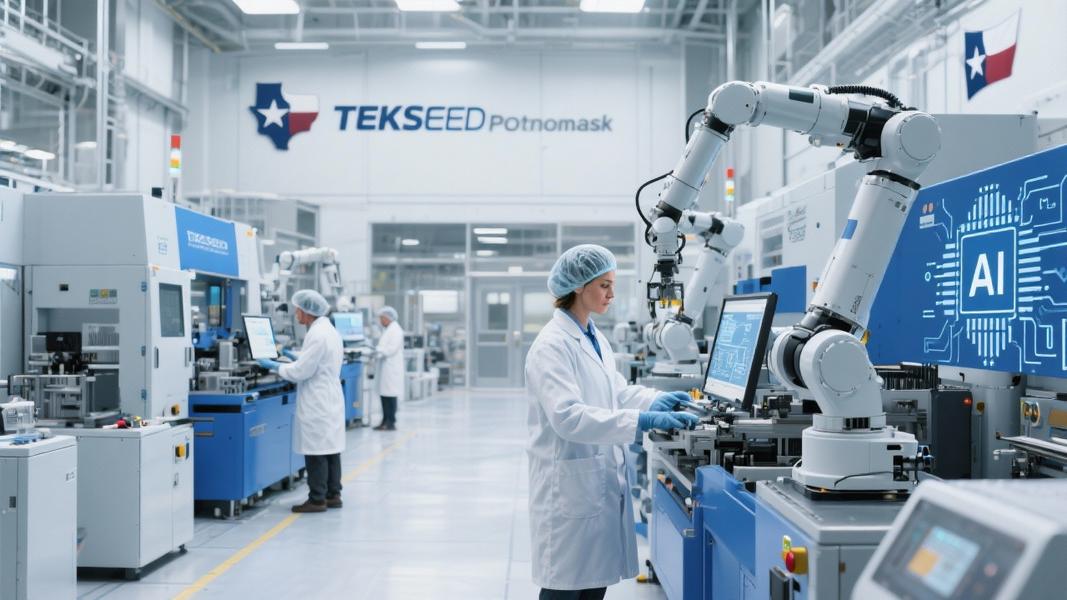
Texas is doubling down on its bet to become America’s semiconductor powerhouse. Governor Greg Abbott has announced a $15.2 million grant from the Texas Semiconductor Innovation Fund (TSIF) to Tekscend Photomask Round Rock Inc., fueling a massive expansion of photomask production in Central Texas.
The investment, part of a broader push to revitalize American chip manufacturing, is expected to create 50 new jobs while leveraging over $223 million in capital investment from the company. It’s a significant boost for a state eager to reclaim its historical role in semiconductor innovation.
Building on Texas’ Semiconductor Legacy
“Texas is where the integrated circuit began and where the future of the semiconductor industry is being built,” said Governor Abbott during the announcement. The governor’s statement nods to the state’s deep roots in chip technology — Texas Instruments engineers invented the integrated circuit in 1958, forever changing modern electronics.
The expansion at Tekscend’s Round Rock facility isn’t modest. Plans include increasing production capacity by more than 40% and modernizing equipment to extend capabilities to the 12nm technology node — crucial for chips used in artificial intelligence, automotive applications, Bluetooth, Wi-Fi, microcontrollers, and sensors.
“Since 1987, Tekscend Photomask has been proud to call Round Rock home, supporting the Texas and U.S. semiconductor industry with world-class photomask manufacturing,” said Tekscend Photomask Round Rock President John Nykaza. The company has deep ties to the region and was recently named 2025 Local Employer of Excellence by Workforce Solutions Rural Capital Area for its leadership in innovation and workforce development.
A Broader Strategy Takes Shape
The Tekscend grant isn’t happening in isolation. It’s part of a coordinated effort to rebuild semiconductor manufacturing capacity across Texas.
Just weeks earlier, Abbott approved a $4.8 million TSIF grant to the Texas Quantum Institute at UT Austin for QLab, a quantum-enhanced semiconductor metrology facility that promises to push the boundaries of chip technology.
“Texas is the new frontier of innovation and UT Austin is where world-changing discoveries in quantum research and development are being made,” Abbott noted during that announcement.
But can Texas produce enough skilled workers to staff these expanding facilities? That’s where another piece of the strategy comes into play.
Building the Workforce Pipeline
A $3.5 million TSIF grant was awarded to Texas State Technical College for expanding semiconductor workforce training, including equipment purchases, curriculum development, and specialized programs like Accelerated Semiconductor Technician Training.
The timing couldn’t be more critical. With Samsung’s massive expansion in nearby Taylor, the region faces unprecedented demand for technical talent.
“It is crucial to us because of the expansion of Samsung in Taylor and the growth,” said Kelly Coke, provost of TSTC’s Williamson County campus, where new semiconductor technician training programs will debut in 2026 thanks to the funding.
Economic Impact Beyond Austin
The TSIF isn’t limited to Central Texas. The fund provides grants for semiconductor manufacturing, research, and development to support expansion and job creation throughout the state, including areas like Baytown near Houston.
Industry analysts note that photomasks — the specialized templates used in the photolithography process that patterns semiconductor wafers — represent a critical chokepoint in chip production. By expanding this capacity locally, Texas positions itself to support not just manufacturing but the entire semiconductor ecosystem.
The $223 million investment by Tekscend will significantly expand production capacity at their Round Rock facility, creating what state officials hope will be a multiplier effect throughout the regional economy.
As global competition for semiconductor supremacy intensifies, with China, Taiwan, and the European Union all making major investments, Texas appears determined not to cede the ground it helped break decades ago. The question remains whether these strategic bets will pay off in the long run — but for now, the Lone Star State is putting its chips on the table.
