
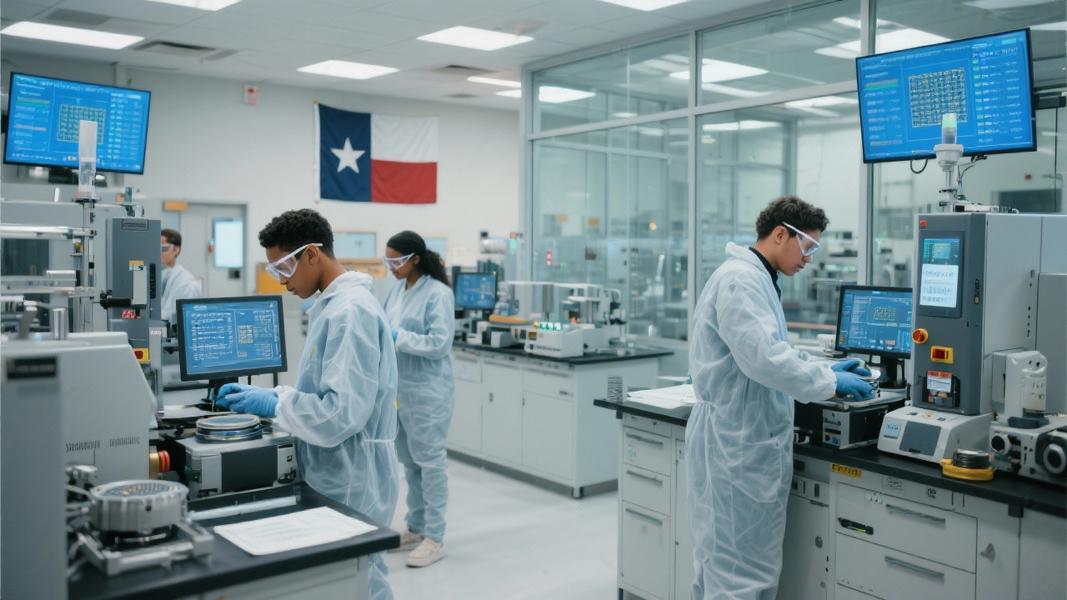
Texas is doubling down on its semiconductor ambitions with a fresh wave of investment aimed at building the skilled workforce needed for its expanding chip industry. The Texas State Technical College (TSTC) has secured a $3.5 million grant from the Texas Semiconductor Innovation Fund to transform its Williamson County Campus in Hutto into a specialized training facility for semiconductor fabrication roles.
The grant, announced by Governor Greg Abbott’s office, will support the college’s Accelerated Semiconductor Technician Training Program, addressing the growing demand for skilled workers in the state’s burgeoning chip manufacturing sector.
“Texas maintains its investment in high-demand skills training to open the door for Texans to have better jobs and bigger paycheck opportunities,” said Governor Abbott. “With this TSIF grant, TSTC will transform existing instructional and lab space into a training facility focused on semiconductor and electromechanical workforce development. Working together with our higher education partners, we will ensure the technologies that power the future are made in Texas.”
Strategic Investment in Tech Workforce
The Texas Semiconductor Innovation Fund, created by the 2023 Texas CHIPS Act, represents a significant commitment from the state to maintain its competitive edge in chip production. With $698.3 million appropriated by the Texas Legislature, the fund supports semiconductor research, manufacturing, and design projects through grants and matching funds to various entities.
Why such a substantial investment in a single technical college? The answer lies just down the road in Taylor, Texas, where Samsung is expanding its semiconductor operations.
“It is crucial to us because of the expansion of Samsung in Taylor and the growth,” explained Kelly Coke, provost of TSTC’s Williamson County campus. “Without it (the grant), we would not be able to meet any of the job demands in the semiconductor and advanced manufacturing field,” Coke noted.
The funding will help develop both the Accelerated Semiconductor Technician Training Program and an Advanced Manufacturing Technology – Semiconductor program scheduled to debut in fall 2026. Eventually, instruction will move to an Advanced Manufacturing Center of Excellence planned to open in spring 2027 in Hutto.
Building a Regional Semiconductor Hub
This isn’t the first major investment Texas has made in semiconductor education and training in the region. The Austin Community College District previously received a $3.6 million TSIF grant to build an advanced semiconductor manufacturing lab and precision welding program at its Round Rock Campus, marking the first such grant to a Texas higher education institution.
“This grant is a testament to our state’s commitment to building a world-class semiconductor industry and expanding our high-tech workforce,” officials stated when announcing the ACC funding. “By providing state-of-the-art, hands-on training to meet real industry needs, ACC’s Advanced Manufacturing Lab and precision welding program will create opportunities for students across Texas, ensuring our state remains at the epicenter of cutting-edge innovation in the advanced manufacturing sector.”
The investments extend beyond educational institutions. Yerico Manufacturing Inc. in Elgin received a $1.3 million grant from the same fund to support construction of new facilities and acquisition of advanced equipment for semiconductor equipment refurbishment and repair. This project is expected to create 30 new jobs and generate more than $13 million in capital investment.
“Texas is leading a new era of innovation in manufacturing,” Governor Abbott remarked about the Yerico grant. “With significant investments from global technology and manufacturing leaders, Texas will continue to partner with industry innovators to ensure supply chain resilience and solidify our dominance in domestic semiconductor manufacturing.”
Taken together, these investments reflect Texas’s strategic push to position itself as the nation’s semiconductor powerhouse, creating an ecosystem that spans from education and workforce development to manufacturing and support services. As global chip shortages continue to affect industries from automotive to consumer electronics, the state’s bet on semiconductor infrastructure may prove to be both timely and transformative for its economic future.
