
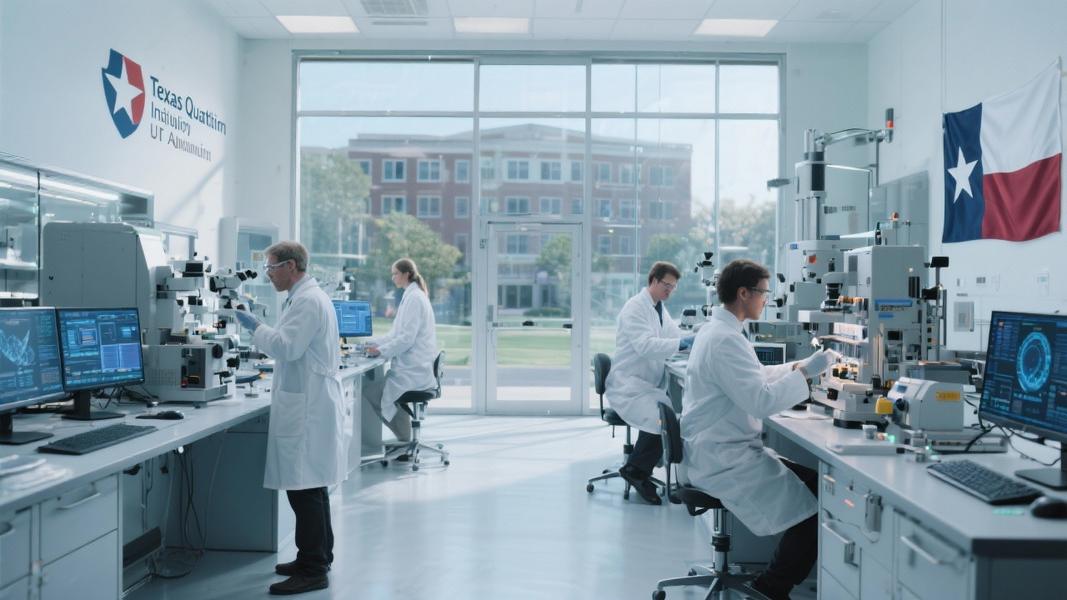
Texas has placed another multi-million-dollar bet on the future of semiconductor technology, this time with a quantum twist.
Governor Greg Abbott announced Wednesday that the state has awarded a $4.8 million grant to the Texas Quantum Institute at the University of Texas at Austin to establish QLab, a first-of-its-kind quantum-enhanced semiconductor metrology facility. The funding, drawn from the Texas Semiconductor Innovation Fund, aims to position the state at the forefront of both quantum research and semiconductor manufacturing — two technologies increasingly viewed as critical to America’s economic and national security interests.
“Texas is the new frontier of innovation and UT Austin is where world-changing discoveries in quantum research and development are being made,” Governor Abbott said in a statement announcing the grant. “Texas will continue to lead the nation with quantum leaps into the future.”
But what exactly is “quantum-enhanced semiconductor metrology,” and why does it matter?
At its core, metrology is the science of measurement — and in semiconductor manufacturing, where materials are manipulated at atomic and molecular levels, ultra-precise measurement capabilities are essential. The new QLab facility will acquire state-of-the-art instrumentation that leverages quantum science principles to achieve measurement precision beyond what’s currently possible with conventional technology.
The facility will be managed by the Texas Quantum Institute in collaboration with UT Austin’s Microelectronic Research Center, Texas Institute for Electronics, and Texas Materials Institute. This consortium approach underscores the interdisciplinary nature of the work, which sits at the intersection of quantum physics, materials science, and electrical engineering.
“Metrology has been identified by the U.S. Department of Commerce as the key enabling technology for the semiconductor industry,” representatives from the Texas Quantum Institute noted. “This investment from the TSIF will empower UT Austin to advance metrology tools that can be applied to address critical challenges in the semiconductor industry.”
Quantum Leap for Texas Manufacturing
The timing of this investment isn’t coincidental. The semiconductor industry is undergoing a renaissance in the United States, driven by supply chain concerns and the CHIPS Act, which allocated billions in federal funding to revitalize domestic chip manufacturing.
Texas has been particularly aggressive in positioning itself to capture this growth. Last year, Governor Abbott signed the Texas CHIPS Act, establishing both the Texas Semiconductor Innovation Fund and the Texas Semiconductor Innovation Consortium to encourage industry expansion within the state and enhance the capabilities of Texas higher education institutions in semiconductor research.
Xiuling Li, Co-director of the Texas Quantum Institute, emphasized the transformative potential of the grant. “This investment gives us tremendous momentum to advance quantum-enhanced semiconductor metrology, driving breakthroughs that will shape the future of both the semiconductor and quantum industries,” Li explained.
The initiative has also garnered support from state legislators. Senator Sarah Eckhardt highlighted how UT Austin’s researchers have helped make Central Texas “a national hub for semiconductor innovation” and suggested that QLab will “play a pivotal role in positioning our region to capitalize on growth in the semiconductor and quantum industries, including the thousands of high-paying advanced manufacturing jobs that will come with it,” according to a statement released by the Governor’s office.
The programs are administered by the Texas CHIPS Office, a division within the Governor’s Texas Economic Development & Tourism Office, and are designed to maintain the state’s position as the nation’s leader in semiconductor manufacturing while pushing into emerging quantum technologies.
For Texas, which already boasts significant semiconductor manufacturing presence from companies like Samsung and Texas Instruments, the move into quantum-enhanced capabilities represents not just an evolution of existing strengths but a strategic push into what many experts believe will be the next technological frontier. As quantum computing advances, the tools and techniques developed at facilities like QLab may prove essential to maintaining American competitiveness in an increasingly high-stakes global technology race.
