
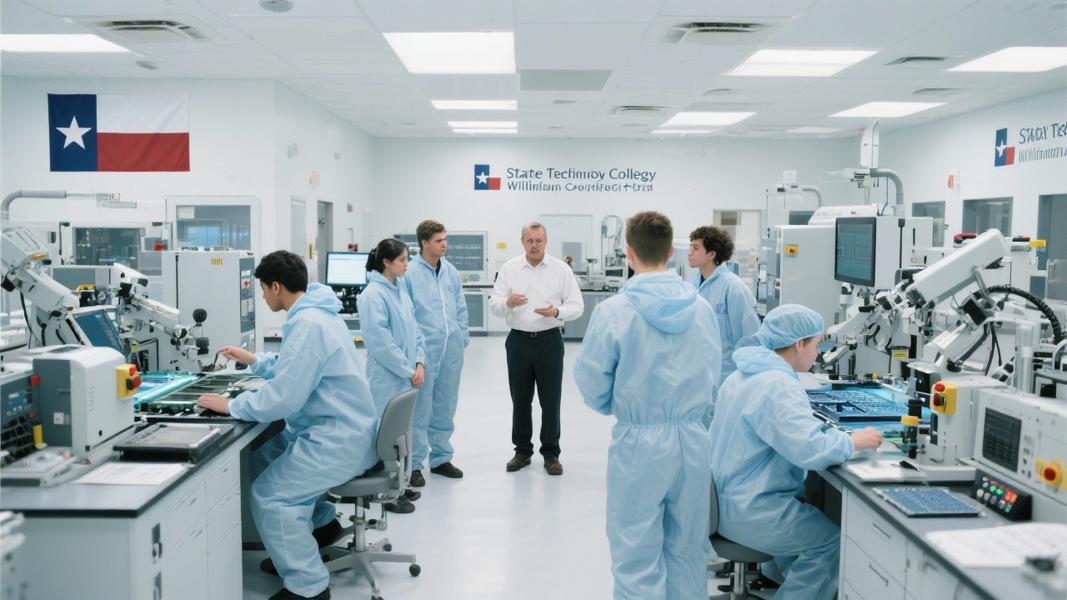
Texas is doubling down on its semiconductor ambitions, pouring millions into technical colleges and manufacturers as part of a strategic push to position the Lone Star State at the forefront of America’s chip renaissance.
The Texas Semiconductor Innovation Fund (TSIF) — a nearly $700 million initiative created by the 2023 Texas CHIPS Act — has been steadily distributing grants across the state to build infrastructure, expand training programs, and strengthen the semiconductor supply chain. The initiative represents one of the country’s most aggressive state-level responses to chip manufacturing shortages that rattled global supply chains during the pandemic.
Technical Colleges Leading the Charge
Texas State Technical College’s Williamson County campus recently secured a $3.5 million TSIF grant to develop the Accelerated Semiconductor Technician Training Program (ASTTP) in Hutto. The funding will support semiconductor and electromechanical workforce development, including the creation of a wafer processing learning facility with a mock cleanroom. “Texas maintains its investment in high-demand skills training to open the door for Texans to have better jobs and bigger paycheck opportunities,” Governor Abbott stated when announcing the grant.
The investment comes at a critical time for Central Texas’s growing semiconductor ecosystem. “It is crucial to us because of the expansion of Samsung in Taylor and the growth,” said Kelly Coke, provost of TSTC’s Williamson County campus, who emphasized the importance of the grant for the region’s economic development. The campus plans to launch an Advanced Manufacturing Technology – Semiconductor program in fall 2026, with equipment specifically designed to mirror tools used in actual semiconductor manufacturing facilities.
But TSTC isn’t alone. Austin Community College District received an even larger grant — $3.6 million — marking the first TSIF grant awarded to a Texas higher education institution. The funds will be used to build an advanced semiconductor manufacturing lab and precision welding program at its Round Rock Campus. Senator Charles Schwertner called the grant “a testament to our state’s commitment to building a world-class semiconductor industry and expanding our high-tech workforce,” according to ACC’s announcement.
Further expanding the state’s educational network, Temple College was awarded a substantial $9.8 million grant to support semiconductor-related workforce development and training capacity, establishing the institution as another regional hub in Texas’s semiconductor talent pipeline.
Industry Giants and Local Manufacturers Benefit
Why is Texas investing so heavily in semiconductor education? The answer lies partly in the massive industry presence already taking root in the state.
Samsung Electronics’ Taylor campus received a $250 million grant from the state semiconductor fund — by far the largest single allocation — to support advanced chip research and development. This supplements the company’s previously announced $17 billion investment in the Taylor foundry and further cements Central Texas’s position as an emerging semiconductor hub.
“This grant will ensure that our semiconductor manufacturing facility in Taylor delivers the most advanced technology for our global customers and continues to reinforce the chip supply chain in the U.S.,” said Young Hyun Jun, vice chairman and head of the Device Solutions Division at Samsung Electronics, in a statement published by local media.
Smaller manufacturers are also benefiting from the state’s semiconductor strategy. Yerico Manufacturing Inc., based in Elgin, received a $1.3 million TSIF grant to expand its semiconductor equipment materials and services facility. The project is expected to create 30 new jobs and generate more than $13 million in capital investment while supporting the chip production supply chain. Governor Abbott emphasized that “Texas is leading a new era of innovation in manufacturing” when announcing the funding.
The legislature’s decision to appropriate $698.3 million for the Texas Semiconductor Innovation Fund represents one of the most significant state-level commitments to the industry nationwide. The fund provides grants and matching funds for semiconductor research, manufacturing, and design projects by state entities, higher education institutions, and qualifying businesses, according to the governor’s office.
As global competition for semiconductor manufacturing intensifies, Texas appears determined to leverage its existing technology corridors, educational institutions, and manufacturing base to capture a larger share of this strategic industry. For thousands of Texans seeking careers in the high-tech sector, these investments may well translate into the “bigger paycheck opportunities” the governor promised.
