
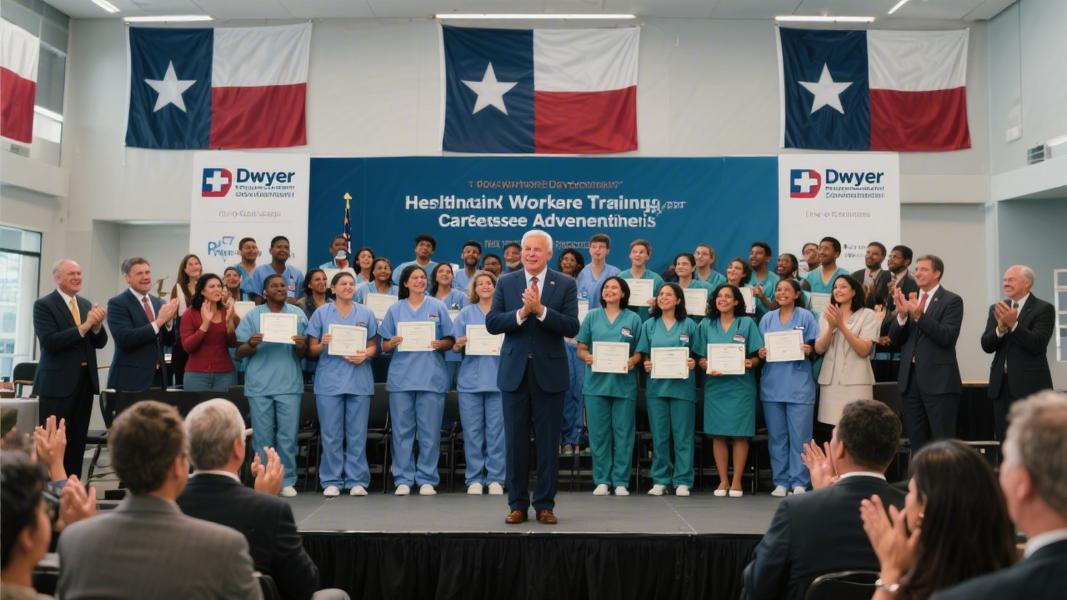
Fifty students in the Rio Grande Valley picked up their diplomas this week — and with them, the promise of a career in healthcare that didn’t exist for them a few months ago.
Governor Greg Abbott traveled to McAllen to personally attend the graduation ceremony for the latest class of Dwyer Scholars, a cohort of fifty Texans who completed intensive training programs in Certified Nursing Assistant and Medication Aide instruction. The event spotlights a growing state push to close a persistent gap in the healthcare workforce — one that’s been especially acute along the Texas-Mexico border.
A Calling, Not Just a Career
Abbott didn’t hold back at the podium. “What you’re doing is more than just a job,” he told the graduates, as reported by local outlets covering the ceremony. “What you’re doing is stepping into a calling, a noble calling to serve other people.” He went on to praise their persistence directly: “Through your grit, through your determination, you have seized control of your own life and charted a new path for your future.”
It’s the kind of language politicians reach for at ribbon-cuttings. But in this case, it doesn’t feel entirely hollow. The Dwyer Workforce Development program targets individuals who’ve faced real barriers to employment — and the Rio Grande Valley, one of the most economically distressed regions in the country, has no shortage of those.
State Money Behind the Momentum
So where’s the funding coming from? Earlier in 2025, the Texas Workforce Commission awarded Dwyer Workforce Development a $375,000 grant through its Self-Sufficiency Fund, earmarked specifically to expand healthcare training programs across the state. That’s not a massive check by government standards, but in the world of workforce development, it’s meaningful runway.
Dwyer’s leadership clearly felt the weight of the moment. “Standing alongside Governor Abbott marks a pivotal moment for Dwyer Workforce Development in Texas,” the organization stated following the event. “TWC’s investment underscores the critical role that innovative workforce development programs play in the future of Texas.” They added that they intend to keep scaling — “strengthening the workforce and creating life-changing opportunities in communities across Texas.”
Why This Region, Why Now
Texas is staring down a healthcare staffing crunch that’s only expected to worsen as the state’s population ages. Rural and border communities tend to feel that pressure first and hardest. Programs like Dwyer’s aren’t just filling jobs — they’re attempting to build a pipeline from within communities that have historically been underserved, both as patients and as potential healthcare workers.
Still, fifty graduates in one ceremony isn’t a solution. It’s a start. The real test will be whether the state continues investing at a pace that matches the scale of the problem — and whether programs like this one can prove their outcomes over time, not just at a well-attended graduation with a governor at the mic.
Abbott’s parting words to the class carried a kind of open-ended optimism that, intentional or not, acknowledged exactly that uncertainty. “Congratulations on this remarkable achievement on your part,” he said. “I wish you all the best in your careers wherever they may go.”
Wherever they may go. For fifty new certified healthcare workers in the Rio Grande Valley, that question — and the answer they’re building — might matter more than anything said at the podium.
