
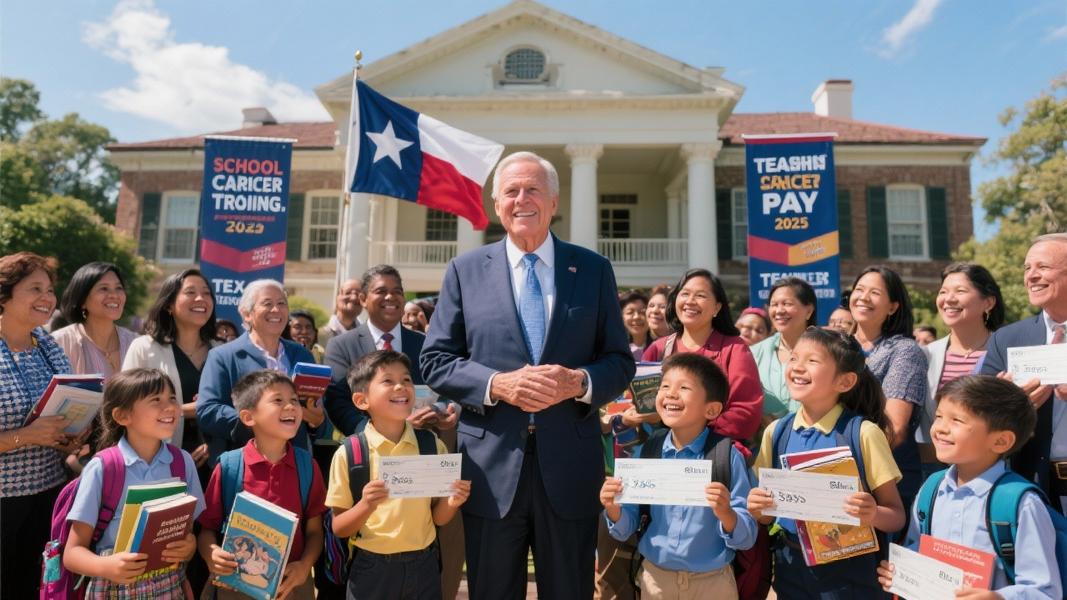
In a sweeping education overhaul that marks one of the most significant shifts in Texas’ approach to schooling in decades, Governor Greg Abbott has signed a series of bills allocating nearly $10 billion toward both public education improvements and the creation of a controversial school choice program.
School Choice Becomes Reality in Texas
After years of legislative battles, Texas has officially joined the ranks of states embracing school choice. Governor Abbott signed Senate Bill 2 in May 2025, establishing the Texas Education Freedom Account (TEFA) program with a $1 billion initial investment—making it the largest day-one launch of such a program in the country, according to state officials.
“When I ran for re-election in 2022, I promised Texans that we will bring education freedom to every Texas family,” Abbott said at the signing ceremony. “Today, Texas delivers on that promise.”
The program, set to launch in the 2026-2027 school year, will create education savings accounts worth approximately $10,000 per student, potentially available to all six million K-12 students in Texas. These funds can be used for private school tuition, tutoring, transportation, and special needs therapies, with priority given to students with disabilities and families with the greatest financial need, according to the Federation for Children.
Texas becomes the 11th state to implement a universal Education Savings Account (ESA) program, and advocates are already celebrating it as a landmark victory. Critics, however, worry about the long-term impact on public school funding.
Record Public Education Investment
Perhaps anticipating those concerns, Abbott didn’t stop with school choice. Just weeks later in June, he signed House Bill 2, providing a record $8.5 billion in new funding for public education—including over $4 billion earmarked specifically for teacher and staff pay raises.
“Now is the time to make Texas No. 1 in educating our children,” Abbott declared at the bill signing.
The breakdown of this massive funding package reveals the state’s educational priorities. Beyond the $3.5 billion for permanent teacher pay raises, the bill allocates $834 million for special education programs, $648 million for early literacy and numeracy initiatives, $187 million for teacher preparation, and $430 million specifically for school safety improvements.
Will this dual approach of both funding public schools while creating an alternative pathway satisfy stakeholders on both sides of the education debate? That remains to be seen, but the governor has made clear this two-track strategy was deliberate.
Career Training Expansion
The third prong of Abbott’s education agenda materialized in September, when he signed House Bill 20 and House Bill 120, expanding career and technical education opportunities across the state. The legislation creates the Applied Sciences Pathway Program, allowing 11th and 12th graders to earn their diplomas while simultaneously completing certificate programs in high-demand fields.
“Career training is a game-changer for our students, for our state, and for our employers,” Abbott said during the bills’ signing ceremony.
The governor had telegraphed these priorities months earlier during his 2025 State of the State Address, where he outlined his vision for making Texas a leader in education through this three-pronged approach of school choice, teacher pay raises, and expanded career training.
Education advocates note that the career training expansion in particular addresses a growing need in Texas’ evolving economy, where skilled workers are increasingly in demand across multiple sectors.
The package of education reforms represents one of the most comprehensive overhauls in Texas education in recent memory. But the true test will come in implementation—particularly how the state balances its newfound commitment to school choice with its parallel investment in public education infrastructure.
For now, Texas has staked its claim on a bold experiment that will likely be watched closely by policymakers nationwide as the debate over education’s future continues to evolve.
