
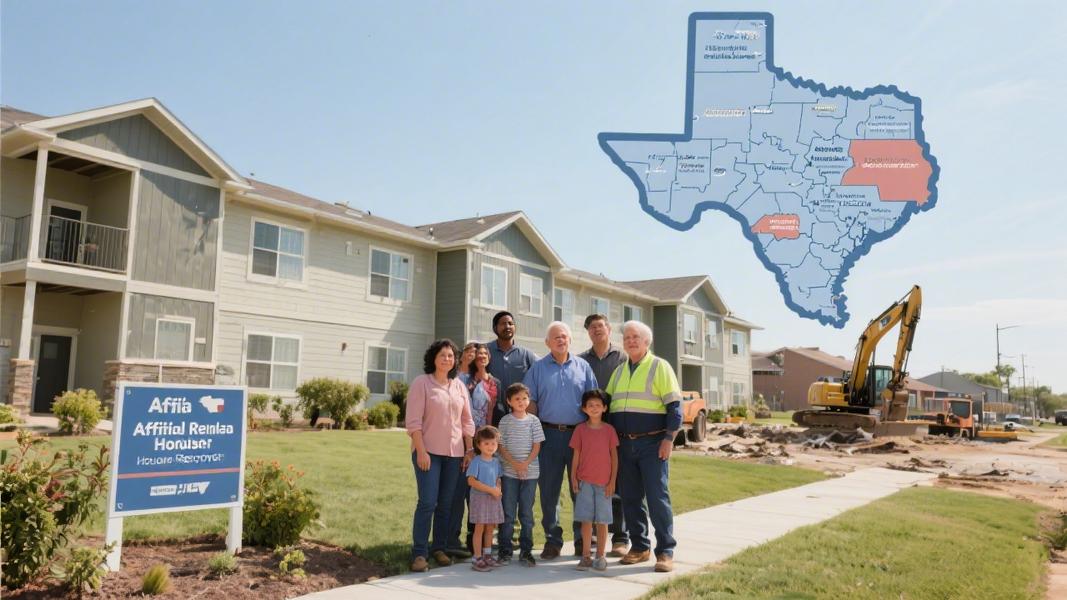
Texas is about to open the floodgates — literally and figuratively — on nearly a hundred million dollars in housing recovery money. Starting March 10, 2026, the state will begin accepting applications for a program that could reshape the affordable housing landscape in some of its most storm-battered communities.
The Texas General Land Office announced it will launch the 2024 Disasters Affordable Rental Program (24D-ARP), making $88.1 million available for the rehabilitation, reconstruction, and new construction of affordable multifamily housing across 27 counties designated by HUD as most impacted or distressed following last year’s disasters. That’s not a small footprint. Those counties represent real communities — families still living in damaged homes, doubled up with relatives, or priced out of whatever rental stock survived the storms.
Where the Money Comes From
The funding is part of a much larger federal commitment. Texas received $555,687,000 in Community Development Block Grant Disaster Recovery funds — known as CDBG-DR — from the U.S. Department of Housing and Urban Development, allocated through the State of Texas 2024 Disasters Action Plan. That money covers recovery from two separate federal disaster declarations: DR-4781, which addressed severe storms, straight-line winds, tornadoes, and flooding, and DR-4798, which covered Hurricane Beryl. Together, they hit Texas hard and left a housing deficit that’s still being tallied.
The Affordable Rental Program carves out its $88.1 million slice of that pie for multifamily housing specifically — with a cap of $7.5 million per development. That’s a meaningful ceiling. It keeps any single project from swallowing the entire pot while still allowing developers to take on substantial work.
What Commissioner Buckingham Is Saying
GLO Commissioner Dawn Buckingham framed the program in terms of long-term resilience, not just short-term relief. “The Texas General Land Office is committed to helping Texas communities recover and rebuild stronger after disasters,” she said. “Through the Affordable Rental Program, we are investing in projects that restore and expand safe, affordable housing options for families in communities impacted by the 2024 disaster events. These efforts help Texans recover faster while strengthening housing infrastructure for the future.” It’s the kind of statement that could sound boilerplate — except the dollar figures behind it suggest something more serious is actually being attempted here.
Homeowners Aren’t Being Left Out
But it’s not just renters and developers who are getting attention. Alongside the rental program, the state has also structured the 2024 Disasters Homeowner Assistance Program (HAP), which directs $244.1 million toward repairing and reconstructing owner-occupied single-family homes damaged in the same 27 HUD-designated counties. The damage cap sits at $90,000 for non-historic homes and climbs to $175,000 for historic properties — a distinction that matters in older Texas neighborhoods where historic designation is common and repair costs run considerably higher.
What makes HAP more than a simple repair grant is the package of wraparound benefits that come with it. Eligible homeowners can receive hazard mitigation upgrades, elevation assistance, and up to $7,000 in temporary relocation assistance while work is underway — plus one full year of insurance coverage. That said, nothing comes without strings. Homeowners who accept the aid must maintain ownership, residency, property taxes, and insurance for three years following completion. Miss any of those requirements and the deal could unravel. The GLO has outlined those conditions in detail for prospective applicants.
A Portfolio That Keeps Growing
Still, it’s worth stepping back and taking stock of just how large Texas’s disaster recovery apparatus has become. The GLO currently administers more than $14.3 billion in disaster recovery and mitigation funding spanning eight separate disasters. That’s not a program. That’s an industry. Texas has, in many ways, become the country’s most practiced state at turning federal disaster dollars into on-the-ground housing programs — a distinction born entirely out of necessity and repeated catastrophe.
How effective has it all been? That’s the harder question. Programs this size move slowly, and the communities waiting on them tend to move faster — people make decisions about where to live, whether to stay, whether to sell. Every month of delay is a month someone is living somewhere they didn’t plan to be.
March 10th is still weeks away. For the 27 counties watching the calendar, it probably can’t come soon enough.
