
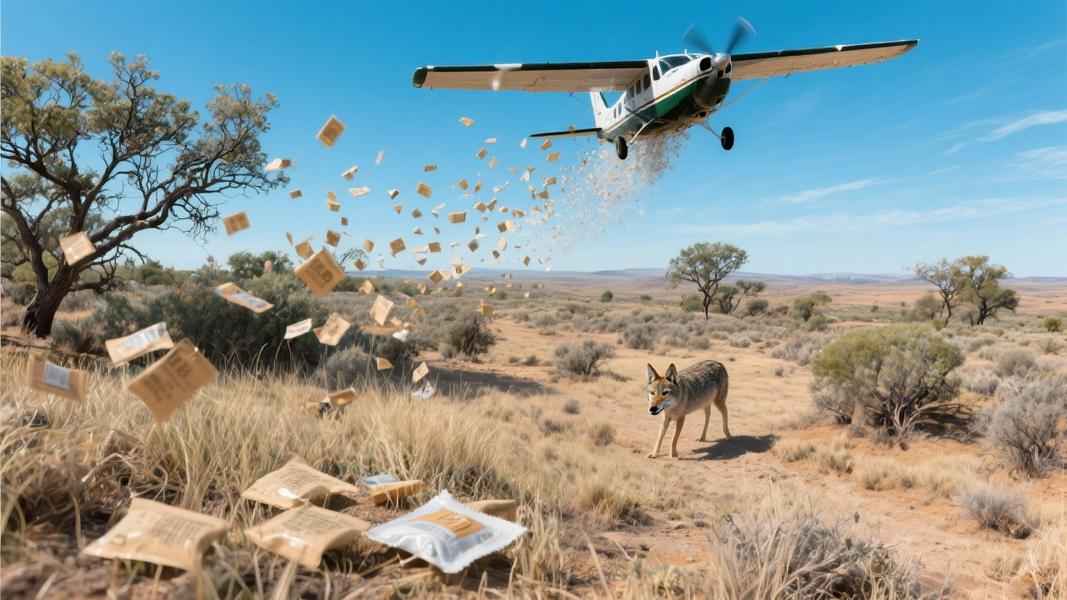
Texas is taking to the skies in its battle against rabies, expanding its decades-old aerial vaccine program to include far West Texas for the first time as officials work to combat a new rabies variant creeping in from New Mexico.
Beginning January 16, planes will crisscross the Texas sky dropping nearly 700,000 fish-scented vaccine packets across 19 border counties in what has become an annual public health campaign now entering its 31st year. The expanded effort will also include hand-distribution in urban areas, marking a significant evolution in the state’s approach to wildlife disease management.
Three Decades of Aerial Defense
The Texas Oral Rabies Vaccination Program (ORVP) has been quietly protecting Texans since 1995, when the state faced dual rabies outbreaks that threatened both wildlife and human populations. Since then, the program has distributed an astonishing 55 million doses of Raboral V-RG, an oral rabies vaccine specifically designed for wildlife consumption.
“Our mission is to vaccinate wildlife along the borders of Texas to maintain herd immunity against rabies and keep new or previously eliminated rabies variants from becoming established in any part of Texas,” said Kathy Parker, ORVP Director and Field Surveillance Lead. “However, we continue to monitor all the counties of Texas for outbreaks and/or potential areas of rabies interest,” she added.
The strategy is deceptively simple yet remarkably effective: aircraft release small packets containing rabies vaccine that smell like fish – irresistible to target species like foxes and coyotes. When wildlife consume the bait, they’re vaccinated against the deadly virus.
A Public Health Success Story
How successful has the program been? The numbers tell a compelling story. Texas developed its vaccination initiative to address two separate rabies outbreaks, and the results have been dramatic – animal rabies cases from the domestic dog and coyote variant plummeted from 122 cases in 1994 to zero by 2000, according to historical records.
The consistent, aggressive application of these vaccination strategies has dramatically decreased the risk of rabies infection in both domestic animals and humans. This January marked 30 years since the program’s inception in South Texas, where it first targeted coyote populations carrying a rabies variant that threatened to spread northward.
That said, the fight against rabies requires constant vigilance. The disease remains one of the deadliest viral infections known, with a near 100% fatality rate once symptoms appear in humans. This explains why health officials are moving quickly to address the new threat from neighboring New Mexico.
New Threats, Expanded Response
The decision to expand into far West Texas didn’t come from nowhere. Public health officials have been monitoring the movement of a concerning rabies variant across state lines, prompting this year’s expansion of the program. The addition of hand-distribution methods in urban areas represents an acknowledgment that wildlife doesn’t always respect the boundaries between wilderness and human settlement.
The vaccine packets themselves are small, coated in fishmeal crumbles, and pose no threat to humans or pets, though officials always advise leaving them undisturbed if found. Pets that accidentally consume a packet may experience mild stomach upset but face no serious health risks.
Texas’ approach to rabies control through wildlife vaccination has become a model for other states and countries. The program demonstrates how targeted public health interventions, consistently applied over time, can effectively control diseases that once seemed unmanageable.
As climate change and human development continue to alter wildlife habitats and movement patterns, programs like Texas’ ORVP will likely become even more critical in preventing deadly zoonotic diseases from establishing new footholds in vulnerable populations.
For Texans living in the targeted counties, the sight of small aircraft flying in grid patterns this January might seem routine – but those planes represent one of the most successful public health campaigns in the state’s history, one bait packet at a time.
