
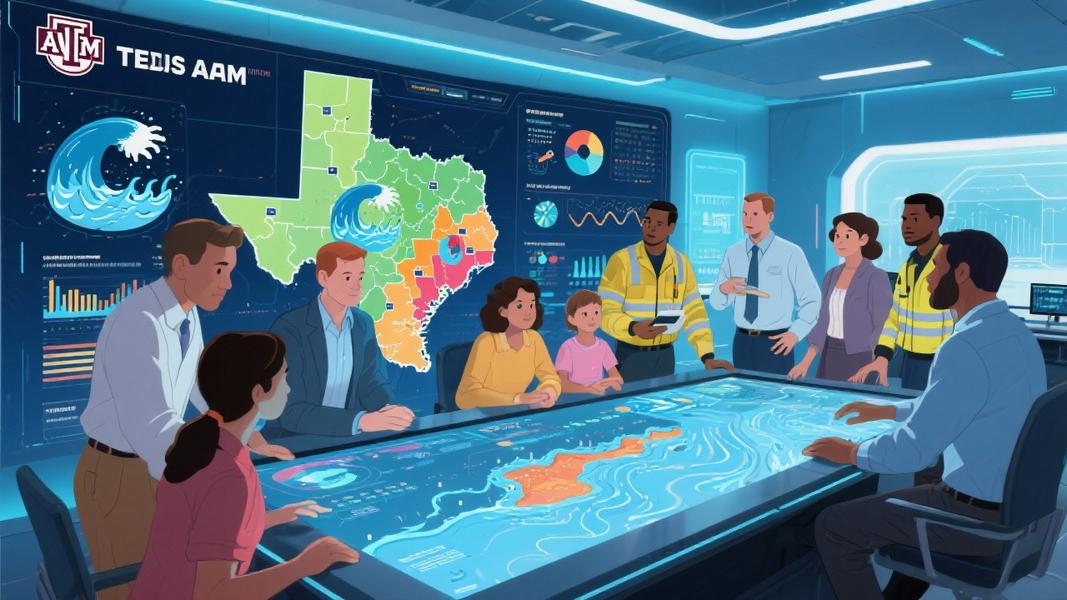
Texas has faced its share of natural disasters, from catastrophic hurricanes to devastating floods. Now, a new centralized platform aims to transform how the Lone Star State prepares for and responds to these events.
Texas A&M University’s Institute for a Disaster Resilient Texas (IDRT) has launched the Texas Disaster Information System (TDIS), an interactive platform designed to break down data silos and provide comprehensive disaster information to communities, researchers, and government agencies across the state.
“Texas is no stranger to hurricanes, storms and flood events, but we are learning from previous events to forge the path to a continuously more resilient future,” said Land Commissioner Dawn Buckingham, M.D. “Using complex data from past events to develop publicly available flood models with access to all online through the Texas Disaster Information System will help our communities increase efficiencies, save money and make more informed decisions related to planning, preparedness, response and recovery.”
Solving the Data Disconnect
For years, critical disaster information in Texas has been fragmented across various agencies and platforms. The result? Communities often lacked the comprehensive data needed to make informed decisions before, during, and after catastrophic events.
TDIS addresses this problem by integrating data from multiple sources, including the Texas General Land Office’s (GLO) Combined River Basin Flood Studies. The system has already completed 67 flood models covering an impressive 22,635 square miles, providing updated and detailed flood risk representation for 51 counties across Texas, according to officials.
Dr. Samuel Brody, Director of IDRT and a professor at Texas A&M University, emphasized the platform’s practical applications. “Through partnerships with state agencies and communities across Texas, we’ve created a resource that not only organizes critical data but turns that information into decision support tools for disaster resilience,” he stated. “At its core, the TDIS portal is about helping Texans. Whether it’s a city planner, policy maker or a family considering a new home, TDIS puts vital information at their fingertips so they can make decisions with greater confidence.”
Tools for Decision-Making
What exactly does TDIS offer the average Texan? The platform features several specialized tools designed for different users and needs.
Buyers Aware provides property-level flood and fire risk information for areas impacted by Hurricane Harvey — a free resource for the public that could prove invaluable for homebuyers and property owners. Meanwhile, the Data & Models Query Tool (DMQT) allows users to search and download state flood modeling data to help reduce flood risk in their communities.
For professionals, the platform includes Measuring, Mapping, and Managing Flood Risk (M3FR), a reference tool offering models and risk communication best practices, and the Model Management and Storage Solution (MS2), which stores flood models and provides access through the State Flood Plan Viewer.
Behind the scenes, the system operates through five core functions — ingesting data from various sources, cataloging it in a streamlined model, processing it through validation and cleaning, storing the information securely, and creating innovative tools for data consumption.
Building on Legislative Momentum
The creation of TDIS represents the culmination of efforts that began in the Texas Legislature. IDRT itself was established in 2020 following legislation passed by the 86th Texas Legislature, with the explicit mission of bridging research and decision-making to enhance disaster resilience across the state.
The system was developed through collaboration between Texas A&M’s IDRT and several state agencies, including the Texas General Land Office, Texas Water Development Board, and Texas Division of Emergency Management — a partnership that reflects the cross-agency cooperation needed to address complex disaster challenges.
While TDIS currently focuses primarily on flooding, the platform is designed as an all-hazards system. Using an iterative approach, developers plan to expand its capabilities over time to include additional disaster types and support recovery and response across various emergency scenarios.
For a state that has weathered more than its share of natural disasters, TDIS represents not just a technological achievement but a potential lifeline. As climate change continues to influence weather patterns and population growth puts more Texans in harm’s way, having the right information at the right time isn’t just convenient — it could be the difference between resilience and catastrophe.
