
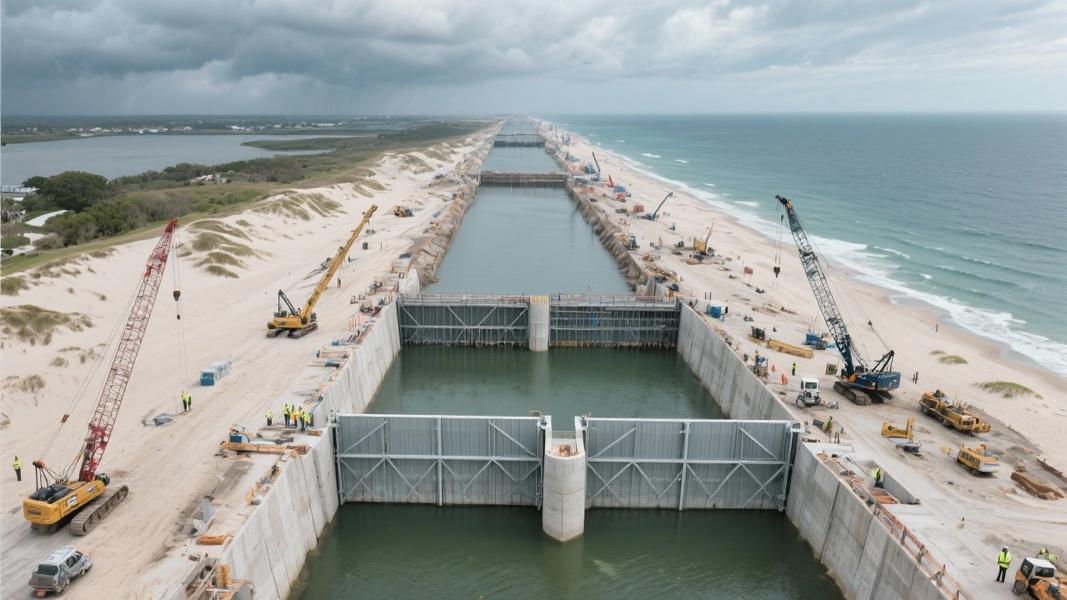
Texas is going big — really big — on coastal protection with what’s set to become the largest barrier gate system in the world, officials announced as the massive project moves forward with newly awarded engineering contracts.
The Coastal Texas Project, described as the largest coastal resiliency undertaking in U.S. Army Corps of Engineers history, is advancing with engineering design contracts awarded to Jacobs and HDR for two critical components: the Bolivar Roads Gate System (dubbed “The Gate”) and the Bolivar and West Galveston Beach and Dune System, respectively. The massive initiative aims to protect the Texas Gulf Coast from devastating storm surges that have historically threatened the region’s communities and critical infrastructure, including the nation’s largest petrochemical complex, officials confirmed.
A Multi-Billion Dollar Defense System
How big is this undertaking? The Galveston Bay Barrier System alone accounts for a staggering 85 percent of the $35 billion authorized for the broader Coastal Texas Project, making it one of the most expensive infrastructure projects in American history. The State of Texas has already appropriated nearly $1 billion to the Gulf Coast Protection District to advance these protective measures, which offer “multiple lines of defense” against coastal storm surges, according to a statement from the U.S. Army Corps of Engineers.
“Everything is bigger in Texas – including the Coastal Texas Project,” notes a recent announcement about the initiative, a sentiment that seems aptly applied to both the physical scale and financial commitment of this ambitious protection plan.
The centerpiece of the project, The Gate, will span the two-mile-wide waterway between Galveston Island and Bolivar Peninsula. Once completed, it will stand as the largest flood gate system in the world, designed to hold back storm surges that could otherwise devastate communities and industries across the region, according to project details.
Protecting Critical Infrastructure
The stakes couldn’t be higher. The Gulf Coast Protection District, established by the Texas Legislature in 2021, is tasked with safeguarding approximately 5,220 square miles across five counties: Chambers, Galveston, Harris, Jefferson, and Orange. This area contains some of the nation’s most critical energy infrastructure.
“We can no longer wait to implement this long-term resiliency strategy, aimed at safeguarding the largest port and petrochemical complex in the nation,” project leaders emphasized in discussing the urgency behind the massive undertaking.
The memory of devastating hurricanes like Harvey, Ike, and earlier storms has made the need for comprehensive protection painfully clear to coastal residents and industry leaders alike. But designing a system that can withstand the Gulf’s fury while maintaining the ecological balance and access to waterways has presented enormous engineering challenges.
From Concept to Reality
Coalter Baker, Executive Director of the Gulf Coast Protection District, called the awarding of these contracts a pivotal moment. “These contracts are important because they move two major features of the Coastal Texas Project into design,” Baker explained. “Once designed, we can finally realize the full magnitude of these ideas and further engage local communities with details, not concepts.”
The first two components to move into design are The Gate and the Beaches and Dunes features, which will work in concert to provide layered protection against storm surges. While The Gate will block the most direct path for storm surge into Galveston Bay, the enhanced beach and dune systems will provide critical protection to coastal communities on Bolivar Peninsula and Galveston Island.
Still, the path from design to completion remains long. The project represents an unprecedented coordination effort between federal, state, and local authorities, with construction timelines likely stretching over many years.
For Gulf Coast communities that have weathered devastating storms with increasing frequency, the progress, however incremental, represents something that’s been in short supply when facing climate threats: concrete action toward long-term protection that matches the scale of the challenge.
